NGHỆ THUẬT
LÀM ĐẸP VÀ SỨC KHỎE
THỦ CÔNG
VĂN HÓA VÀ LỊCH SỬ
GIẢI TRÍ
MÔI TRƯỜNG
THỰC PHẨM VÀ ĐỒ UỐNG
KỸ THUẬT NGƯỢC
KHOA HỌC
THỂ THAO
CÔNG NGHỆ
THIẾT BỊ ĐEO



Two-Dimensional Paper Chromatography
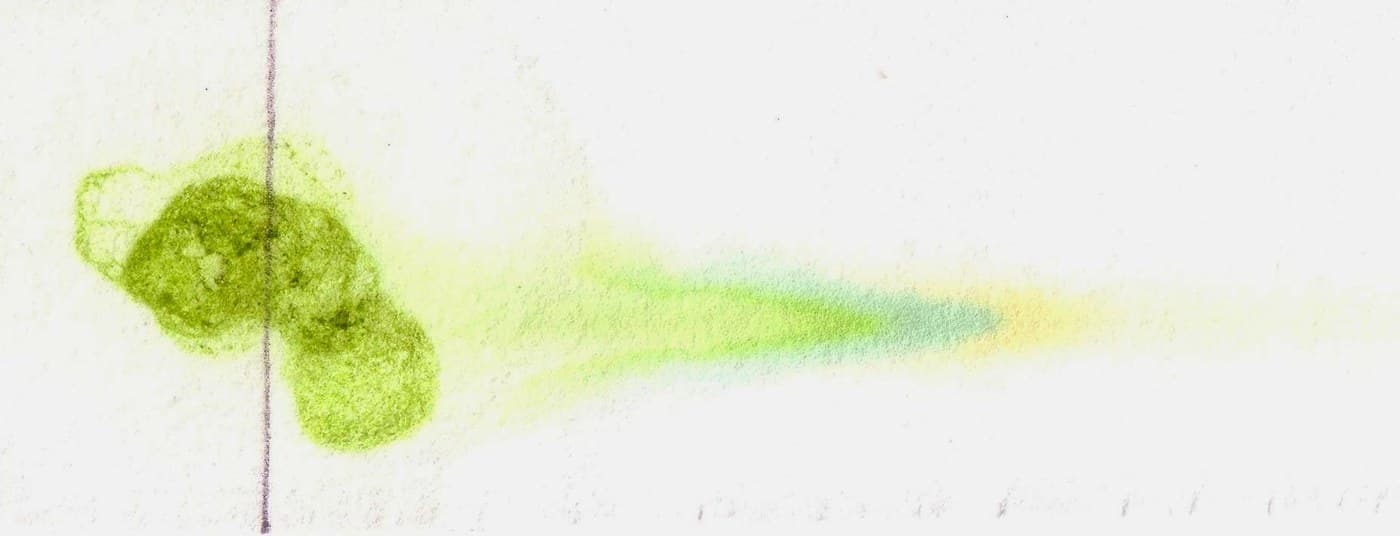
Paper chromatography, already published here, has a hard limit: two substances that happen to travel at the same speed in your solvent land in the same place, and no amount of care will pull them apart. They are not unresolved because the technique is sloppy — they are unresolved because you asked one question and got one answer.
In 1944 Consden, Gordon and Martin at the Wool Industries Research Association asked a second question of the same sheet. Run the paper as usual, dry it, turn it ninety degrees, and run it again in a DIFFERENT solvent. A pair that matched in the first solvent will almost never match in the second, so the spots that were one become two.
It is the cheapest large increase in resolving power in analytical chemistry, it needs no equipment you do not already have, and it separated the amino acids of a protein hydrolysate well enough to start the work that sequenced insulin.
Trung cấp
1 day
Hướng dẫn
1
1
Cut a square, and mark the origin in PENCIL
Cut a square, and mark the origin in PENCIL
Cut a square of chromatography or good filter paper, about 15 by 15 cm. Mark a pencil dot 2 cm in from two adjacent edges. That corner is your origin.
Pencil, never pen: graphite is carbon and does not move in any solvent, while ink is a mixture of dyes that will run up the paper and contaminate the very thing you are trying to read. Handle the sheet by its edges from now on — a fingerprint deposits amino acids and oils that show up as their own spots, which is a genuinely common way to get a confusing result.
Vật liệu cho bước này:
 Giấy sắc ký4 cái
Công cụ cần thiết:
 Thước kẻ
2
2
Spot small, spot repeatedly, dry between
Spot small, spot repeatedly, dry between
Touch a loaded capillary briefly to the origin, let it dry completely, and repeat five or six times on the same dot.
The aim is a concentrated spot under 3 mm across. Loading it all at once gives a wide wet blot that spreads before it ever starts to travel, and every spot downstream inherits that width. Repeated small applications with drying between build up the quantity without the diameter — and in a two-dimensional run, where the spot has to survive being developed twice, that discipline pays double.
Vật liệu cho bước này:
 Phẩm màu thực phẩm1 chai
Công cụ cần thiết:
 Ống mao dẫn thủy tinh
3
3
Run the first dimension
Run the first dimension
Stand the sheet in a closed jar with a shallow depth of your first solvent — a butanol/acetic acid/water mixture is the classic — with the origin edge down and the origin ABOVE the liquid line. Let the front climb to about 2 cm from the top, then take it out and mark the front in pencil immediately.
The jar must be closed and ideally lined with damp paper, so the atmosphere is saturated with solvent vapour. In an open vessel, solvent evaporates from the paper face as fast as it climbs, the front becomes ragged and every Rf you measure is wrong. Mark the front at once: it vanishes as the sheet dries and cannot be recovered.
Vật liệu cho bước này:
 Axit axetic (băng)10 ml
 Etanol phẩm cấp thí nghiệm, 95 %100 ml
Công cụ cần thiết:
 Lọ thuỷ tinhThước kẻ
4
4
Dry it thoroughly — this is the step people rush
Dry it thoroughly — this is the step people rush
Hang the sheet and let it dry completely, for an hour or more, until it has no smell of the first solvent at all.
Any solvent left in the paper joins the second run and makes a mixed mobile phase you did not design, so your second-dimension Rf values are not reproducible and the whole point of the exercise is lost. Acetic acid is particularly stubborn. If the sheet smells, it is not dry, whatever it looks like.
5
5
Turn ninety degrees and run the second solvent
Turn ninety degrees and run the second solvent
Rotate the sheet a quarter turn so the edge that was at the side is now at the bottom, and develop it in a clearly different solvent — phenol-water, or simply a much more aqueous mixture than the first.
'Different' has to mean different in KIND, not just in strength. A second solvent that separates by the same property as the first only stretches the pattern along a diagonal and separates nothing new. The pair you want attacks a different property: one sorting mainly by polarity, the other by size or by acidity.
Vật liệu cho bước này:
 Cồn isopropyl 99 %100 ml
 Muối nở5 g
Công cụ cần thiết:
Lọ thuỷ tinh6
6
Develop the invisible spots
Develop the invisible spots
If your sample is not coloured, drop a few iodine crystals into a closed jar with the dry sheet and wait. The violet vapour settles into any organic spot and turns it brown.
Iodine is the most forgiving visualiser there is: it stains almost any organic compound, it needs no spray or heat, and the stain FADES as the iodine evaporates, so the sheet is unharmed and can be stained again. Circle every spot in pencil while the colour is there, because in twenty minutes it will not be. Handle the crystals with gloves and keep the jar closed — iodine vapour is an irritant.
Vật liệu cho bước này:
 Tinh thể iot2 g
Công cụ cần thiết:
Lọ thuỷ tinh Găng tay nitrile
7
7
The resolving power you just bought
The resolving power you just bought
Đang tải sổ tay Jupyter…
Công cụ cần thiết:
Thước kẻ8
8
Record the map, not just the picture
Record the map, not just the picture
Measure each spot's distance from the origin along both edges, divide each by the corresponding solvent front distance, and write the pair of Rf values beside it.
A photograph of a stained sheet is unrepeatable — the stain fades and the paper yellows. A table of Rf pairs is a fingerprint you can compare against a run you do next year, or against someone else's, provided you record the solvents and the temperature with it. That table, not the sheet, is what the next rung in this batch and every published method actually exchange.
Công cụ cần thiết:
Thước kẻVật liệu
7- 4 cáiTạm thời
- 1 chaiTạm thời
- 10 mlTạm thời
- Tạm thời
- 100 mlTạm thời
- 5 gTạm thời
- 2 gTạm thời
Blueprint liên quan
Các blueprint này chia sẻ kiến thức — kỹ thuật, vật liệu hoặc nguyên tắc
CC0 Phạm vi công cộng
Bản thiết kế này được phát hành theo CC0. Bạn tự do sao chép, sửa đổi, phân phối và sử dụng cho bất kỳ mục đích nào mà không cần xin phép.
Hỗ trợ nhà sáng tạo bằng cách mua sản phẩm qua bản thiết kế, nơi họ nhận Hoa hồng nhà sáng tạo do nhà bán hàng đặt, hoặc tạo phiên bản mới và kết nối trong bản thiết kế riêng để chia sẻ doanh thu.