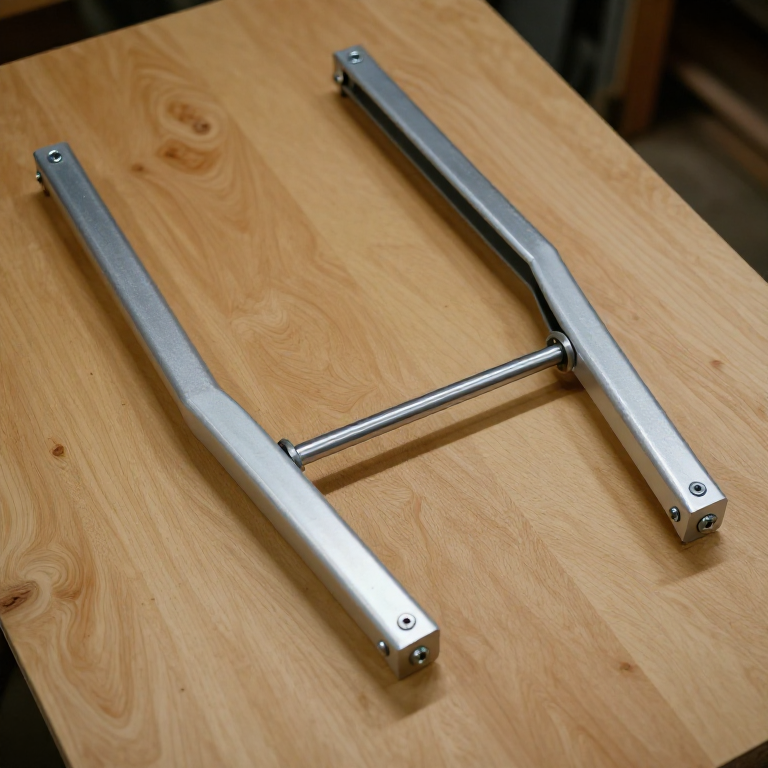


Watt's Linkage
Hướng dẫn
Lay out the three bars
Lay out the three bars
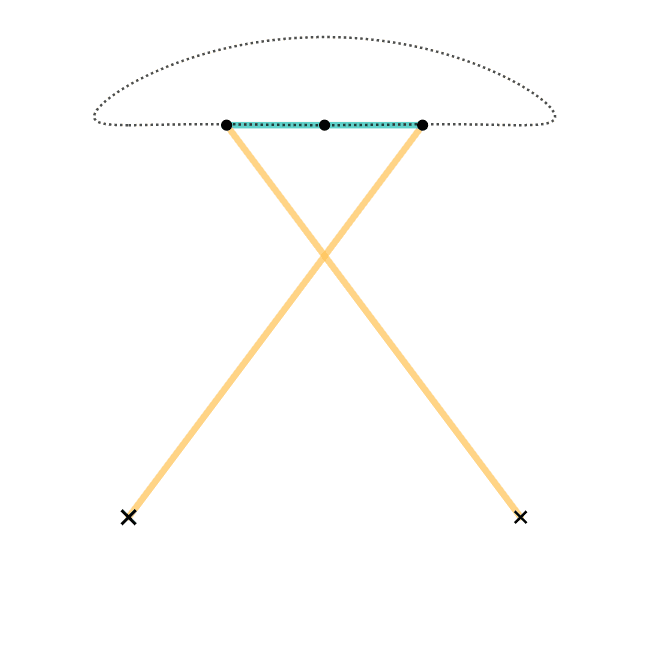
Two long arms and one short coupler, symmetrical about the centre.
- Cut two rocking arms at 120 mm hole centres from 3 mm aluminium flat bar.
- Cut one coupler at 60 mm hole centres.
- Mark the coupler's midpoint at 30 mm — the tracing point.
- Stack-drill the two arms together at 4.1 mm so they match exactly.
The proportion that matters: the tracing point divides the coupler in the inverse ratio of the two arm lengths. With equal arms, that is the exact midpoint. Make the arms unequal and the tracing point must move off centre by the same ratio, or the path tilts.
Equal arms is the easy case and the one to build first. It is also what a vehicle Watt's link uses, for the same reason — symmetry means the axle stays centred as it rises and falls.Vật liệu cho bước này:
 Thanh nhôm dẹt1 cái
Công cụ cần thiết:
 Khung cưa sắt kèm lưỡi
 Ê tô bàn nguội
 Đục dấu tâm
 Máy khoan pin
 Thước cặp điện tử 6 inch
Set the two fixed pivots
Set the two fixed pivots
Pivot spacing decides how long the straight portion is.
- Cut a baseplate 250 × 200 mm from 18 mm ply.
- Mark two fixed pivots on a vertical centreline, 180 mm apart.
- Drill 4.2 mm and fit M4 × 30 socket head cap screws × 2 from behind, with M4 flat washers × 2 and M4 hex nuts × 2.
- Check the two pivots are exactly level with the combination square.
Vật liệu cho bước này:
 Ván ép bạch dương Baltic1 tờ
 Vít đầu trụ lục giác chìm2 cái
 Vòng đệm phẳng4 cái
 Đai ốc lục giác2 cái
Công cụ cần thiết:
Máy khoan pin Bộ mũi khoan
 Thước ke tổ hợp
 Bộ lục giác
Hang the arms and fit the coupler
Hang the arms and fit the coupler
Four pivots total, and the assembly order is fixed by access.
- Fit each arm onto its ground pin with a washer above and below, retained by an M4 nylon insert lock nut.
- Swing both arms so their free ends point toward one another.
- Join the coupler to both arm ends with M4 × 16 socket head cap screws × 2, washers each side, and M4 nylon insert lock nuts × 2.
- Check the whole assembly falls under its own weight from any position.
Vật liệu cho bước này:
Vít đầu trụ lục giác chìm2 cáiVòng đệm phẳng8 cái Đai ốc khóa lõi nylon4 cái
Công cụ cần thiết:
Bộ lục giácTrace the figure of eight
Trace the figure of eight
Watt's linkage does not draw a line — it draws a very slim figure of eight, and you use the middle of it.
- Fit a marker at the coupler midpoint.
- Sweep the linkage through its FULL range, well past the working region, and let it draw.
- Examine the trace: a slender crossing curve.
- Lay a straight edge along the central section and measure how far it stays within a tenth of a millimetre.
Vật liệu cho bước này:
Ván ép bạch dương Baltic1 góiCông cụ cần thiết:
Thước cặp điện tử 6 inchThước ke tổ hợpHistory and its second life
History and its second life
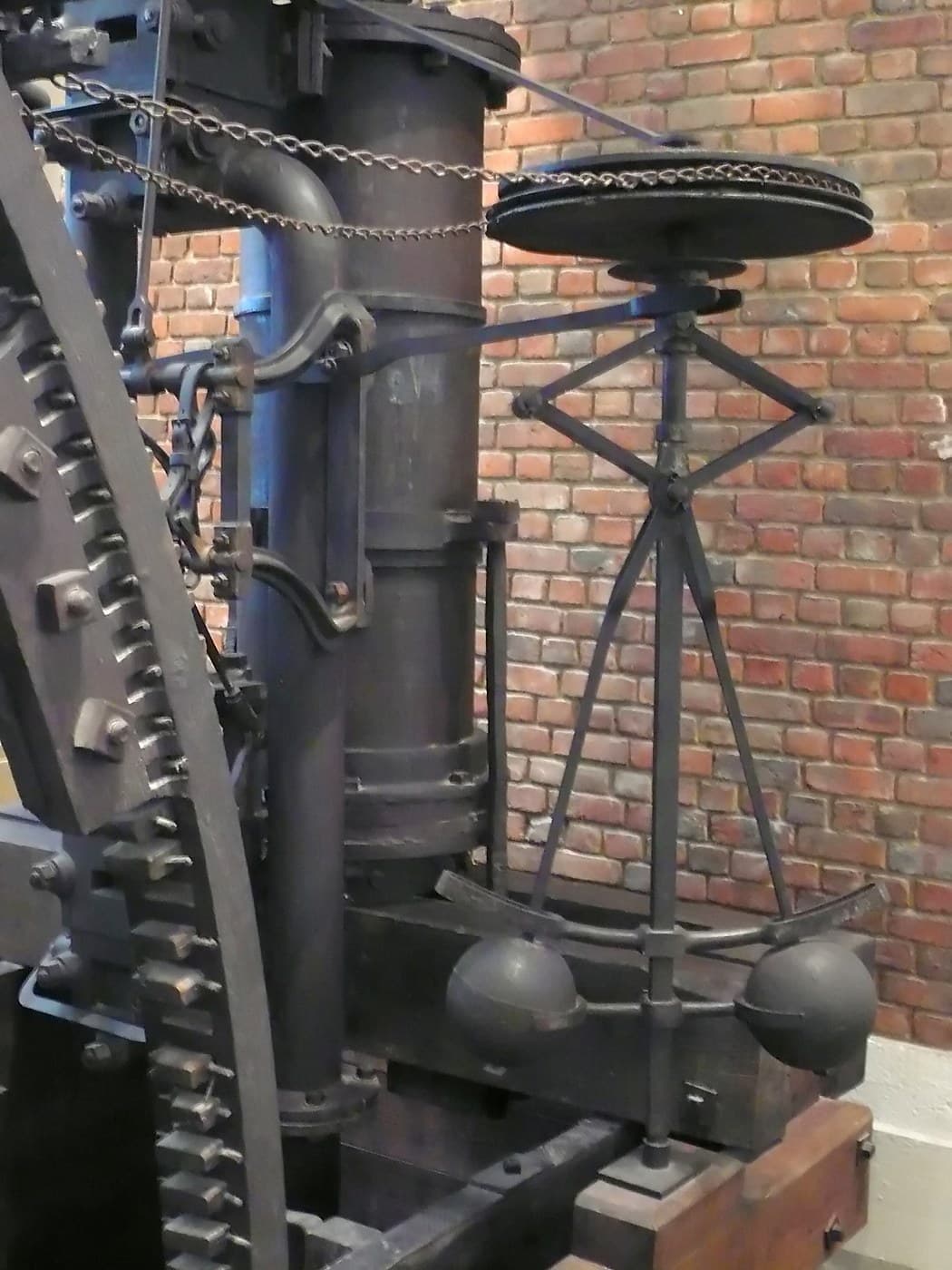
James Watt devised the linkage in 1784. His double-acting engine drove the beam in both directions, so the flexible chain used on earlier single-acting engines was useless — it could pull but not push. A rigid connection was needed, and it had to travel straight while the beam end swung in an arc. Watt wrote to Boulton that he was not "over anxious after fame" but was "more proud of the parallel motion than of any other mechanical invention I have ever made".
What the parallel motion actually was: in the engines, Watt combined this three-bar linkage with a pantograph so that the piston rod and the air pump rod could both be driven from one beam. The straight-line element at its heart is what is built here.
Its second life is the surprising part. Long after beam engines were scrapped, the Watt's link reappeared in vehicle suspension. Mounted transversely, it locates a live rear axle laterally while allowing it to move vertically along that near-straight central path — better centred than a Panhard rod, which swings the axle sideways as it rises. It is still fitted to production cars and to many racing chassis.
Compared with its siblings: three bars and four pivots make it the most compact and the cheapest of the straight-line family. Chebyshev's four bars give a mathematically minimised error; Peaucellier's eight give exactness. Watt's is the one that has been in continuous industrial use for two hundred and forty years — which suggests that compactness and part count matter at least as much as accuracy when a mechanism has to survive in the real world.
Vật liệu
7- 1 cáiTạm thời
- Tạm thời
- Tạm thời
- 12 cáiTạm thời
- 2 cáiTạm thời
- Tạm thời
- Tạm thời
Công cụ yêu cầu
8- Tạm thời
- Tạm thời
- Tạm thời
- 1 vendor sell this, none ship to you yetTạm thời
- Tạm thời
- Tạm thời
- Tạm thời
- Tạm thời
Blueprint liên quan
Các blueprint này chia sẻ kiến thức — kỹ thuật, vật liệu hoặc nguyên tắc


CC0 Phạm vi công cộng
Bản thiết kế này được phát hành theo CC0. Bạn tự do sao chép, sửa đổi, phân phối và sử dụng cho bất kỳ mục đích nào mà không cần xin phép.
Hỗ trợ nhà sáng tạo bằng cách mua sản phẩm qua bản thiết kế, nơi họ nhận Hoa hồng nhà sáng tạo do nhà bán hàng đặt, hoặc tạo phiên bản mới và kết nối trong bản thiết kế riêng để chia sẻ doanh thu.