NGHỆ THUẬT
LÀM ĐẸP VÀ SỨC KHỎE
THỦ CÔNG
VĂN HÓA VÀ LỊCH SỬ
GIẢI TRÍ
MÔI TRƯỜNG
THỰC PHẨM VÀ ĐỒ UỐNG
KỸ THUẬT NGƯỢC
KHOA HỌC
THỂ THAO
CÔNG NGHỆ
THIẾT BỊ ĐEO
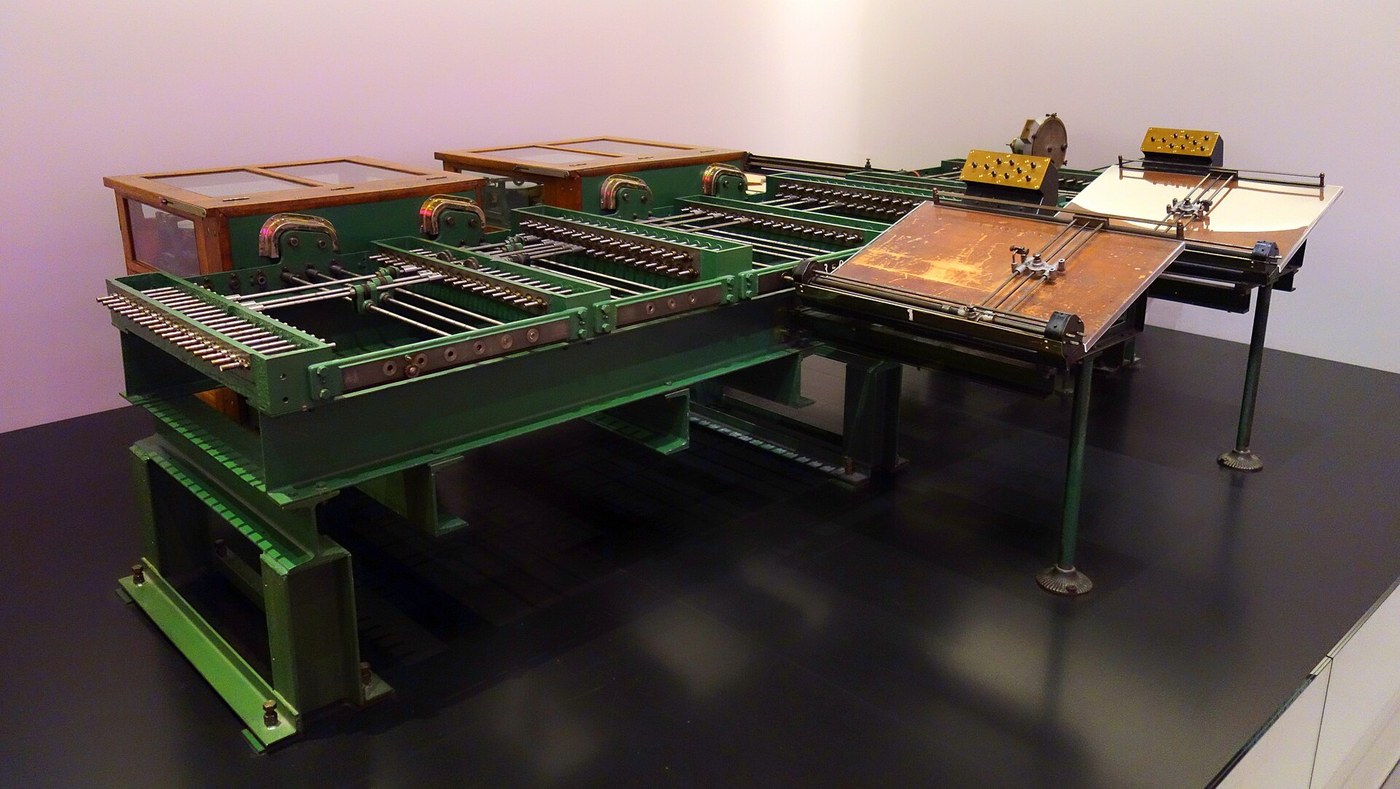


The Wheel-and-Disc Integrator
Stand a small friction wheel on a flat rotating disc with its axle pointing at the centre and its rim touching at radius x. Turn the disc once and the wheel is dragged along an arc of length two-pi-x, so it turns x over r times. Now move the wheel in and out while the disc keeps turning, and every increment of disc rotation adds whatever x happens to be at that instant. The wheel's total rotation is the integral of x, performed by friction, with no numbers anywhere.
William Thomson described this in 1876, together with a scheme for wiring several of them together to solve differential equations, and then could not build it. The reason is in the friction: a wheel pressed onto a disc with a few newtons can deliver perhaps twenty millinewton-metres before it slips, and setting the carriage of the NEXT integrator takes twenty times that. Each unit works; none of them can drive the next.
Vannevar Bush's differential analyser of 1931 solved it by putting a torque amplifier after every wheel. That is not a gearbox - gearing up the torque gears down the motion just as far, and the wheel has no motion to spare. It is a power amplifier: a band rides on a continuously driven capstan, the feeble wheel only has to tighten or slacken the band, and a separate motor does the work. Gains of ten thousand, from a mechanism that is itself a feedback loop, built a year before anybody could analyse one.
The machine that resulted solved ballistics, power-network transients and atomic-physics problems to about a tenth of a per cent per integrator, which was better than anything else available and is exactly the number that later lost to electronics. The op-amp integrator two blueprints further on does the same calculus by putting charge on a capacitor, and it wins because charge does not slip.
Trung cấp
4 hours
Hướng dẫn
1
1
A disc, a wheel, and a carriage
A disc, a wheel, and a carriage
Cut a 300 mm plywood disc, true it on the drill, and drive it slowly from the geared motor. Face it with paper for grip.
Make the wheel from an O-ring on a 30 mm hub, on a shaft carried in two bearings, and mount the whole shaft on a carriage that slides along a rail across the disc's radius. Mark the rail in millimetres from the centre.
Vật liệu cho bước này:
 Ván ép bạch dương Baltic1 tờ
 Bộ gioăng chữ O1 bộ
 Vòng bi2 cái
 Thanh thép mềm300 mm
Công cụ cần thiết:
 Máy khoan pin
 Động cơ một chiều có hộp số
 Thước cặp điện tử 6 inch
 Thước kẻ
 Nguồn điện để bàn
2
2
Integrate something, then find the slip
Integrate something, then find the slip
Park the wheel at a fixed radius, count ten disc revolutions and count the wheel revolutions. The ratio should be the radius ratio; the shortfall is your slip.
Now do a real integral: crank the disc steadily and push the carriage out at a constant rate, so x rises linearly. The wheel should turn as t squared. Read it off at four times and plot against the arithmetic.
Vật liệu cho bước này:
 Giấy kẻ ô ly4 tờ
Công cụ cần thiết:
 Đồng hồ bấm giờThước kẻ
 Bộ bút chì than chì
 Máy đo tốc độ vòng quay
3
3
The kinematics, the torque that is missing, and four integrators
The kinematics, the torque that is missing, and four integrators
Đang tải sổ tay Jupyter…
Công cụ cần thiết:
 Máy tính để bàn
4
4
Compendium: how a whole equation gets wired up
Compendium: how a whole equation gets wired up
The integrator is one unit; the analyser is what you make of six. Every variable in the problem is the angle of a shaft, and the machine is programmed by physically connecting shafts. To solve y-double-prime equals minus y you take a shaft carrying y, feed it to an integrator to get y-prime, feed that to a second to get y, and then couple the second output back to the first input through a reversing gear - a mechanical loop that literally is the differential equation. Addition is a differential gear; multiplying by a constant is a gear ratio; an arbitrary function is a shaped cam or a girl following a curve with a pointer while a servo copies her hand. Setting up one problem took a day or two, and changing a coefficient meant changing a gear.
It is worth knowing why the machines were kept long after electronic computers arrived. An analyser makes an error of a tenth of a per cent per integrator and never blows up, because friction is a physically bounded thing; early numerical integration on a digital machine could be far more accurate or catastrophically wrong depending on the step size, and nothing on the panel told you which. Operators who had watched a shaft turn could see the answer being wrong. That is a real advantage of an analogue machine and it is why the last differential analysers were still running into the 1950s.
Vật liệu
5- Tạm thời
- 1 bộTạm thời
- Tạm thời
- 300 mmTạm thời
- 4 tờTạm thời
Công cụ yêu cầu
9- 1 vendor sell this, none ship to you yetTạm thời
- 1 vendor sell this, none ship to you yetTạm thời
- Tạm thời
- Tạm thời
- Tạm thời
- Tạm thời
- Tạm thời
- Tạm thời
- Tạm thời
Blueprint liên quan
Các blueprint này chia sẻ kiến thức — kỹ thuật, vật liệu hoặc nguyên tắc


CC0 Phạm vi công cộng
Bản thiết kế này được phát hành theo CC0. Bạn tự do sao chép, sửa đổi, phân phối và sử dụng cho bất kỳ mục đích nào mà không cần xin phép.
Hỗ trợ nhà sáng tạo bằng cách mua sản phẩm qua bản thiết kế, nơi họ nhận Hoa hồng nhà sáng tạo do nhà bán hàng đặt, hoặc tạo phiên bản mới và kết nối trong bản thiết kế riêng để chia sẻ doanh thu.