NGHỆ THUẬT
LÀM ĐẸP VÀ SỨC KHỎE
THỦ CÔNG
VĂN HÓA VÀ LỊCH SỬ
GIẢI TRÍ
MÔI TRƯỜNG
THỰC PHẨM VÀ ĐỒ UỐNG
KỸ THUẬT NGƯỢC
KHOA HỌC
THỂ THAO
CÔNG NGHỆ
THIẾT BỊ ĐEO
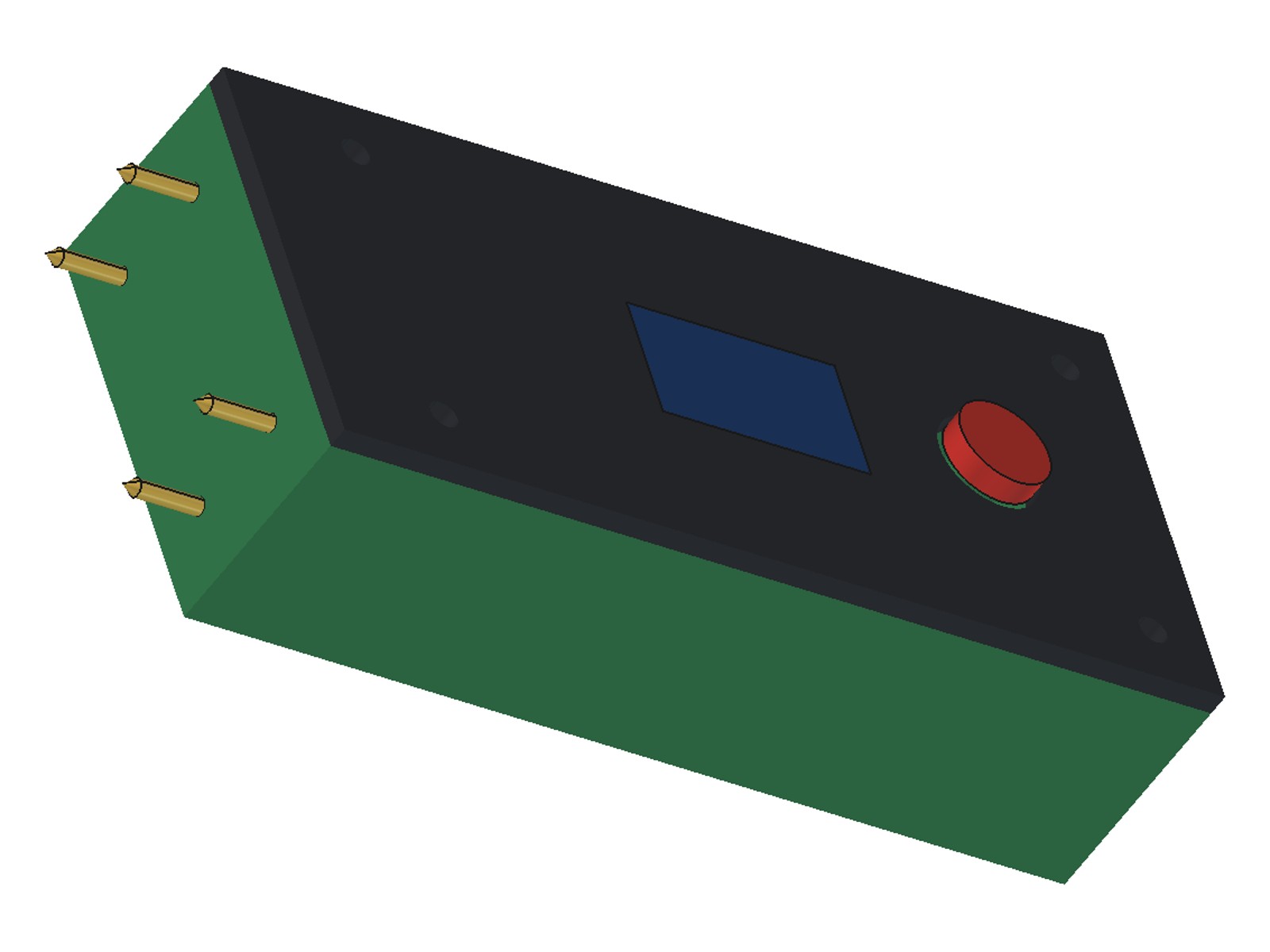
Wood Moisture Meter: Pins, a CMOS Timer and the Forest Products Laboratory Resistance Table (FPL-6)
Ed

Tạo bởi

Ed

22. tháng Mười Một 2026FI
5
0
0
0
0

Wood Moisture Meter: Pins, a CMOS Timer and the Forest Products Laboratory Resistance Table (FPL-6)

A pocket pin meter that tells whether wood is dry enough to use, from 12 to 25 % moisture content. Four brass pins pushed into the wood make it the timing resistor of a CMOS timer; an ESP32 turns the frequency into resistance and reads the moisture from the US Forest Products Laboratory's own table for six woods, corrected for temperature.
Trung cấp
About 1 day

Hướng dẫn

1

Watch a pin meter used

A pin-type meter checked on firewood and lumber (Wilson Forest Lands).
2

How wood resistance tells moisture

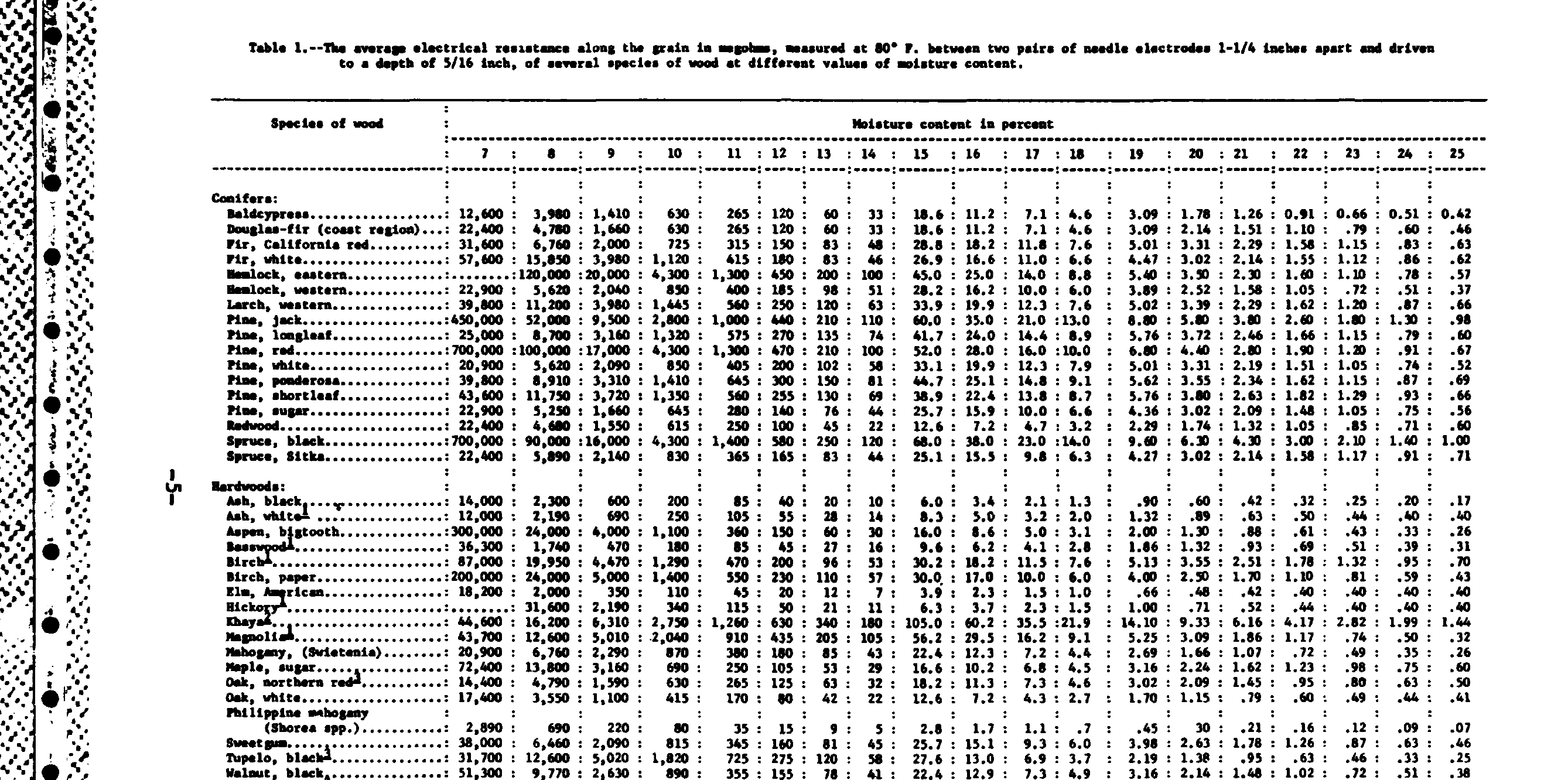
From FPL-6 (James, Forest Products Laboratory): below fiber saturation, wood's resistance rises steeply as it dries; Douglas-fir measures 22,400 megohms at 7 % and 0.46 megohm at 25 %. Above about 10 % it roughly halves for each 10 C rise. The meter reads the wettest wood touching both poles, so pins should reach 1/4 to 1/5 of the thickness, with the current along the grain.
Bước 2 - Image 1
3

Resistance, frequency and temperature

Đang tải sổ tay Jupyter…
4

Print the case

Floor down, no supports, PETG. The solid front block holds the four pins at the table's spacing.
Tệp thiết kếSTLCC0 - Free

Vật liệu cho bước này:

Sợi in PETGSợi in PETG45 g

Công cụ cần thiết:

Máy in 3D sợi nhựa (FDM)Máy in 3D sợi nhựa (FDM)
5

Print the lid

Flat, no supports. Windows for the OLED and the species button.
Tệp thiết kếSTLCC0 - Free

Vật liệu cho bước này:

Sợi in PETGSợi in PETG15 g

Công cụ cần thiết:

Máy in 3D sợi nhựa (FDM)Máy in 3D sợi nhựa (FDM)
6

Change the case (optional)

The FreeCAD script that made the case: OUT=. freecadcmd build_all.py
build_all.pypython
"""Batch 2531 -- printed case for the pin-type wood moisture meter. Pin spacing copies the FPL-6 Table 1 electrode (two poles 1-1/4 in =
31.75 mm apart, the two pins of each pole 1/2 in = 12.7 mm apart, driven 5/16 in = 8 mm deep). Other sizes ours. PETG, no supports.
  wm-base   tray 110 x 50 x 26 mm with a 10 mm solid pin block at the front end: four 1.9 mm holes for 2 mm brass pins (press fit +
            epoxy), USB slot at the back, 4 corner posts
  wm-lid    2.5 mm lid: OLED window 26 x 15 mm, 12.2 mm button hole, 4 x 3.4 mm holes
Run: OUT=<dir> freecadcmd build_all.py"""
import os
import FreeCAD as App, Part, MeshPart
OUT = os.environ["OUT"]; V = App.Vector
L, W, H, WALL, FLOOR, LID, BLOCK = 110.0, 50.0, 26.0, 2.4, 2.4, 2.5, 10.0
POLE, PAIR = 31.75, 12.7
def save(sh, n):
    sh = sh.removeSplitter(); bb = sh.BoundBox
    print(n, "valid", sh.isValid(), "solids", len(sh.Solids), "bbox", [round(v, 1) for v in (bb.XLength, bb.YLength, bb.ZLength)])
    MeshPart.meshFromShape(Shape=sh, LinearDeflection=0.03, AngularDeflection=0.12).write(os.path.join(OUT, n + ".stl"))
    return sh
POSTS = [(BLOCK + 4.5, WALL + 4.5), (L - WALL - 4.5, WALL + 4.5), (BLOCK + 4.5, W - WALL - 4.5), (L - WALL - 4.5, W - WALL - 4.5)]
base = Part.makeBox(L, W, H).cut(Part.makeBox(L - BLOCK - WALL, W - 2 * WALL, H, V(BLOCK, WALL, FLOOR)))
pins = []
for y in (W / 2 - POLE / 2, W / 2 + POLE / 2):
    for z in (H / 2 - PAIR / 2, H / 2 + PAIR / 2):
        pins.append((y, z))
        base = base.cut(Part.makeCylinder(0.95, BLOCK + 2, V(-1, y, z), V(1, 0, 0)))                      # pin hole through the block
        base = base.cut(Part.makeBox(4, 3, 3, V(BLOCK - 0.5, y - 1.5, z - 1.5)))                        # pocket behind for the wire joint
for x, y in POSTS:
    base = base.fuse(Part.makeCylinder(3.5, H - FLOOR, V(x, y, FLOOR))).cut(Part.makeCylinder(1.4, 14, V(x, y, H - 13)))
base = base.cut(Part.makeBox(WALL + 2, 12, 8, V(L - WALL - 1, W / 2 - 6, FLOOR + 3)))                   # USB slot
base = save(base, "wm-base")
lid = Part.makeBox(L, W, LID, V(0, 0, H))
lid = lid.cut(Part.makeBox(26, 15, LID + 2, V(45, W / 2 - 7.5, H - 1)))
lid = lid.cut(Part.makeCylinder(6.1, LID + 2, V(88, W / 2, H - 1)))
for x, y in POSTS:
    lid = lid.cut(Part.makeCylinder(1.7, LID + 2, V(x, y, H - 1)))
lid = save(lid, "wm-lid")
print("pins (y, z):", [(round(a, 2), round(b, 2)) for a, b in pins], "; poles", POLE, "mm apart, pins in a pole", PAIR, "mm apart")

Công cụ cần thiết:

Thước cặp điện tử 6 inchThước cặp điện tử 6 inch
7

Fit the pins

Cut four 25 mm pieces of 2 mm brass rod and file one end of each to a point. Press them through the front block so 8 mm stands out, and fix them with epoxy. Inside, join the two pins of each pole with a short wire and solder; run one wire from each pole.

Vật liệu cho bước này:

Thanh đồng thauThanh đồng thau1 piece (2 mm x 100 mm)
Keo epoxy hai thành phầnKeo epoxy hai thành phần2 g
Dây đấu nốiDây đấu nối0.3 m
Dây thiếc hànDây thiếc hàn1 g

Công cụ cần thiết:

Cưa sắtCưa sắt
Giũa kim loạiGiũa kim loại
Mỏ hànMỏ hàn
8

Build the timer

On perfboard: ICM7555 powered from the ESP32's 3V3 and GND; pins 2 and 6 joined; 1 nF film capacitor from pins 2/6 to GND; pin 4 to 3V3. One pole wire to pin 3 (output), the other to pins 2/6. Pin 3 also to ESP32 GPIO27. OLED SDA 21, SCL 22; button GPIO26 to GND. Keep the pins 2/6 wiring short and clean the flux off: at 100 megohms, dirt leaks.

Vật liệu cho bước này:
Vi mạch tích hợpVi mạch tích hợp1 piece (ICM7555 CMOS timer, 8-pin DIP)

Bộ tụ điệnBộ tụ điện1 piece (1 nF film)
Bo mạch phát triển ESP32Bo mạch phát triển ESP321 cái
Màn hình OLEDMàn hình OLED1 piece (0.96 in, I2C)
Nút nhấnNút nhấn1 piece (12 mm panel)
Bo mạch lỗ / bo mạch thửBo mạch lỗ / bo mạch thử1 cái
Dây đấu nốiDây đấu nối0.5 m
Dây thiếc hànDây thiếc hàn2 g

Công cụ cần thiết:

Mỏ hànMỏ hàn
Kìm tuốt dâyKìm tuốt dây
9

Load the firmware

Measure your 1 nF capacitor if you can and set C_TIMING; set WOOD_TEMP_C. Libraries Adafruit SSD1306 and GFX; board ESP32 Dev Module. The button steps through the six woods.
wood_moisture_meter.inocpp
// Pin-type wood moisture meter: the wood between two pairs of needles is the timing resistor of an ICM7555 CMOS timer
// (astable, one resistor from OUTPUT to THRESHOLD/TRIGGER, f = 1/(1.4 R C), Renesas ICM7555 datasheet EQ. 1); an ESP32 measures
// the period, works out R, corrects it to 80 F and reads moisture content from the USDA Forest Products Laboratory table
// (Gen. Tech. Rep. FPL-6, James 1975/1984, Table 1: megohms along the grain at 80 F, electrode of two pairs of needles
// 1-1/4 in apart driven 5/16 in deep). CC0. Pins (ours): timer OUTPUT -> GPIO27; OLED SDA 21, SCL 22; button GPIO26 to GND.
#include <Wire.h>
#include <Adafruit_GFX.h>
#include <Adafruit_SSD1306.h>
#include <math.h>

const int PIN_FREQ = 27, PIN_BTN = 26;
const float C_TIMING = 1.0e-9;      // 1 nF film capacitor: measure yours and put it here
const float WOOD_TEMP_C = 20.0;     // temperature of the wood (set yours); the table is for 80 F = 26.7 C

// Table 1 (FPL-6), megohms at 12 ... 25 percent moisture content
const int MC0 = 12, NMC = 14;
struct Species { const char* name; float r[NMC]; };
const Species SP[] = {
  {"Douglas-fir",   {120, 60, 33, 18.6, 11.2, 7.1, 4.6, 3.09, 2.14, 1.51, 1.10, .79, .60, .46}},
  {"Pine, white",   {200, 102, 58, 33.1, 19.9, 12.3, 7.9, 5.01, 3.31, 2.19, 1.51, 1.05, .74, .52}},
  {"Pine, ponder.", {300, 150, 81, 44.7, 25.1, 14.8, 9.1, 5.62, 3.55, 2.34, 1.62, 1.15, .87, .69}},
  {"Oak, red",      {125, 63, 32, 18.2, 11.3, 7.3, 4.6, 3.02, 2.09, 1.45, .95, .80, .63, .50}},
  {"Oak, white",    {80, 42, 22, 12.6, 7.2, 4.3, 2.7, 1.70, 1.15, .79, .60, .49, .44, .41}},
  {"Maple, sugar",  {105, 53, 29, 16.6, 10.2, 6.8, 4.5, 3.16, 2.24, 1.62, 1.23, .98, .75, .60}},
};
const int NSP = sizeof(SP) / sizeof(SP[0]);
int sp = 0;

Adafruit_SSD1306 oled(128, 64, &Wire, -1);
volatile unsigned long lastEdge = 0, period = 0;
void IRAM_ATTR onRise() { unsigned long t = micros(); period = t - lastEdge; lastEdge = t; }

// moisture content from megohms (at 80 F): log-log interpolation in the table; NAN outside 12-25 %
float mcFromMeg(float meg, const Species& s) {
  if (meg > s.r[0] || meg < s.r[NMC - 1]) return NAN;
  for (int i = 0; i < NMC - 1; i++) {
    if (meg <= s.r[i] && meg >= s.r[i + 1]) {
      float f = (log(meg) - log(s.r[i])) / (log(s.r[i + 1]) - log(s.r[i]));
      return MC0 + i + f;   // between i and i+1 percent (linear in log R, as the table steps are 1 percent)
    }
  }
  return NAN;
}

void show(const char* a, const char* b, const char* c) {
  oled.clearDisplay(); oled.setTextColor(SSD1306_WHITE);
  oled.setTextSize(1); oled.setCursor(0, 0); oled.print(a);
  oled.setTextSize(2); oled.setCursor(0, 22); oled.print(b);
  oled.setTextSize(1); oled.setCursor(0, 52); oled.print(c);
  oled.display();
}

void setup() {
  pinMode(PIN_FREQ, INPUT); pinMode(PIN_BTN, INPUT_PULLUP);
  attachInterrupt(digitalPinToInterrupt(PIN_FREQ), onRise, RISING);
  Wire.begin(21, 22); oled.begin(SSD1306_SWITCHCAPVCC, 0x3C);
}

void loop() {
  if (digitalRead(PIN_BTN) == LOW) { sp = (sp + 1) % NSP; delay(300); }
  noInterrupts(); unsigned long p = period, age = micros() - lastEdge; interrupts();
  char b[24], c[32];
  if (p == 0 || age > 3000000UL) {                    // no edge for 3 s: wood too dry (or no contact)
    show(SP[sp].name, "DRY <12%", "or pins not in the wood");
  } else {
    float f = 1e6 / p;
    float R = 1.0 / (1.4 * C_TIMING * f);              // ohms, EQ. 1
    float meg80 = R / 1e6 * pow(2.0, (WOOD_TEMP_C - 26.7) / 10.0);   // to 80 F: halves per +10 C (FPL-6, above 10 % MC)
    float mc = mcFromMeg(meg80, SP[sp]);
    snprintf(c, sizeof c, "R %.2f Mohm @ %.0fC", R / 1e6, WOOD_TEMP_C);
    if (isnan(mc)) snprintf(b, sizeof b, meg80 < SP[sp].r[NMC - 1] ? "WET >25%%" : "DRY <12%%");
    else snprintf(b, sizeof b, "%.1f %%", mc);
    show(SP[sp].name, b, c);
  }
  delay(250);
}

Vật liệu cho bước này:

Cáp USB-CCáp USB-C1 cái

Công cụ cần thiết:

Máy tính cài Arduino IDEMáy tính cài Arduino IDE
10

Close it and check it

Fix the boards with tape, close the lid with 4 x M3 x 10. Check: a 1 megohm resistor across the poles must show R about 1 megohm; ten 10 megohm resistors in series, about 100. If 100 reads far off, your timer chip leaks more than typical.

Vật liệu cho bước này:

Băng dính hai mặtBăng dính hai mặt0.2 m
Vít đầu trụ lục giác chìmVít đầu trụ lục giác chìm4 piece (M3 x 10)

Công cụ cần thiết:
Bộ lục giácBộ lục giác
Bộ điện trởBộ điện trở
11

Measure wood

Choose the wood with the button. Push the pins in so the two poles lie one behind the other along the grain, 1/4 to 1/5 of the board's thickness deep, and read at once.
12

Troubleshooting

Meter problems and fixes.

Flow

Loading...
13

History and honest limits

From William L. James, Electric Moisture Meters for Wood, USDA Forest Service Gen. Tech. Rep. FPL-6 (1975): Table 1 values for six woods, the temperature rule and the electrode spacing. Timer figures from the ICM7555 datasheet. Ours: the circuit, the pins and case, the firmware. Range 12-25 % only; the temperature must be set by hand; the chip's leakage limits the dry end. Not built by us yet.

Vật liệu

14

Công cụ yêu cầu

9

Tệp thiết kế

2

Bản thiết kế này làm ra

CC0 Phạm vi công cộng

Bản thiết kế này được phát hành theo CC0. Bạn tự do sao chép, sửa đổi, phân phối và sử dụng cho bất kỳ mục đích nào mà không cần xin phép.

Hỗ trợ nhà sáng tạo bằng cách mua sản phẩm qua bản thiết kế, nơi họ nhận Hoa hồng nhà sáng tạo do nhà bán hàng đặt, hoặc tạo phiên bản mới và kết nối trong bản thiết kế riêng để chia sẻ doanh thu.

Thảo luận

(0)

Đăng nhập để tham gia thảo luận

Đang tải bình luận...