UBUCIKO
UBUHLE NEMPILO
UBUCIKO BEZANDLA
AMASIKO NOMLANDO
EZOKUZIJABULISA
IMVELO
UKUDLA NEZIPHUZO
REVERSE ENGINEERING
IZAYENSI
EZEMIDLALO
UBUCHWEPHESHE
IZINTO EZIGQOKWAYO
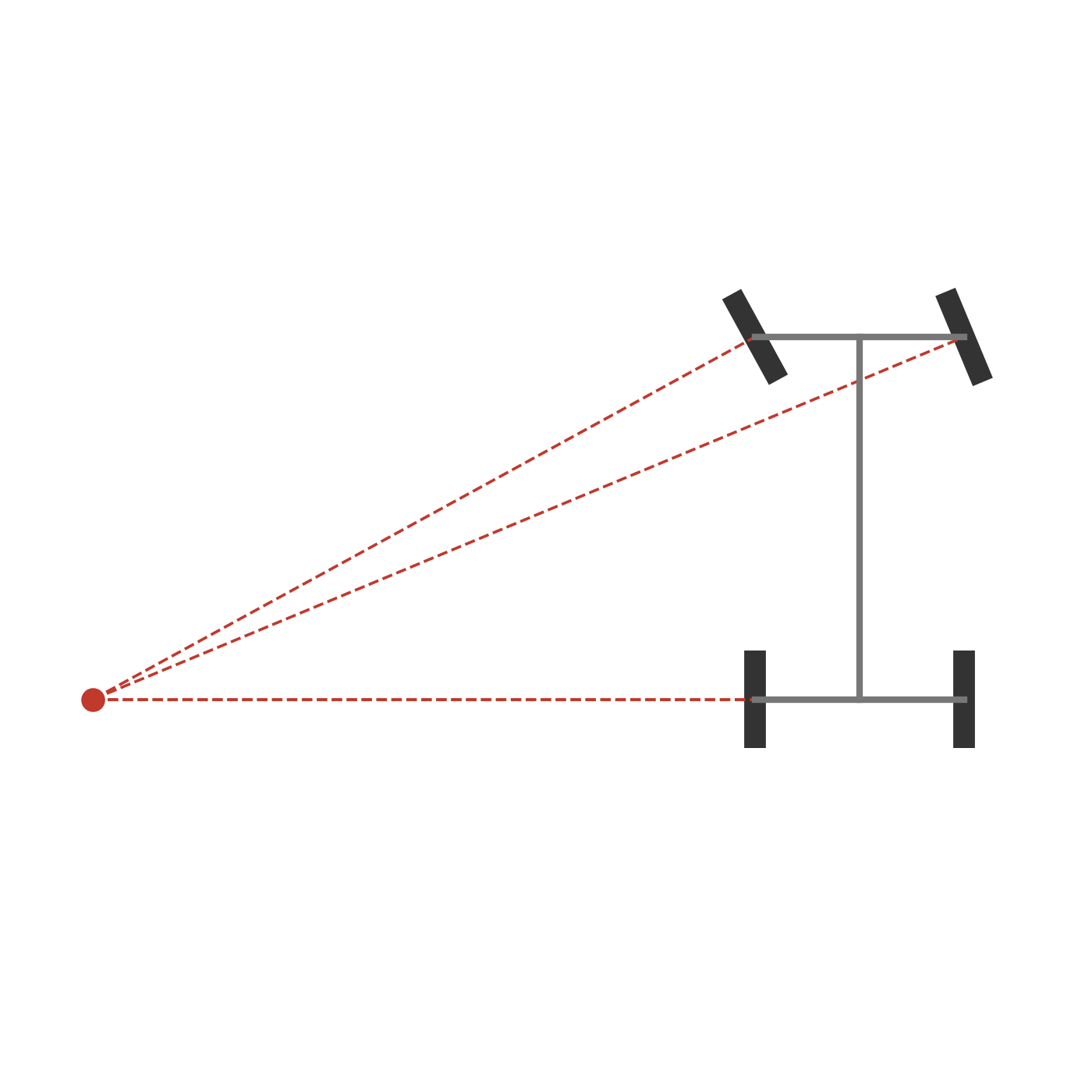
Youblob (generated from this blueprint's notebook) · CC0


Ackermann Steering: The Inner Wheel Turns Further
A cart turns by swivelling its whole front axle on a pin — simple, but the axle sweeps under the body and the cart grows unstable. In 1816 the Munich carriage-builder Georg Lankensperger pivoted each front wheel on its own stub instead, joined them with a tie rod, and angled the steering arms so the inner wheel turns further than the outer. Rudolph Ackermann patented it in England on his behalf in 1818, and the geometry has carried Ackermann's name ever since.
Every wheel should roll round one common centre on a turn; this linkage gets very close to that without any clever mechanism at all.
This rung works out the wheel angles and checks a trapezoid linkage numerically, then builds one and measures it with a protractor.
Oqalayo
About 3 hours
Imiyalelo
1
1
The angles, and the linkage that makes them
The angles, and the linkage that makes them
Ilayisha incwadi ye-Jupyter…
2
2
Build a steering model
Build a steering model
Cut a plywood 'axle beam' 300 mm long. Near each end, pivot a small plywood wheel carrier on a screw (the kingpin). Glue a steering arm to each carrier pointing backward and inward, so that the two arms, extended, meet at a point on the centre line one 'wheelbase' behind — use 520 mm for a 300 mm track, the same ratio as the notebook's car.
Join the arm ends with a tie rod of balsa strip, pinned at each end. Glue a protractor under each carrier.
Steer one wheel to 10°, 20° and 30° and read the other. Compare with the notebook's linkage column. Then make the arms parallel and repeat: both wheels now turn the same angle — the scrubbing layout.
Izinto zokwakha zalesi sinyathelo:
 Ishidi le-plywood1 ishidi
 Ishidi Lokhuni Lwe-balsa1 ishidi
 Izikulufu zomshini6 izicucu
Amathuluzi adingekayo:
 Ibhola Elingenantambo
 Iqoqo Lamakhanda Ebhola
 Iphrothrakta
 Irula
Irula3
3
History and context
History and context
**Georg Lankensperger, Munich, 1816**; patented in England in 1818 by **Rudolph Ackermann**, his agent, as a steering for carriages. No patent number is asserted here. Charles Jeantaud refined the geometry in France later in the century, and the arrangement passed to the motor car.
**Honest limits.** The linkage is exact at only a few angles. At speed, tyres run at slip angles and a car may want less than full Ackermann; racing cars often use less or even reverse it. And the geometry assumes rigid wheels rolling without slip — a fair assumption only for slow, tight turns.
Izinto
3- 1 ishidiIsibambeli
- 1 ishidiIsibambeli
- 6 izicucuIsibambeli
Amathuluzi Adingekayo
4- 1 vendor sell this, none ship to you yetIsibambeli
- Isibambeli
- Isibambeli
- Isibambeli
Ama-blueprint ahlobene
Lama-blueprint abelana ngolwazi — amasu, izinto noma izimiso

CC0 Isizinda Somphakathi
Le blueprint ikhishwe ngaphansi kwe-CC0. Ukhululekile ukukopisha, ukuguqula, ukusabalalisa, nokusebenzisa ngaphandle kwemvume.
Sekela uMenzi ngokuthenga imikhiqizo nge-Blueprint yabo IKhomishane Yomenzi kumiswe ngabathengisi, noma dala inguqulo entsha yale Blueprint bese uyifaka njengoxhumaniso ku-Blueprint yakho ukuze wabelane ngemali engenayo.