Ukusebenzisana
UBUCIKO
UBUHLE NEMPILO
UBUCIKO BEZANDLA
AMASIKO NOMLANDO
EZOKUZIJABULISA
IMVELO
UKUDLA NEZIPHUZO
REVERSE ENGINEERING
IZAYENSI
EZEMIDLALO
UBUCHWEPHESHE
IZINTO EZIGQOKWAYO
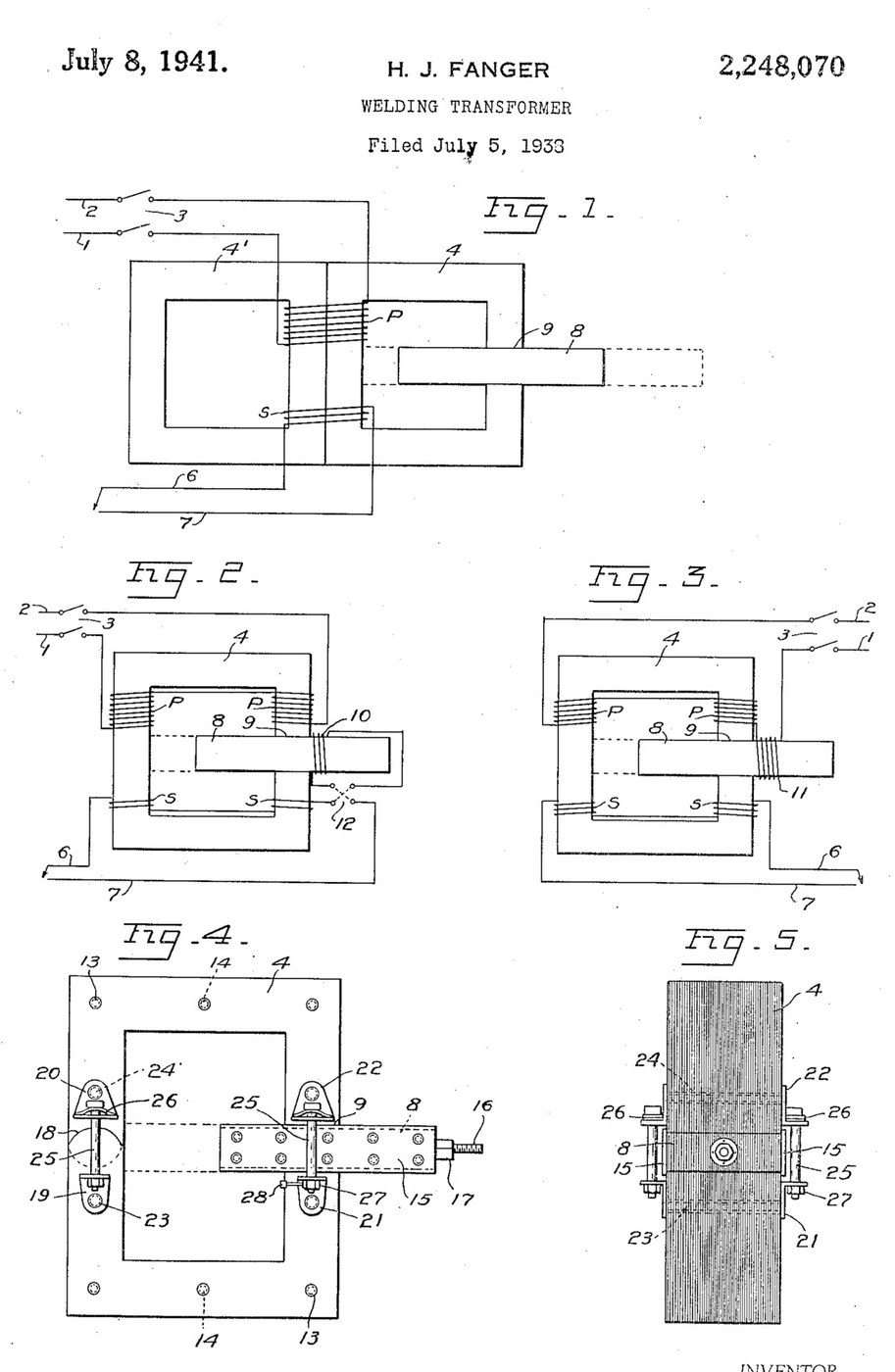


Arc Welder: AC Transformer with a Sliding Shunt Core (Fanger, US 2,248,070)
An AC arc welder is a step-down transformer whose current can be turned up and down. H. J. Fanger (US 2,248,070, 1941) cuts a gap through one leg of a laminated ring core and slides a laminated iron shunt bar through it: pushed in, it carries flux past the secondary and lowers the welding current; pulled out, the current rises.
For arc welding he gives about 60 to 68 volts open circuit, 15 to 200 amps, dropping to 38 or 40 volts at the working arc, with a small coil on the shunt bar in series with the secondary.
Source: H. J. Fanger, "Welding Transformer", US Patent 2,248,070 (filed 1938, granted 1941). Picture: its Figs. 1-5.
Osezingeni eliphezulu
Unknown
Imiyalelo
1
1
Read Fanger
Read Fanger
"With arc welding, infinite control of the volume of the secondary current, between maximum and minimum is obtained by adjustment of the slidable shunt core without altering the welding characteristics of the current, also better ignition of the arc is had at a given voltage, and greater stability of the arc".
2
2
Stack the core
Stack the core
Build a single rectangular ring core of insulated iron laminations, held together with brass (or insulated) bolts or rivets in insulating tubes (Fig. 4). Cut a gap straight through one leg, accurately machined and finished, and make a circular joint through the opposite leg with the segments staggered to overlap in successive laminations. Core size, lamination iron and thickness are not given (ours: the tools).
Izinto zokwakha zalesi sinyathelo:
 Insimbi engaziwa1 iron laminations
 Iqoqo lamabhawoti anezinhlangothi eziyisithupha1 brass bolts
 Into evimbela ugesi engaziwa1 insulating tubes
Amathuluzi adingekayo:
 Isikeli sensimbi
 Ibhola Elimile
 Iqoqo Lamakhanda Ebhola
 Izinsimbi zokuhlikihla (ezesandla)
 Izilinganiso ezingaziwa
3
3
Make the shunt bar
Make the shunt bar
Make the sliding shunt section of the same laminated iron, a snug fit in the gap with its laminations edge-to-edge with the core's, and long enough to fill the gap at every position. Sheath both sides with a slightly wider plate of Bakelite that overlaps the edges of the gap to guide it. Fit a threaded rod on its outer end, working in a nut fixed to the section (or move it by hand, with calibration marks along one edge).
Izinto zokwakha zalesi sinyathelo:
Insimbi engaziwa1 shunt laminations I-Bakelite2 side platesIqoqo lamabhawoti anezinhlangothi eziyisithupha1 brass bolts
 Insika enemicu yesikulufu1 ucezu
 Inathi Yezinhlangothi Eziyisithupha1 ucezu
Amathuluzi adingekayo:
Ibhola ElimileIqoqo Lamakhanda EbholaIzinsimbi zokuhlikihla (ezesandla)4
4
Wind the coils
Wind the coils
Wind the primary and secondary windings on both legs of the core (Fig. 2), in series or in parallel to suit the line voltage and the current wanted. Wind a small auxiliary coil round the shunt bar's path, fixed so the bar slides through it, and connect it in series with the secondary through a reversing switch (some jobs weld better with the current through it one way). Turns and wire sizes are not given.
Izinto zokwakha zalesi sinyathelo:
 Ucingo Lwethusi1 insulation and size not given
Amathuluzi adingekayo:
Izilinganiso ezingaziwa5
5
Spring the joints
Spring the joints
On both sides of the gap and of the circular joint fit pairs of confronting angle plates, held by brass bolts in insulating sleeves and drawn together by spring bolts whose heads rest on slightly arched spring plates, so the joints close snugly on the sliding bar. A small lever on the gap-joint nut gives a half turn to release the bar for moving. The angle-plate material is not given.
Izinto zokwakha zalesi sinyathelo:
 Okokwakha okungaziwa4 angle platesIqoqo lamabhawoti anezinhlangothi eziyisithupha1 brass and spring boltsInto evimbela ugesi engaziwa1 sleeves
 Umucu wensimbi yensipho1 arched spring platesInathi Yezinhlangothi Eziyisithupha4 izicucu
Amathuluzi adingekayo:
Ibhola ElimileIqoqo Lamakhanda Ebhola Isipanela esilungisekayo
6
6
Connect and set
Connect and set
Connect the primary to the line through a line switch, and the secondary leads to the electrode holder and the work. Pull the shunt bar out for more current, push it in for less: Fanger gives about 60-68 volts open circuit and 15-200 amps, dropping to 38-40 volts at the arc.
Izinto zokwakha zalesi sinyathelo:
 Iswishi yokuvula/ukuvala1 line switch
Amathuluzi adingekayo:
Isipanela esilungisekayoIzinto
10- 1 shunt laminationsIsibambeli
- 1 brass and spring boltsIsibambeli
- 1 sleevesIsibambeli
- 2 side platesIsibambeli
- 1 ucezuIsibambeli
- 5 izicucuIsibambeli
- 1 insulation and size not givenIsibambeli
- 4 angle platesIsibambeli
- 1 arched spring platesIsibambeli
- 1 line switchIsibambeli
Le blueprint yenza

CC0 Isizinda Somphakathi
Le blueprint ikhishwe ngaphansi kwe-CC0. Ukhululekile ukukopisha, ukuguqula, ukusabalalisa, nokusebenzisa ngaphandle kwemvume.
Sekela uMenzi ngokuthenga imikhiqizo nge-Blueprint yabo IKhomishane Yomenzi kumiswe ngabathengisi, noma dala inguqulo entsha yale Blueprint bese uyifaka njengoxhumaniso ku-Blueprint yakho ukuze wabelane ngemali engenayo.