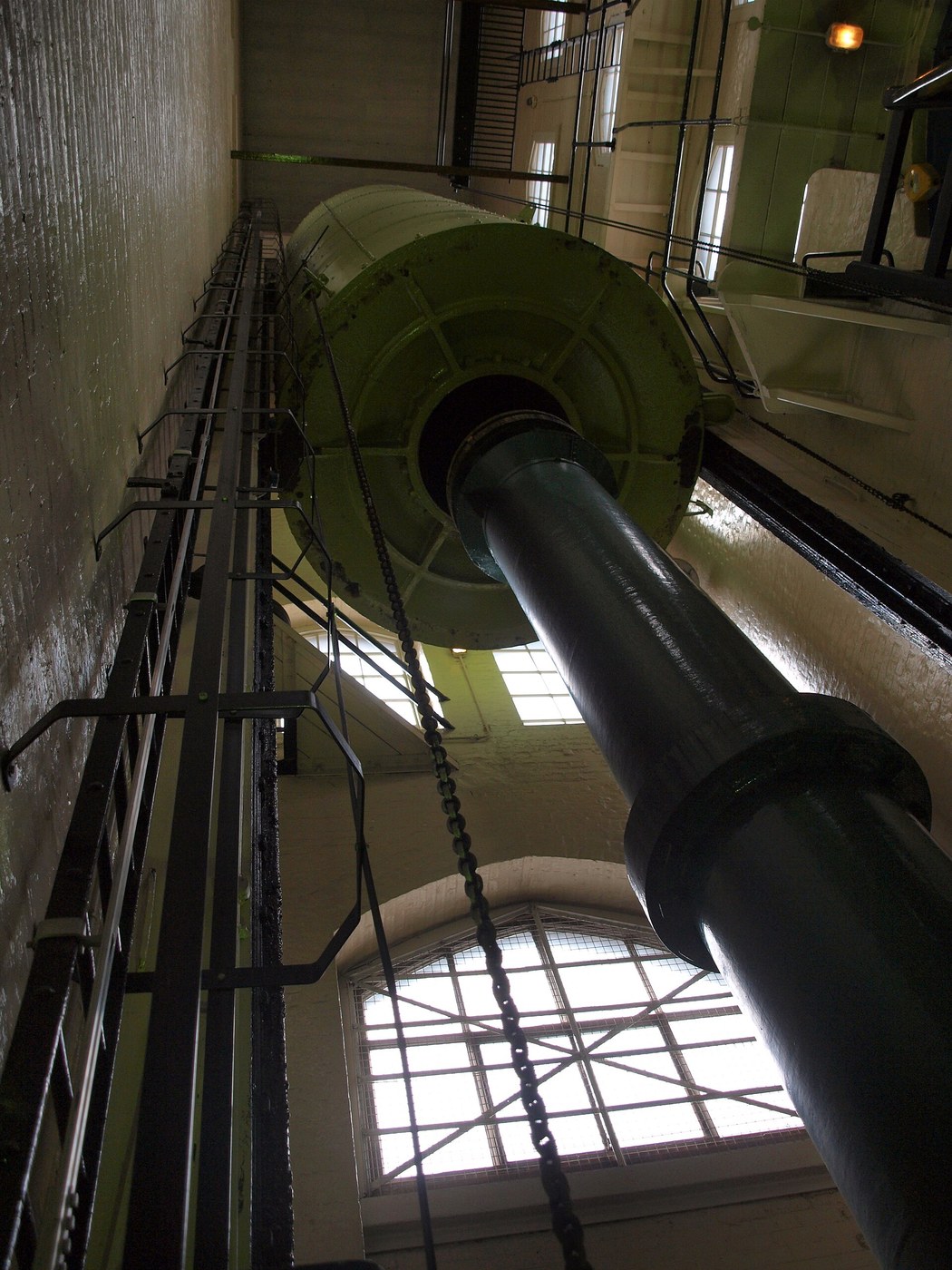


Hydraulic Accumulator
Hydraulic machinery has an awkward duty cycle. A dock crane lifting a load wants an enormous flow for thirty seconds, then nothing for ten minutes. Size the pump for the peak and it sits idle almost all the time; size it for the average and the crane cannot lift.
An accumulator decouples the two. It is a vertical ram carrying a very heavy weight — a cylinder loaded with stone, gravel or iron. The pump runs steadily and slowly, pushing water underneath the ram and lifting the weight. When a machine calls for water, the falling weight drives it out at full pressure and full flow.
What makes it different from a spring or a gas bottle is that the pressure is constant. Force is weight divided by ram area, and neither changes as the ram rises and falls — so the mains pressure stays the same whether the accumulator is nearly full or nearly empty. A gas accumulator's pressure sags as it discharges; this one does not.
It stores energy as height: E = m g h. A 100-tonne weight on a 6 m stroke stores about 5.9 MJ, deliverable in seconds.
William Armstrong developed it at Newcastle in the 1850s, and it is what made hydraulic power practical as a public utility rather than a machine-by-machine arrangement.
⚠ We have not pinned Armstrong's accumulator patent number to a document; the date and attribution are well attested, the number is not cited here.
Imiyalelo
Show the problem with a small pump
Show the problem with a small pump
Connect a small pump directly to a cylinder and try to move a heavy load quickly.
Expect it to move, but slowly — the pump's flow rate sets the speed and nothing else.
Record how long it takes. This is the constraint an accumulator removes.
Build a weighted accumulator
Build a weighted accumulator
Stand a syringe or small cylinder vertically, plunger upward, and load the plunger with a known mass.
Compute the pressure it will hold: p = m g / A, using the bore area from your caliper measurement.
That figure is fixed by the weight and the area — it does not depend on how far the plunger has risen. Note that now; step 4 tests it.
Izinto zokwakha zalesi sinyathelo:
 Isethi yamasirinji1 isethi
 Ipayipi Le-silicone1 m
Amathuluzi adingekayo:
 I-Caliper Yedijithali Yamayintshi Ayi-6
 Isikali Sedijithali Sasekhishini
Charge slowly, discharge fast
Charge slowly, discharge fast
Fill the accumulator gradually from the small pump — the weight rises slowly. Then open the valve to the load.
Time both. Expect charging to take many times longer than discharge.
The pump is now sized for the average demand, while the machine gets the peak. That is the entire economic argument, and it is why Victorian hydraulic mains could run a whole dockyard from a modest engine house.
Prove the pressure is constant
Prove the pressure is constant
Measure delivery pressure with the weight near the top of its travel, then again near the bottom.
Expect them to be the same.
Now repeat the comparison with a sealed air pocket in place of the weight. Its pressure will fall as it discharges, because the gas expands.
That difference is the whole reason Victorian systems used dead weight: every machine on the main got identical pressure regardless of how charged the accumulator was.
Compute the stored energy
Compute the stored energy
Compute E = m g h for your model — mass, gravity, stroke height.
Then scale it: a full-size accumulator with a 100-tonne weight and a 6 m stroke stores about 5.9 MJ.
Note that this is a genuinely large amount of energy held by nothing but gravity and a column of water, which is why these towers were built massively and why a burst main was extremely dangerous.
History & Context
History & Context
Armstrong's problem was a crane. William Armstrong began with hydraulic cranes on the Newcastle quayside in the 1840s, fed from a water tower. Where there was no head available he needed another way to hold pressure, and the weighted accumulator of the 1850s was it. ⚠ The attribution and decade are well attested; we have not verified a patent number and do not quote one.
What it turned hydraulics into. Before the accumulator, a hydraulic machine needed its own pump sized to its peak. After it, one engine house could supply a network. Hydraulic power mains ran under Hull, Liverpool, Manchester, Glasgow, Sydney and London, driving cranes, dock gates, swing bridges, warehouse hoists and theatre machinery. The London Hydraulic Power Company operated until 1977 — a utility as real as gas or electricity, and now almost entirely forgotten.
Tower Bridge is the surviving demonstration. Its bascules were raised by hydraulic engines fed from weighted accumulators, and the original machinery is preserved. The bridge did not need an engine capable of lifting it — it needed one capable of slowly refilling an accumulator between ships.
What replaced it, and what did not. Electric motors made local power cheap and killed the mains. But the principle is untouched: modern hydraulic systems carry gas-charged accumulators for exactly the same duty-cycle reason, accepting the falling pressure of step 4 in exchange for not needing a hundred tonnes of iron. And pumped-storage hydro is the same idea again — store energy by lifting a mass of water, release it on demand.
Izinto
2- 1 isethiIsibambeli
- Isibambeli
Amathuluzi Adingekayo
2- Isibambeli
- Isibambeli
Izinto Zokwakha Ze-Blueprint Exhunyiwe
Ama-blueprint ahlobene
Lama-blueprint abelana ngolwazi — amasu, izinto noma izimiso
CC0 Isizinda Somphakathi
Le blueprint ikhishwe ngaphansi kwe-CC0. Ukhululekile ukukopisha, ukuguqula, ukusabalalisa, nokusebenzisa ngaphandle kwemvume.
Sekela uMenzi ngokuthenga imikhiqizo nge-Blueprint yabo IKhomishane Yomenzi kumiswe ngabathengisi, noma dala inguqulo entsha yale Blueprint bese uyifaka njengoxhumaniso ku-Blueprint yakho ukuze wabelane ngemali engenayo.