
UBUCIKO
UBUHLE NEMPILO
UBUCIKO BEZANDLA
AMASIKO NOMLANDO
EZOKUZIJABULISA
IMVELO
UKUDLA NEZIPHUZO
REVERSE ENGINEERING
IZAYENSI
EZEMIDLALO
UBUCHWEPHESHE
IZINTO EZIGQOKWAYO
Breaking Stone by Compression: The Nip Angle Decides Everything
Martin

Yenziwe ngu-

Martin

27. uMandulo 2026NO
4
0
0
0
0

Breaking Stone by Compression: The Nip Angle Decides Everything

Before 1858 a road was surfaced with stone broken by men sitting beside it with hammers. One man could break about a cubic yard a day, and the size was whatever his eye and his arm produced. Eli Whitney Blake's machine put the stone between two steel plates, one fixed and one swinging, and drove the swinging one through a pair of toggle links. It is still, in outline, every jaw crusher made since. This rung is about the one angle that makes it work. Two plates closing on a stone do not crush it unless the angle between them is small enough for friction to hold the stone in place. Get that angle wrong and the stone is spat out of the top, unbroken, over and over. Everything else about the machine's shape follows from it.
Ophakathi
About 3 hours

Imiyalelo

1

Measure what you are actually breaking, and to what

Take a bucket of quarry stone or coarse aggregate. Spread it on a board and measure the longest dimension of the twenty biggest pieces with calipers. Write down the largest and the average. Then decide the product: what size do you need, and how strictly? 'Passing a 20 mm sieve' and 'all about 20 mm' are completely different requirements, and only the first one is achievable by crushing. A crusher always makes a **range**, from its setting down to dust; what you control is the top of that range. Those two numbers — feed top size and product top size — are the whole specification of a crushing stage, and their ratio is the **reduction ratio**. Write it down. Step 4 shows why a single machine will not give you more than about six.

Izinto zokwakha zalesi sinyathelo:

Amatshe okuxubaAmatshe okuxuba1 bucket

Amathuluzi adingekayo:

I-Caliper Yedijithali Yamayintshi Ayi-6I-Caliper Yedijithali Yamayintshi Ayi-6
Isihlungo esibanziIsihlungo esibanzi
Isikali SedijithaliIsikali Sedijithali
IbhakedeIbhakede
2

The toggle: how a small push becomes an enormous squeeze

Blake's mechanism is a **toggle**: two links, hinged end to end, that start nearly in line. Push sideways on the joint between them and the links try to straighten; because they are already close to straight, a small sideways movement produces a very large movement along their length, and correspondingly a very large force. Make the model before you trust the arithmetic. Hinge two flat bar links end to end, pin the far end of one to the bench and rest the far end of the other against a bathroom scale or a spring balance. Press down on the centre hinge with a known weight and read what comes out at the end. Then straighten the pair a little and repeat. You will find the gain climbing steeply as the links approach straight — and with it the movement shrinking to nothing. That is the bargain the toggle makes, and it suits crushing exactly: a crusher needs a huge force through a very small distance. In the machine the eccentric shaft lifts and drops a vertical pitman; the pitman's motion is turned through the toggle into the jaw's swing. Nothing else in the machine has to be strong in the same way, because the toggle is where the force is made.

Izinto zokwakha zalesi sinyathelo:

Insimbi eluhlaza eyindukwanaInsimbi eluhlaza eyindukwana2 izicucu
Izikulufu zomshiniIzikulufu zomshini4 izicucu

Amathuluzi adingekayo:

Isibambo SebhentshiIsibambo Sebhentshi
Ibhola ElingenantamboIbhola Elingenantambo
Iqoqo Lamakhanda EbholaIqoqo Lamakhanda Ebhola
Isikali SedijithaliIsikali Sedijithali
IrulaIrula
IphrothraktaIphrothrakta
3

Find the nip angle by hand before you calculate it

Clamp two pieces of flat steel plate in a vise so they meet at an adjustable angle — a hinge at the bottom and a spacer at the top is enough. Drop a stone in and close the vise slowly. Start with the plates nearly parallel and work outwards. At small angles the stone stays put and cracks. Somewhere past twenty-odd degrees it will start to climb: instead of breaking, it rides up the plates and jumps out of the top. Find that angle with the protractor and write it down. Do it again with the stone wet. It will spit out at a smaller angle, because water lowers the friction that was holding it. This is the single most useful thing in the rung: **the angle a machine can hold depends on the friction available, and friction is not a constant of the rock — it is a property of the rock as it arrives that day.** Wear the face shield. A stone squeezed between steel plates leaves at speed, and it leaves upward.

Izinto zokwakha zalesi sinyathelo:

Amatshe okuxubaAmatshe okuxuba1 isandla esigcwele
Ishidi lensimbi ethambileIshidi lensimbi ethambile2 izicucu

Amathuluzi adingekayo:

Isibambo SebhentshiIsibambo Sebhentshi
IphrothraktaIphrothrakta
IrulaIrula
Izibuko Zokuphepha EzicwathileIzibuko Zokuphepha Ezicwathile
Amagilavu Omsebenzi EsikhumbaAmagilavu Omsebenzi Esikhumba
4

The angle, and what it forces on the machine

Ilayisha incwadi ye-Jupyter…
5

The toggle plate is meant to break

A crusher will eventually be fed something it cannot crush — a digger tooth, a drill bit, a piece of its own liner. The stone crushes; steel does not. The force rises until something in the machine gives way. So one link is designed to give way first. The **toggle plate** is made deliberately weak: a plain plate with a notch, or a bolted plate with a shear section. When the crusher takes a bite of tramp iron the toggle breaks, the jaw goes slack, and the uncrushable object falls out of the bottom. Replacing a toggle plate takes an hour. Replacing a cracked frame takes a new crusher. The toggle is the cheapest part in the machine and it is the one that saves it. Inspect yours before every run, and understand the difference between the two failures: a toggle that has sheared cleanly did its job; a toggle that is bent and still in place means the machine has been running overloaded and the frame has been taking the excess.

Izinto zokwakha zalesi sinyathelo:

Ipuleti le-toggle (isixhumanisi sokuphepha somphahlazi)Ipuleti le-toggle (isixhumanisi sokuphepha somphahlazi)1 ucezu
Ipuleti lokugqoka lensimbi ye-manganeseIpuleti lokugqoka lensimbi ye-manganese2 izicucu

Amathuluzi adingekayo:

Isethi yamaspanelaIsethi yamaspanela
Isethi yezikhiye ze-hexIsethi yezikhiye ze-hex
I-Caliper Yedijithali Yamayintshi Ayi-6I-Caliper Yedijithali Yamayintshi Ayi-6
Amagilavu Omsebenzi EsikhumbaAmagilavu Omsebenzi Esikhumba
6

Why one machine cannot take rock to sand

Ilayisha incwadi ye-Jupyter…
7

Break a sample and sieve it

You do not need a crusher to see what crushing does to a size distribution. Weigh out a kilogram of stone of known top size. Put it in a heavy steel box or a section of thick pipe standing on a plate, and break it with a sledge — a few deliberate blows, not a pounding. Now sieve the whole kilogram through your nest of sieves, from coarsest to finest, and weigh what sits on each. Add the weights up: they should come back within a few per cent of the kilogram you started with. If they do not, you have lost dust, and the dust is the part that matters most. Plot cumulative percentage passing against sieve aperture. You will get a curve, not a spike, and you will get fines you did not ask for. Both are inherent: a brittle solid broken by compression fractures along its flaws, and the flaws are at every scale. Keep the numbers. The screening rung uses them again, and so does the mill rung.

Izinto zokwakha zalesi sinyathelo:

Amatshe okuxubaAmatshe okuxuba1 kg

Amathuluzi adingekayo:

Isando esikhuluIsando esikhulu
Isihlungo esibanziIsihlungo esibanzi
Isisefo Senetha EcolekileIsisefo Senetha Ecolekile
Isihlungo sokuhlukanisaIsihlungo sokuhlukanisa
Isikali SedijithaliIsikali Sedijithali
Imaski YothuliImaski Yothuli
Izibuko Zokuphepha EzicwathileIzibuko Zokuphepha Ezicwathile
Ukuvikelwa kokuzwaUkuvikelwa kokuzwa
Amagilavu Omsebenzi EsikhumbaAmagilavu Omsebenzi Esikhumba
8

History and context

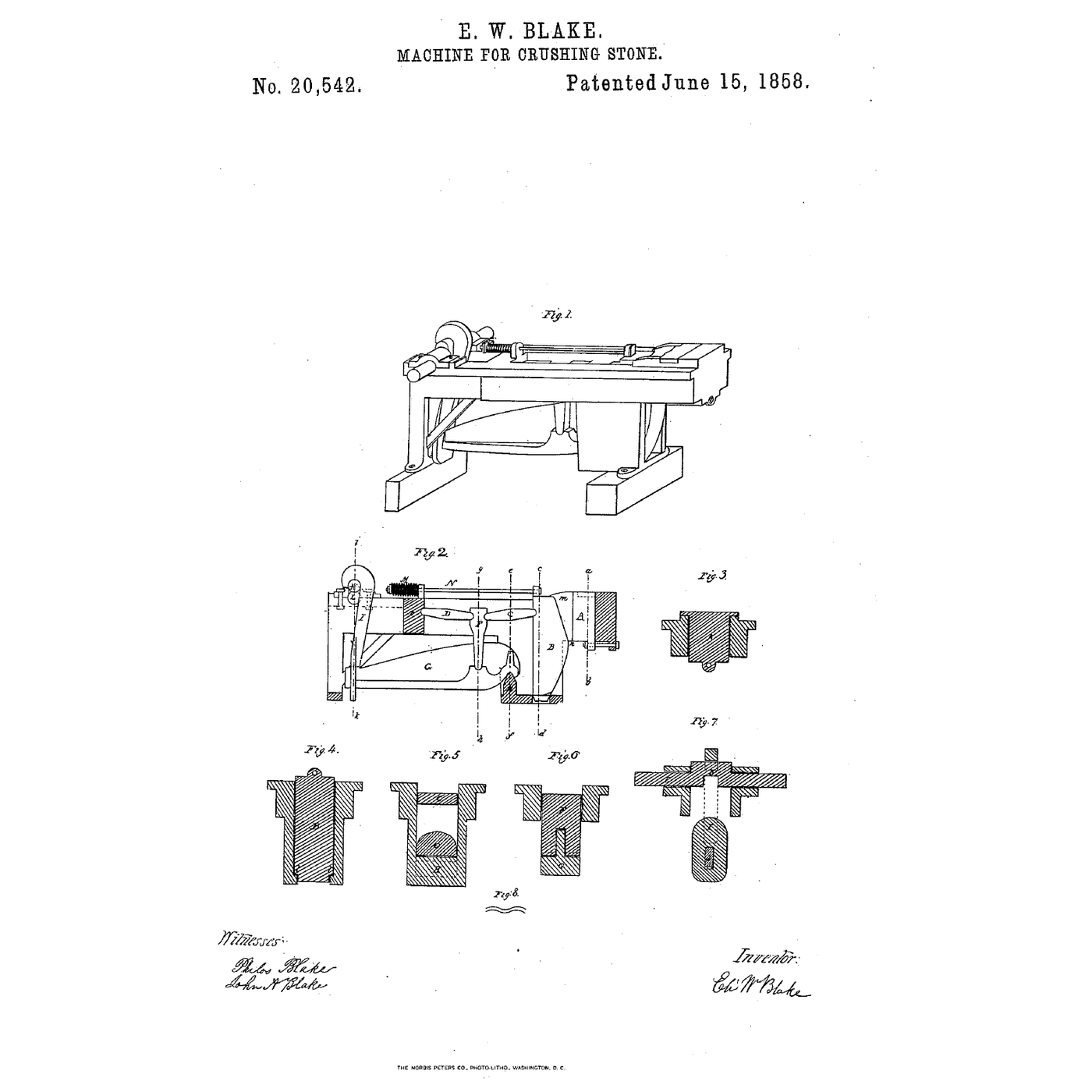
**US 20,542, 'Machine for Crushing Stone', Eli W. Blake of New Haven, Connecticut, granted 15 June 1858.** The patent was reissued in January 1859, which the specification itself records on its first page. Blake was a nephew of Eli Whitney and had spent his working life in manufacturing. The story usually told is that he was serving on a committee to macadamise a road in New Haven, saw what hand-breaking cost, and built a machine. What the patent actually claims is the arrangement: a fixed jaw and a swinging jaw converging downward, with the swinging jaw driven through toggles from an eccentric — the double-toggle layout that carried his name for a century. It spread because the output was gradeable. Hand-broken stone was whatever the man's eye produced; machine-broken stone came out to a setting, and a road specification could finally name a size and be met. **Honest limits.** A jaw crusher gets you roughly six to one and no more, so it is a first stage and never the only one. It is a compression machine, so it makes slabby product from layered rock — good for a base course, poor for concrete aggregate, which wants cubes. It makes fines you did not order. It is noisy in a way that damages hearing quickly. And it is only as good as its feed: a jaw crusher fed a trickle rattles, wears unevenly and produces an inconsistent size, because a jaw is designed to be **choke fed** — full, with stone crushing against stone as well as against the plates.

Izinto

6

Amathuluzi Adingekayo

18

CC0 Isizinda Somphakathi

Le blueprint ikhishwe ngaphansi kwe-CC0. Ukhululekile ukukopisha, ukuguqula, ukusabalalisa, nokusebenzisa ngaphandle kwemvume.

Sekela uMenzi ngokuthenga imikhiqizo nge-Blueprint yabo IKhomishane Yomenzi kumiswe ngabathengisi, noma dala inguqulo entsha yale Blueprint bese uyifaka njengoxhumaniso ku-Blueprint yakho ukuze wabelane ngemali engenayo.

Ingxoxo

(0)

Ngena ukuze ujoyine ingxoxo

Kulayishwa amazwana...