

Cipher Disk
Imiyalelo
Build the two discs
Build the two discs
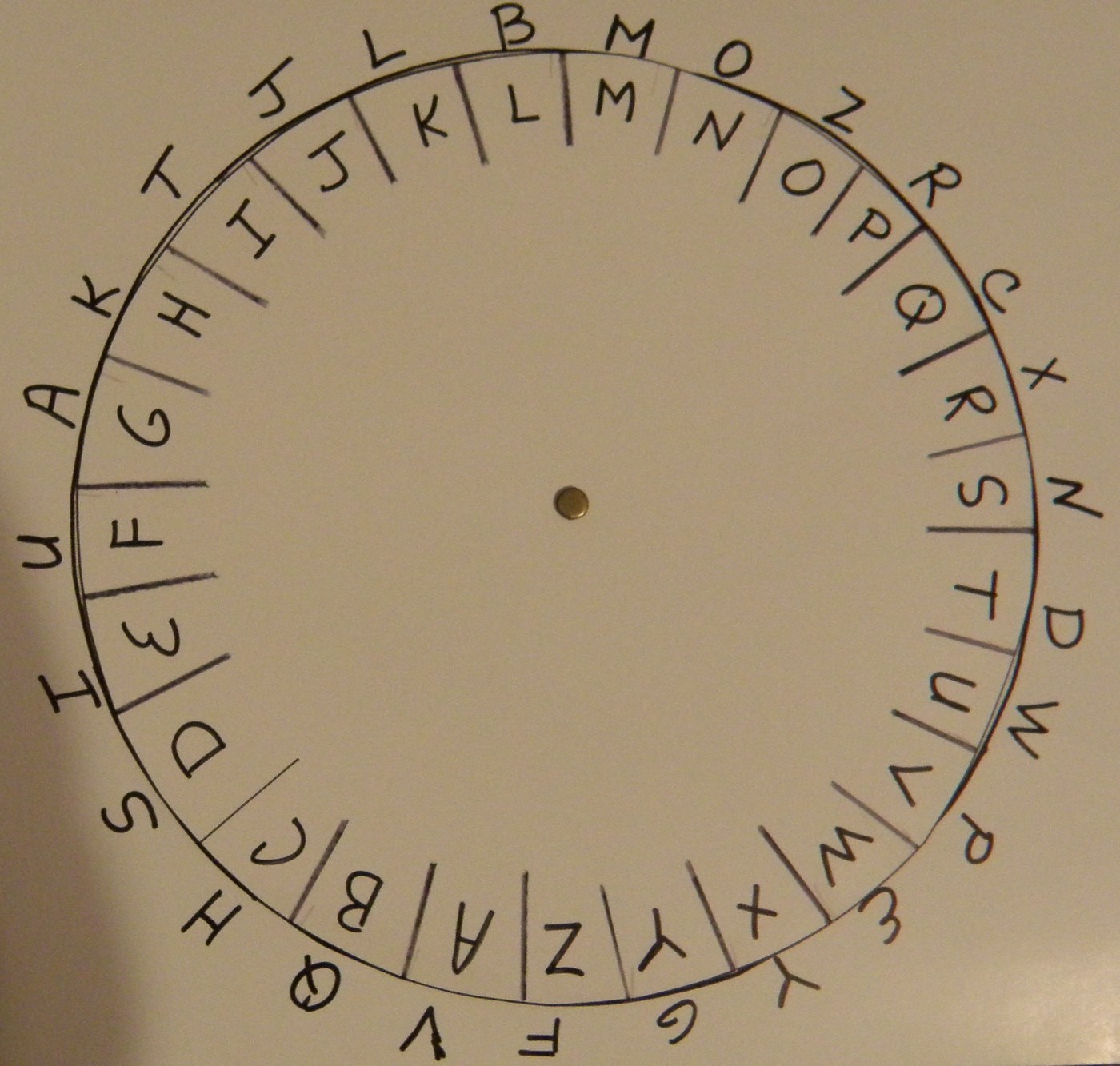
A fixed outer ring and a rotating inner one.
- Cut two card discs, one noticeably smaller.
- Write the alphabet evenly around each — use a protractor, not your eye.
- Pin them at the centre with a paper fastener so the inner turns freely.
Izinto zokwakha zalesi sinyathelo:
 Ikhadi elimnyama1 iphakethe
 Izikhwibisho zephepha zethusi1 iphakethe
 Iphrothrakta1 ucezu
Use it as a fixed substitution first
Use it as a fixed substitution first
Establish the baseline that Alberti improved on.
- Set the inner A against outer D and leave it there.
- Encrypt a long message without moving the disc.
- Run the frequency attack from the Caesar blueprint on your own ciphertext.
Izinto zokwakha zalesi sinyathelo:
 Iphepha Lamagridi1 pad
Turn the disc mid-message
Turn the disc mid-message
Now make it polyalphabetic, and signal the change.
- Encrypt several words at one setting.
- Insert an index letter into the ciphertext to mark a change.
- Turn the disc so the index letter now aligns with a new position, and continue.
Measure what changed
Measure what changed
Compare frequency profiles from step 2 and step 3.
- Tally ciphertext letter frequencies for the fixed-disc message.
- Tally them for the turning-disc message of similar length.
- Draw both charts side by side.
History and context
History and context
Leon Battista Alberti (1404-1472) was an architect, humanist and polymath who wrote on painting, architecture and the family, and produced his cipher treatise around 1467. He is often called the father of Western cryptography, and specifically for the polyalphabetic idea rather than the disc itself.
What made it a genuine advance: before Alberti, European ciphers were fixed substitutions with elaborations — nulls, symbols for common words — and al-Kindi's frequency analysis defeated all of them. Changing the alphabet mid-message attacks the analyst's core assumption rather than adding complexity on top of it. That is the difference between making a cipher fiddlier and making it stronger.
The disc had a long service life. Confederate forces used a brass cipher disc in the American Civil War, and the US Army's M-94 cylinder device of 1922 — twenty-five rotating alphabet discs on a shaft — is a direct descendant. Rotating alphabets lead on to the rotor machines, and Enigma is a cipher disc that turns itself, automatically, with three or more discs geared together.
The weakness Alberti left behind: if the disc turns on a short, repeating schedule, the cipher becomes periodic — and a period can be detected and attacked, which is precisely what breaks Vigenère. Alberti's irregular, index-signalled turning was actually stronger than the regular keyword systems that followed him, and cryptography arguably went backwards for a while.
Izinto
4- 1 iphaketheIsibambeli
- 1 iphaketheIsibambeli
- 1 ucezuIsibambeli
- 1 padIsibambeli
Ama-blueprint ahlobene
Lama-blueprint abelana ngolwazi — amasu, izinto noma izimiso
CC0 Isizinda Somphakathi
Le blueprint ikhishwe ngaphansi kwe-CC0. Ukhululekile ukukopisha, ukuguqula, ukusabalalisa, nokusebenzisa ngaphandle kwemvume.
Sekela uMenzi ngokuthenga imikhiqizo nge-Blueprint yabo IKhomishane Yomenzi kumiswe ngabathengisi, noma dala inguqulo entsha yale Blueprint bese uyifaka njengoxhumaniso ku-Blueprint yakho ukuze wabelane ngemali engenayo.