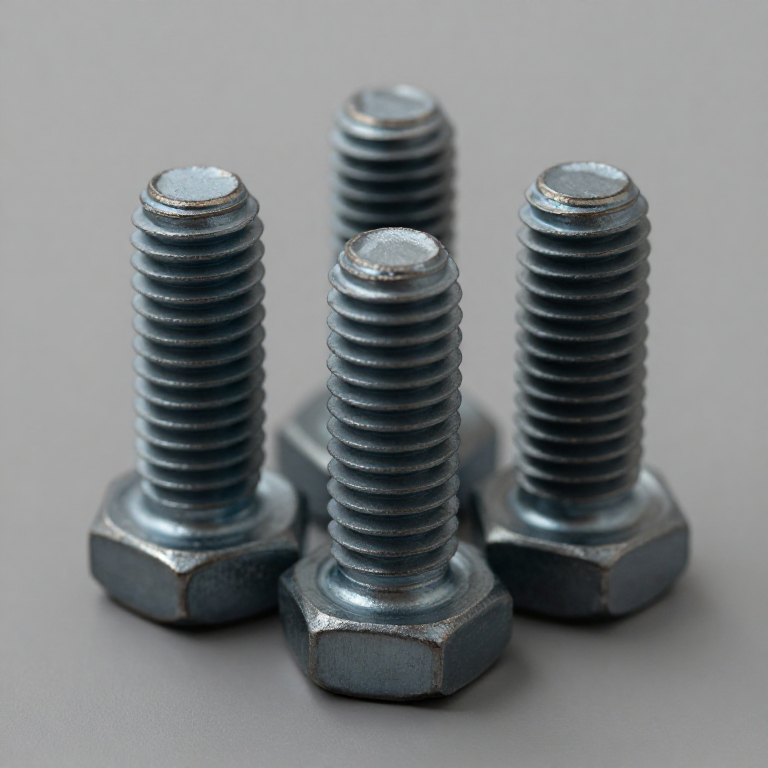


Sherardizing
Hot-dip galvanizing works by drowning steel in molten zinc at about 450 °C. It is fast, cheap and it has two failure modes: the zinc pools and freezes into thick drips on anything with a complex shape, and it fills the threads of a bolt so the nut no longer turns. A galvanized nut and bolt often have to be re-tapped before they will meet.
Sherardizing solves both by never melting the zinc at all. Pack the steel parts in zinc dust in a closed steel drum, heat to a dull red — well below zinc's 419 °C melting point at the low end, and still short of pooling at the high end — and rotate slowly. Zinc arrives as a vapour and diffuses into the steel surface, growing a zinc-iron alloy layer that is part of the steel rather than a skin sitting on it. Threads stay sharp. Recesses coat as evenly as flats. Nothing drips.
The patent is US 701,298, "Process of depositing metals on metallic surfaces and the product thereof", filed 24 July 1901 and granted 3 June 1902 to Sherard Cowper-Coles. He found it by accident, annealing steel packed in zinc dust to keep air away from it, and noticed the parts came out coated.
The specification is precise about the result: "a smooth tough adherent coating" of "delicate silver-gray", made of "homogeneous particles free from crystalline structure" — no spangle, because nothing ever froze from a melt.
Imiyalelo
Clean the parts to bare steel
Clean the parts to bare steel
Wire-brush the steel parts until bright. Remove all rust, scale and oil.
Zinc diffuses into steel, not into rust. Any oxide left on the surface is a place the coating will not form.
Izinto zokwakha zalesi sinyathelo:
 Ibha Eyisicaba Yensimbi Ethambile1 ucezu
Pack the parts in zinc dust
Pack the parts in zinc dust
Put the parts in the iron crucible and bury them completely in zinc dust. Parts must not touch each other or the wall.
Fit the lid. The drum needs to be closed — the zinc travels as vapour, and an open vessel simply loses it.
Izinto zokwakha zalesi sinyathelo:
 Impushana ye-zinc300 g
Amathuluzi adingekayo:
 Ibhodwe lokuncibilikisa lensimbi
Heat to dull red and hold
Heat to dull red and hold
Heat the closed crucible to dull red heat — the patent's own description, roughly 350–400 °C for a thin coating, up to about 450 °C for a thicker one.
Hold 30 to 60 minutes. Longer and hotter means a thicker zinc-iron layer.
Zinc melts at 419 °C. Stay at the low end and the zinc never becomes liquid at all — the coating is built entirely from vapour and diffusion, which is exactly why nothing drips.
Amathuluzi adingekayo:
 Isithando Samalahle
 Udlawu Lwesitsha Sokuncibilikisa
Cool closed, then recover the parts
Cool closed, then recover the parts
Let the crucible cool with the lid on before opening. Tip out the dust and brush the parts off.
Unused zinc dust is reusable — sieve out the coarse grey clinker and keep the rest.
Compare it against a galvanized part
Compare it against a galvanized part
Put your part next to a galvanized steel sheet and look at both.
Galvanized: shiny, with a visible spangle — crystal grains frozen out of liquid zinc, sometimes centimetres across.
Sherardized: matt, uniform, the patent's "delicate silver-gray". No spangle, because no melt.
Run a fingernail over a threaded part if you coated one: the thread should still be sharp. That single difference is why the process survived for fasteners.
Izinto zokwakha zalesi sinyathelo:
 Ishidi lensimbi elinesikwasi sikazinki lika-0,9 mm1 ucezu
History & Context
History & Context
The patent. US 701,298, "Process of depositing metals on metallic surfaces and the product thereof", filed 24 July 1901, granted 3 June 1902, to Sherard Cowper-Coles. ⚠ Most accounts say sherardizing was "patented in 1900". The US document says 1901/1902 and claims no earlier priority. Where the record and the document disagree, the document wins.
Found by accident. Cowper-Coles was annealing steel packed in zinc dust — the dust was there to exclude air, not to coat anything. The parts came out with a zinc surface. He recognised what had happened and patented the effect rather than the intention.
Why it did not replace galvanizing. It is slower, batch-only, and limited by what fits in a drum. Hot-dip still wins on big structural steel, which is why bridges are dipped. Sherardizing owns the awkward end: threaded fasteners, springs, small castings, anything where a few hundredths of a millimetre of dimensional change matters or where a drip would be a defect.
What the coating actually is. Not zinc on steel — a series of zinc-iron alloy layers grown into the surface, richer in iron nearest the steel. That is why it does not chip off the way a thick dipped layer can: there is no boundary for it to part along.
Still in use. It survives under EN 13811 and is specified for fasteners in railway and civil work. A rare case of a century-old expired-patent process that was never actually improved upon for its niche.
Izinto
3- Isibambeli
- 300 gIsibambeli
- Isibambeli
Amathuluzi Adingekayo
3- Isibambeli
- Isibambeli
- Isibambeli
Izinto Zokwakha Ze-Blueprint Exhunyiwe


Le blueprint yenza
Ama-blueprint ahlobene
Lama-blueprint abelana ngolwazi — amasu, izinto noma izimiso

CC0 Isizinda Somphakathi
Le blueprint ikhishwe ngaphansi kwe-CC0. Ukhululekile ukukopisha, ukuguqula, ukusabalalisa, nokusebenzisa ngaphandle kwemvume.
Sekela uMenzi ngokuthenga imikhiqizo nge-Blueprint yabo IKhomishane Yomenzi kumiswe ngabathengisi, noma dala inguqulo entsha yale Blueprint bese uyifaka njengoxhumaniso ku-Blueprint yakho ukuze wabelane ngemali engenayo.