UBUCIKO
UBUHLE NEMPILO
UBUCIKO BEZANDLA
AMASIKO NOMLANDO
EZOKUZIJABULISA
IMVELO
UKUDLA NEZIPHUZO
REVERSE ENGINEERING
IZAYENSI
EZEMIDLALO
UBUCHWEPHESHE
IZINTO EZIGQOKWAYO


Ebonite (Hard Rubber)
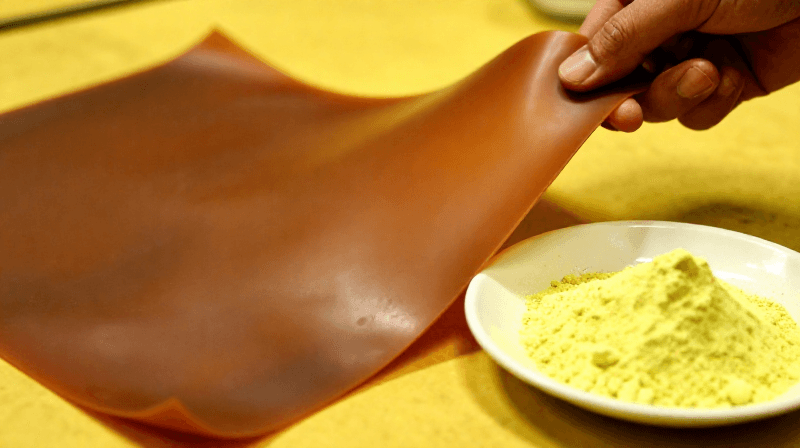
Vulcanised rubber is rubber with a few sulphur bridges between its chains. Keep adding sulphur and the bridges multiply until the chains cannot move at all: the soft, stretchy material turns into a hard black solid you can turn on a lathe, polish like ebony and use as an electrical insulator.
**US 8,075**, "Improvement in the Manufacture of India Rubber", Nelson Goodyear (brother of Charles), granted 6. May 1851, claims "the combining of india-rubber and sulphur… for making a hard and inflexible substance hitherto unknown": about equal parts by weight, heated to 260–275 °F for three to six hours. It was one of the first rigid materials made by chemically changing a natural polymer, over half a century before Bakelite.
**You turn a part from commercial ebonite rod and measure what the sulphur did** — its density, and its charge when rubbed. Curing ebonite needs a heated press and releases hydrogen sulphide, so the blueprint starts from finished rod; the notebook does the chemistry.
Ophakathi
3 hours
Imiyalelo
1
1
Cut the blank
Cut the blank
Clamp 20 mm ebonite rod in the vise between soft jaws. Saw off 60 mm. Ebonite chips like hard wood; saw slowly to avoid cracking the end.
Izinto zokwakha zalesi sinyathelo:
 Induku ye-ebonite1 ucezu
Amathuluzi adingekayo:
 Isaha Sensimbi
 Isibambo Sebhentshi
 Irula
Irula Izibuko Zokuphepha Ezicwathile
2
2
Chuck and face
Chuck and face
Grip 20 mm of the blank in the lathe's 3-jaw chuck. Face the end square with a sharp HSS tool at about 800 rpm, light cuts.
Amathuluzi adingekayo:
 Umshini Wokuphendula Insimbi
 Isethi yamathuluzi e-lathe (HSS)Izibuko Zokuphepha Ezicwathile
 Imaski Yothuli
3
3
Turn to 16 mm
Turn to 16 mm
Turn 40 mm of length down to 16.0 mm. Check with the caliper every pass. The chips smell of sulphur - that is the bonded sulphur you measure later.
Amathuluzi adingekayo:
Umshini Wokuphendula InsimbiIsethi yamathuluzi e-lathe (HSS) I-Caliper Yedijithali Yamayintshi Ayi-6
4
4
Drill the bore
Drill the bore
Spot the centre with a centre drill, then drill 3 mm through 35 mm from the tailstock. Clear chips every 5 mm - ebonite heats and gums if packed.
Amathuluzi adingekayo:
 Isethi yamabhitha okuqala imbobo
 Iqoqo Lamakhanda EbholaUmshini Wokuphendula Insimbi
5
5
Taper the grip
Taper the grip
Set the compound to a shallow angle and taper 25 mm from 16 mm down to 10 mm. This is a fountain-pen grip section, the job ebonite still does today.
Amathuluzi adingekayo:
Umshini Wokuphendula InsimbiIsethi yamathuluzi e-lathe (HSS)I-Caliper Yedijithali Yamayintshi Ayi-66
6
Sand and polish
Sand and polish
At low speed, sand 400 then 800 grit, then run the Micro-Mesh grits in order. Finish with polishing compound on a cloth. Ebonite takes a deep gloss without lacquer.
Amathuluzi adingekayo:
 Isethi Yokugudla Ye-micromesh (Amazinga Angu-9)Umshini Wokuphendula InsimbiImaski Yothuli
 Iphepha Lokugaya
 Isihlanganisi sokucwebezelisa
7
7
Part off
Part off
Part off at 45 mm with the parting tool. Chamfer the cut end by hand with 800 grit.
Amathuluzi adingekayo:
Isethi yamathuluzi e-lathe (HSS)Umshini Wokuphendula Insimbi8
8
Measure the density
Measure the density
Weigh the part. Drop it into 50 ml of water in the graduated cylinder and read the rise. Do the same with a bundle of rubber bands. Enter both in the notebook.
Izinto zokwakha zalesi sinyathelo:
 Amabhande erabha1 iphakethe
Amathuluzi adingekayo:
 Isikali Sedijithali Esinembile
 Isilinda esinezilinganiso
9
9
Rub it and pick up paper
Rub it and pick up paper
Tear tissue into 5 mm scraps. Rub the ebonite 10 strokes on wool felt and hold it 2 cm above the scraps. Repeat with an acrylic offcut. Count scraps lifted by each.
Amathuluzi adingekayo:
 Ifelefele lowoya
 Iphepha elithambile elingenayo i-acid
 Ipuleti Le-akhriliki
10
10
The sulphur arithmetic
The sulphur arithmetic
Ilayisha incwadi ye-Jupyter…
11
11
History & Context
History & Context
**What the patent specifies:** rubber and sulphur in about equal parts (or 2 : 1 with magnesia or lime), 260–275 °F, three to six hours. **Modern build (derived):** commercial ebonite rod, typically 25–32 % sulphur - the notebook shows why more than about 32 % cannot bond.
Ebonite was named for ebony, which it replaced in combs, pipe stems and instrument parts. It became a standard insulator of the electrical age and is still preferred for fountain-pen feeds because ink wets it. Its limits: it softens with heat, fades to brown and smells of sulphur in sunlight as the surface oxidises, and is brittle under impact.
Izinto
2- 1 ucezuIsibambeli
- 1 iphaketheIsibambeli
Amathuluzi Adingekayo
18- Isibambeli
- Isibambeli
- Isibambeli
- Isibambeli
- Isibambeli
- Isibambeli
- Isibambeli
- Isibambeli
- Isibambeli
- Isibambeli
- Isibambeli
- Isibambeli
- Isibambeli
- Isibambeli
- Isibambeli
- Isibambeli
- Isibambeli
Ama-blueprint ahlobene
Lama-blueprint abelana ngolwazi — amasu, izinto noma izimiso

CC0 Isizinda Somphakathi
Le blueprint ikhishwe ngaphansi kwe-CC0. Ukhululekile ukukopisha, ukuguqula, ukusabalalisa, nokusebenzisa ngaphandle kwemvume.
Sekela uMenzi ngokuthenga imikhiqizo nge-Blueprint yabo IKhomishane Yomenzi kumiswe ngabathengisi, noma dala inguqulo entsha yale Blueprint bese uyifaka njengoxhumaniso ku-Blueprint yakho ukuze wabelane ngemali engenayo.