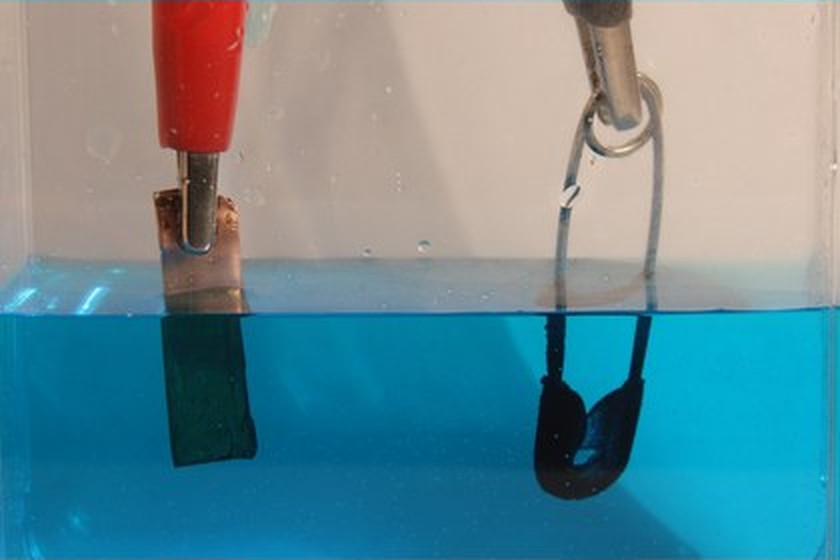


Electroplating
Before 1840, a silver-looking object was either solid silver or Sheffield plate — a sandwich of silver foil fused onto copper and then worked as one sheet. Sheffield plate was skilled, expensive, and it wore through at the edges, showing copper underneath.
Electroplating replaced it. Pass a current through a metal salt solution, and metal leaves the anode, crosses the bath as ions, and deposits atom by atom onto whatever you have wired as the cathode. The coating follows every curve of the object, it is the same thickness in a handle's hollow as on its flat, and it costs a fraction of solid silver.
The patent that commercialised it is British patent 8447 of 1840, "Improvements in Coating, Covering, or Plating certain Metals", held by George Richards Elkington and his cousin Henry. But the process in it was not theirs. John Wright, a Birmingham surgeon, worked out that potassium cyanide would hold silver in solution well enough to plate evenly — the problem everyone else had failed on. The Elkingtons paid Wright £300 for the rights and a further £500 when the patent was granted. Wright died in 1844 and the firm carried his process to the world; his name is missing from most retellings.
This blueprint plates copper onto a brass object from copper sulfate — the same physics, with a bath a school can actually run. Wright's cyanide silver bath is described in the history step and is not something to attempt: potassium cyanide is lethal.
Imiyalelo
Set up the bath
Set up the bath
Dissolve 25 g copper sulfate pentahydrate in 250 ml distilled water in a borosilicate beaker. Stir until clear — no crystals on the bottom.
Distilled, not tap: tap water carries chloride and carbonate that cloud the deposit.
Izinto zokwakha zalesi sinyathelo:
 I-copper sulfate pentahydrate (CuSO4·5H2O)25 g
 Amanzi Acwengisisiwe250 ml
Amathuluzi adingekayo:
 Ibhikha Lengilazi
Clean the object you are plating
Clean the object you are plating
Scrub the brass sheet with abrasive paper, then wash it and do not touch the face again — handle it by the edges.
A fingerprint is grease, and plating does not stick to grease. This is the step that decides whether the coating peels.
Izinto zokwakha zalesi sinyathelo:
 Ishidi Lethusi Eliphuzi 260 Ubukhulu 241 ucezu
Wire the electrodes
Wire the electrodes
Clip the copper sheet to the positive (+) terminal — this is the anode, and it dissolves. Clip the brass object to the negative (−) — the cathode, where copper deposits.
Hang both in the bath without touching. If they touch you short the cell and plate nothing.
Izinto zokwakha zalesi sinyathelo:
 Ishidi Lethusi1 ucezu
Amathuluzi adingekayo:
 Izintambo Zokuhlola Ezinezibambo Zengwenya
 Umthombo kagesi we-DC wetafula
Plate at low current and measure it
Plate at low current and measure it
Set the supply to 1.5 V. Read the current with the multimeter in series — aim for roughly 20 mA per cm² of cathode face.
Run 20 minutes. Write down voltage, current and time; you need all three for step 6.
Push the voltage higher and the deposit turns dark, powdery and loose — that is copper arriving faster than it can arrange itself into the crystal. Slow is bright.
Amathuluzi adingekayo:
 I-Multimeter Yedijithali Yezinga Lelabhorethri
Rinse and inspect
Rinse and inspect
Lift the object out, rinse under running water, blot dry.
You should have a matt salmon-pink copper layer covering every face that hung in the bath — including recesses, which is the whole point. Look at the edge that sat at the surface: it is usually thicker, because current crowds at edges.
Check the deposit against Faraday's law
Check the deposit against Faraday's law
Faraday's first law says deposited mass depends only on charge passed. Compute the prediction:
m = (I × t × M) / (n × F)
I = current in amps · t = time in seconds · M = 63.55 g/mol for copper · n = 2 (Cu²⁺ carries two charges) · F = 96485 C/mol
Worked example: 0.10 A for 1200 s → m = (0.10 × 1200 × 63.55) / (2 × 96485) = 0.0395 g.
Weigh the object before and after on a scale reading to 0.01 g and compare. Coming in low is normal — some current goes to hydrogen instead of copper. That ratio is the current efficiency, and it is what plating shops are paid to keep high.
History & Context
History & Context
What the patent actually covers. British patent 8447 of 1840, "Improvements in Coating, Covering, or Plating certain Metals", stands in the names of George Richards Elkington and Henry Elkington. Its commercial value was the cyanide bath: silver dissolved in potassium cyanide plates smoothly and adheres, where simpler silver salts gave a loose grey powder. That solution was John Wright's work, a Birmingham surgeon experimenting at home. The Elkingtons bought it — £300 for the rights, £500 more on grant. Wright died in 1844, four years in, and the process he solved carried the Elkington name across the world. Credit him.
What it replaced. Sheffield plate: a silver sheet fused to copper, then rolled and worked as one metal. Skilled, costly, and it betrayed itself as the silver wore through at handles and rims to show copper. Electroplating deposits onto the finished object, so the coating reaches everywhere the bath does.
Why cyanide, and why not here. Cyanide holds silver as a complex ion, keeping the free-silver concentration very low so metal arrives slowly and packs into a dense bright layer. It works chemically and it is lethal — potassium cyanide releases hydrogen cyanide gas on contact with acid. Modern shops that still run cyanide baths do it under engineered controls. The copper sulfate bath in this blueprint teaches the same physics with school-safe chemistry.
What we are not certain of. Wright's exact formulation is known only through the patent text and later accounts; the notebooks did not survive. Several people were plating with electricity in the 1830s — Brugnatelli gilded silver in 1805 and was ignored, and de la Rue and Spencer both plated copper — so 8447 is best read as the patent that made it an industry, not the moment plating was invented.
Izinto
4- Isibambeli
- 250 mlIsibambeli
- Isibambeli
- 1 ucezuIsibambeli
Amathuluzi Adingekayo
4- Isibambeli
- Isibambeli
Le blueprint yenza
CC0 Isizinda Somphakathi
Le blueprint ikhishwe ngaphansi kwe-CC0. Ukhululekile ukukopisha, ukuguqula, ukusabalalisa, nokusebenzisa ngaphandle kwemvume.
Sekela uMenzi ngokuthenga imikhiqizo nge-Blueprint yabo IKhomishane Yomenzi kumiswe ngabathengisi, noma dala inguqulo entsha yale Blueprint bese uyifaka njengoxhumaniso ku-Blueprint yakho ukuze wabelane ngemali engenayo.