

French Polishing
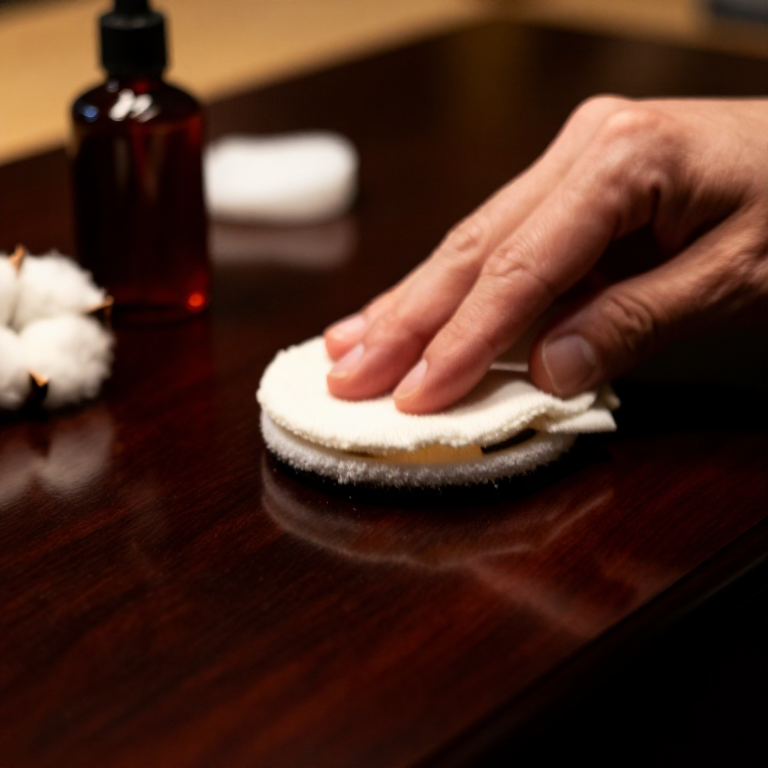
French polish is not a coating you lay on wood. It is dozens of films so thin they are almost molecular, deposited one over another by a cloth pad until the surface has depth you can look into rather than at. No sprayed lacquer quite matches it, and the reason is that nothing else is applied that thinly.
The material is shellac — a resin secreted by the lac insect, dissolved in alcohol. The tool is a rubber: cotton wool wadding wrapped in a soft cotton or linen rag. The rubber is never lifted straight off a surface and never stopped in one place, because either leaves a mark that the next layer will not hide.
Three stages, in order: fadding to fill and seal, bodying to build the film over many sessions, and spiriting off to remove the lubricating oil and bring up the shine. Most failures come from rushing bodying.
Imiyalelo
Work in a ventilated room
Work in a ventilated room
Open a window and keep the alcohol away from flame. Denatured alcohol is flammable and its vapour is heavier than air.
Sand the surface to 400 grit
Sand the surface to 400 grit
Sand progressively to 400 grit and remove all dust. French polish is transparent and extremely thin — every scratch beneath it is magnified, not hidden.
Izinto zokwakha zalesi sinyathelo:
 Ibhulokhi Lokhuni Oluqinile1 ucezu
Amathuluzi adingekayo:
 Iphepha Lokugaya
Dissolve the shellac
Dissolve the shellac
Dissolve shellac flakes in denatured alcohol at roughly a 2 pound cut — about 250 g of flakes per litre. Leave it overnight; shellac dissolves slowly and stirring will not hurry it much.
Izinto zokwakha zalesi sinyathelo:
 Amacwecwe e-shellac250 g
Amathuluzi adingekayo:
 Utshwala olwenziwe lungaphuzwa
Make the rubber
Make the rubber
Ball up unmedicated cotton wool and wrap it in a square of soft cotton or linen. Twist the surplus at the back into a handle. The face must be smooth and creaseless — every crease prints a line into the finish.
Izinto zokwakha zalesi sinyathelo:
 Ukotini omuncayo50 g
 Indwangu Yekotini1 ucezu
Charge the rubber from the inside
Charge the rubber from the inside
Open the cloth, pour shellac into the wadding, and re-wrap. Never pour onto the outer face — the polish must sweat gradually through the cloth, not sit on it.
Fad the surface to seal it
Fad the surface to seal it
Work the rubber in long straight strokes with the grain to lay down the first sealing coats. This stage fills the grain and gives the later coats something to build on.
Never stop the rubber on the surface
Never stop the rubber on the surface
Land the rubber in a sweeping motion and lift it off still moving, like an aircraft touching down and taking off. A rubber set down or lifted straight up sticks and tears the film.
Add the smallest possible touch of oil
Add the smallest possible touch of oil
Put one drop of oil on the rubber face when it starts to drag. Oil is a lubricant, not an ingredient — every drop has to be removed later, so use the minimum that stops it sticking.
Izinto zokwakha zalesi sinyathelo:
 Uwoyela We-linseed Obilisiwe20 ml
Body up in figure-eight passes
Body up in figure-eight passes
Work in circles and figures of eight across the whole surface, then finish each session with straight strokes along the grain. The circular motion is what levels the film.
Rest between bodying sessions
Rest between bodying sessions
Stop and let the surface harden for several hours between sessions. Ten to fifteen bodying sessions give excellent depth on most woods; dark or highly figured timbers reward even more.
Spirit off
Spirit off
Make a fresh rubber charged with almost pure alcohol and the barest trace of shellac. Work lightly over the whole surface. This lifts the oil out and brings up the mirror clarity — it is the stage that makes French polish look like French polish.
Leave it alone for a week
Leave it alone for a week
Do not wax, buff or use the piece for a week. The alcohol continues to leave the film and the surface hardens considerably during that time.
History & Context
History & Context
What shellac is. A resin secreted by the lac insect on trees, principally in India and Thailand, harvested, refined and sold as flakes. It is an animal product, it dissolves in alcohol and in nothing much else, and it has been used as a finish, a mould-release, a food glaze and — famously — as the material of gramophone records before vinyl.
Why the rubber, and not a brush. A brush lays down a thick wet film that must dry as a single layer, trapping brush marks and dust. The rubber sweats a minute quantity through cloth and simultaneously burnishes it, so each pass leaves a film thinner than a brush could ever apply. Depth comes from stacking dozens of those, not from thickness.
The three stages have jobs. Fadding fills and seals the open grain. Bodying builds the film, and this is where nearly all the time goes — the count of sessions is the honest measure of the finish. Spiriting off removes the oil that made bodying possible; skip it and the surface stays slightly cloudy and fingerprints readily.
Its great advantage, and its great weakness. French polish is fully repairable: because each layer redissolves in alcohol, a damaged patch can be blended into the surrounding finish invisibly, which is why antique restorers still use it. The same property makes it vulnerable — alcohol, heat and water all mark it, which is why a wet glass leaves a white ring on an antique table and not on a modern one.
Nineteenth-century, mostly. The technique came to prominence in the early nineteenth century and dominated fine furniture finishing until sprayed lacquers displaced it commercially in the twentieth. It survived in restoration, in musical instruments — many fine guitars are still French polished — and anywhere the repairability is worth the fragility.
Izinto
5- 1 ucezuIsibambeli
- 250 gIsibambeli
- 50 gIsibambeli
- 1 ucezuIsibambeli
- Isibambeli
Amathuluzi Adingekayo
2- Isibambeli
- Isibambeli
Le blueprint yenza
CC0 Isizinda Somphakathi
Le blueprint ikhishwe ngaphansi kwe-CC0. Ukhululekile ukukopisha, ukuguqula, ukusabalalisa, nokusebenzisa ngaphandle kwemvume.
Sekela uMenzi ngokuthenga imikhiqizo nge-Blueprint yabo IKhomishane Yomenzi kumiswe ngabathengisi, noma dala inguqulo entsha yale Blueprint bese uyifaka njengoxhumaniso ku-Blueprint yakho ukuze wabelane ngemali engenayo.