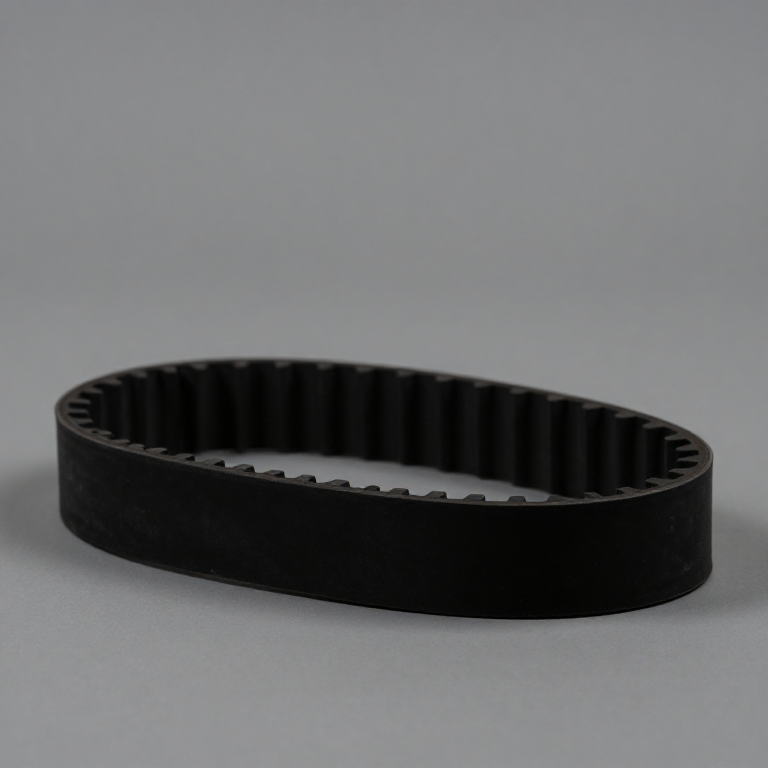


V-Belt Drive
A flat leather belt running on a flat pulley grips by friction alone: whatever force you press it onto the pulley with, times the coefficient of friction. To carry more power you tension it harder, and hard tension crushes bearings, bends shafts and stretches the belt.
The V-belt gets its grip from geometry instead. Cut the belt to a wedge section and the pulley to a matching groove, and belt tension pulls the wedge into the groove. The two flank faces then squeeze the belt from both sides with a force far greater than the tension that caused it — a wedge amplifying force exactly as a wedge does anywhere else.
The multiplication is worth writing down: for a groove half-angle α, effective friction is scaled by 1/sin α. At the usual 18°, that is 1/sin 18° ≈ 3.2. The same belt tension delivers roughly three times the grip. Or, put the way industry cared about, the same power needs a third of the tension — so smaller bearings, lighter shafts, longer belt life.
⚠ On the attribution. "John Gates invented the V-belt in 1917" is repeated everywhere, including by Gates Corporation. We could not locate a John Gates belt patent. What is findable is a patent to his brother Charles Gates for a belt-MAKING MACHINE, filed 1917. The company's role in commercialising the rubber-and-fabric V-belt is not in doubt; the claim that John Gates holds the patent for the belt itself is not something we can support with a document, so this blueprint does not assert it.
Imiyalelo
Measure a flat belt first
Measure a flat belt first
Run a flat belt over a plain round pulley. Hang a known weight from a cord wrapped round the driven pulley and increase it until the belt slips.
Record the belt tension and the slipping load. This is your baseline, and without it the next step proves nothing.
Amathuluzi adingekayo:
 Isikali Sedijithali Sasekhishini
Swap to a V-groove at the same tension
Swap to a V-groove at the same tension
Replace both with a V-belt and matching V-pulleys. Set the same belt tension as before — this only works as a comparison if that is held constant.
Repeat the slip test.
Expect the slipping load to be roughly 3× higher. Same belt tension, same friction material, triple the grip. The only thing you changed was the shape.
Izinto zokwakha zalesi sinyathelo:
 Ibhande le-V (isigaba A)1 ucezu
 Iphuli lebhande le-V (isigaba A)2 izicucu
Check the wedge arithmetic
Check the wedge arithmetic
Measure the groove angle with a protractor. Standard belts use a total included angle of 34–40°, so a half-angle α of 17–20°.
Compute 1/sin α: at 18° that is 3.24.
Compare it against the ratio you measured in steps 1 and 2. They should agree to within the accuracy of your slip test — which is the point. The improvement is not a material property or a trade secret; it is trigonometry you can check with a protractor.
Confirm the belt rides on its flanks, not its base
Confirm the belt rides on its flanks, not its base
Chalk the bottom of the belt and the bottom of the groove, then run the drive briefly.
Expect the chalk on the groove base to be undisturbed. A correctly matched V-belt must not touch the bottom of the groove — it rides on the two flanks, and only the flanks.
A belt bottoming out has lost the wedge entirely and is back to flat-belt friction on a much smaller contact area. That is the single commonest V-belt fault, and it is caused by a worn groove, not a worn belt.
Find the limit of the idea
Find the limit of the idea
Mark the driver and driven pulleys and count revolutions of each under load.
Expect the ratio to be slightly off the pulley-diameter ratio, and to drift with load. A V-belt still slips — typically 1–2%.
So it cannot be used where rotational position matters. That limitation is exactly what the toothed belt was invented to remove, and why both exist side by side rather than one replacing the other.
History & Context
History & Context
What we can and cannot verify. The Gates Rubber Company of Denver commercialised the rubber-and-fabric V-belt from 1917 and the standard account credits John Gates with inventing it. We searched for that patent and did not find it; what surfaces instead is a patent to Charles Gates for a belt-making machine, filed 1917. That may simply mean the belt patent is filed under a title we have not matched — but until it is produced, "John Gates patented the V-belt in 1917" is a claim without a citation, and this blueprint declines to repeat it as fact. The company's commercial role is not in question.
What problem it actually solved. Early cars drove their fan and generator from the crankshaft with flat belts that threw themselves off at speed and needed constant re-tensioning. The V-belt sits in its groove and stays there. Every under-bonnet accessory drive for the next seventy years is this belt.
Why line shafting died. Nineteenth-century factories drove every machine from one engine through overhead shafts and flat belts — a maintenance burden and a serious danger. Cheap electric motors ended that, but the V-belt is what made a small motor practical at each machine, because it transmits usable power at low tension in a short span.
Still evolving, quietly. The modern accessory drive uses a serpentine belt — flat with V-ribs, so it bends both ways and can drive components on either side of its path. The ribs are the same wedge trick, miniaturised and multiplied. And the continuously variable transmission is a V-belt on split pulleys whose effective diameter can change: the ratio is varied by moving the belt up and down the wedge.
Izinto
2- 1 ucezuIsibambeli
- 2 izicucuIsibambeli
Amathuluzi Adingekayo
1- Isibambeli
Izinto Zokwakha Ze-Blueprint Exhunyiwe
Le blueprint yenza
CC0 Isizinda Somphakathi
Le blueprint ikhishwe ngaphansi kwe-CC0. Ukhululekile ukukopisha, ukuguqula, ukusabalalisa, nokusebenzisa ngaphandle kwemvume.
Sekela uMenzi ngokuthenga imikhiqizo nge-Blueprint yabo IKhomishane Yomenzi kumiswe ngabathengisi, noma dala inguqulo entsha yale Blueprint bese uyifaka njengoxhumaniso ku-Blueprint yakho ukuze wabelane ngemali engenayo.