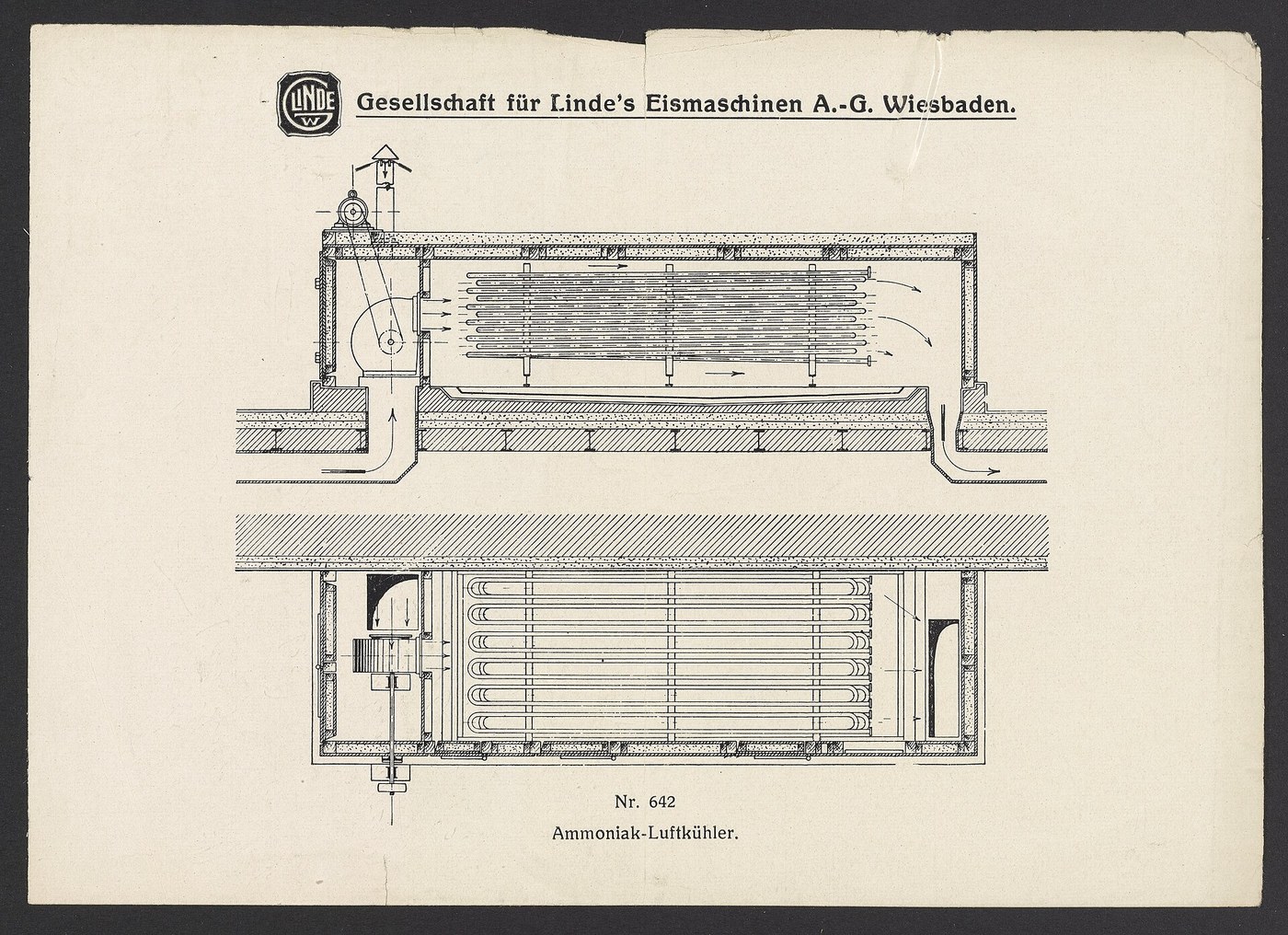


Ammonia Refrigeration Machine
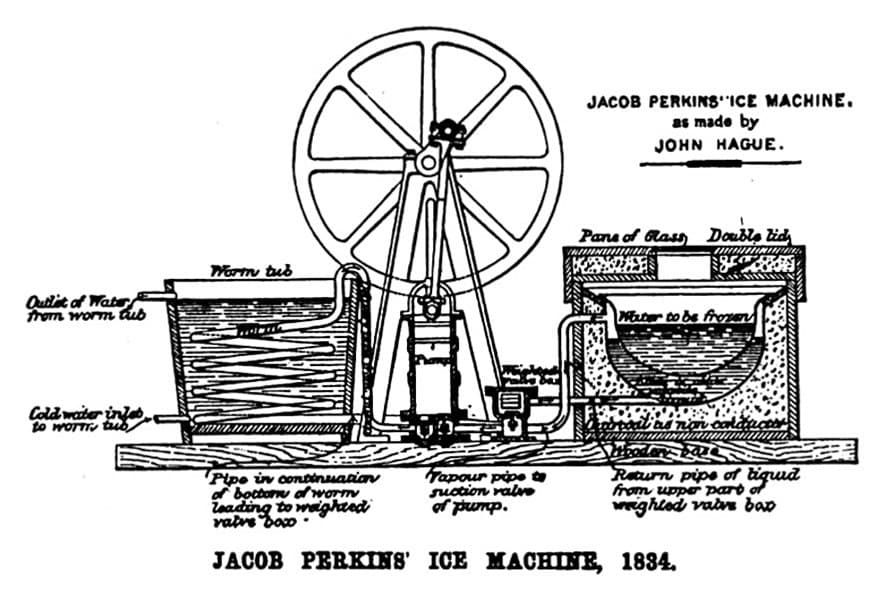
Perkins built the first vapour-compression machine in 1834 and it changed nothing for forty years. Linde built one in 1876 and refrigeration became an industry within a decade. The difference was not the cycle — it is identical — it was the refrigerant and the method.
Ether, Perkins' fluid, is a poor choice on every count: it boils too high to reach useful cold at sensible pressures, it carries little heat per kilogram, and it is ferociously flammable. Ammonia is better at the one thing that matters most — it has an exceptionally large latent heat, so each kilogram circulated carries a great deal of heat, and a machine of a given size does far more work.
The second difference is less visible and mattered more. Earlier machines were built by trial. Linde was a professor of engineering who calculated — he treated the cycle thermodynamically, worked out where the losses were, and designed against the numbers. His machines were the first refrigerators designed for a predicted efficiency rather than tuned until they worked.
His first buyer was a brewery, and that is not incidental: beer needs steady low temperature to ferment, brewers had money, and Bavaria had summers that ruined production.
Carl von Linde, Bavarian patent granted 25 March 1876, German Reichspatent August 1877. The first machine went to the Dreher Brewery in September 1876 and ran until 1908.
Imiyalelo
Compare how much heat different liquids carry
Compare how much heat different liquids carry
Boil away a measured 20 g of water and 20 g of surgical spirit over the same steady heat, timing each.
Expect water to take far longer.
That time difference is latent heat of vaporisation — how much energy each kilogram absorbs in becoming vapour. Water is about 2260 kJ/kg; alcohol roughly a third of that.
Write both down. This single number decides how much refrigerant a machine must circulate to move a given amount of heat, and therefore how big the compressor has to be. Ammonia's figure is around 1370 kJ/kg — far above the refrigerants that came after it.
Amathuluzi adingekayo:
 Isikali Sedijithali Sasekhishini
 Utshwala lokwelapha (i-isopropyl alcohol)
Turn latent heat into a machine size
Turn latent heat into a machine size
Work out the circulation rate for a cold store that must remove 10 kW.
Divide the heat load by the latent heat: with ammonia at roughly 1370 kJ/kg you need about 7.3 g/s. Repeat the sum with a refrigerant carrying a third as much and you need three times the mass flow — and a compressor three times the size to swallow it.
This is why ammonia is still the refrigerant of choice for large industrial plants a century and a half later. Nothing has beaten it on this number.
Find where the work is actually lost
Find where the work is actually lost
On a working machine, measure the temperature of the vapour entering the compressor and leaving it.
Expect a large rise — compression heats a gas, whether or not you wanted it to.
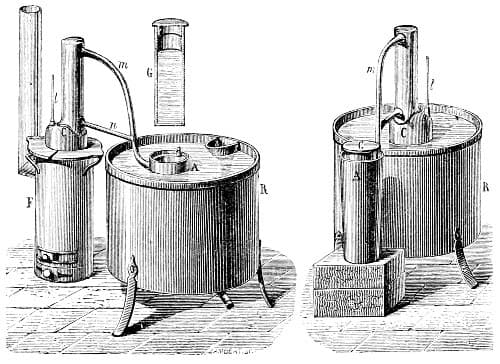
All of that heat must be thrown away again in the condenser before the fluid is any use. It is the tax on using a vapour as the working fluid, and it is exactly the tax Carré's absorption machine avoids by pumping a liquid instead.
Linde's contribution was measuring this rather than guessing: knowing where the losses sat let him choose cylinder sizes and pressures deliberately.
Amathuluzi adingekayo:
 Ithemomitha Ye-Infrared
Find the seal problem that ammonia creates
Find the seal problem that ammonia creates
Put a drop of household ammonia solution on a scrap of bright copper and leave it in air for an hour. Then do the same on steel.
Expect the copper to discolour badly and the steel to be largely unbothered.
Ammonia attacks copper and its alloys. That single fact dictates the whole construction: ammonia plant is built in steel, with steel pipe and steel fittings, and the brass and copper that every other fluid system uses are simply unavailable.
Linde's own answer to sealing the compressor shaft was glycerine as a liquid seal — a solution to a problem the O-ring would not properly settle for another sixty years.
Izinto zokwakha zalesi sinyathelo:
 Isixazululo se-ammonia sasekhaya50 ml
 Ishubhu lethusi1 ucezu
Work out why a brewery bought it first
Work out why a brewery bought it first
Look up the fermentation temperature range for a lager: roughly 7-13°C, held steady for weeks.
Now consider a Bavarian summer without a machine. Brewers cut ice in winter, packed it in cellars, and brewed only while it lasted — which is why lager brewing was seasonal and why cellars were dug under hills.
Estimate the ice a brewery would need for a summer, and what it costs to store.
The machine did not just save money. It removed season as a constraint on production — and a brewer could see that in a single figure.
History & Context
History & Context
The patents. Carl von Linde was granted a Bavarian patent on 25 March 1876 for ten years, and a German Reichspatent in August 1877. His first ammonia compressor had two vertical cylinders and used glycerine as a seal. It weighed and cost about half what his earlier machine did.
Brewing paid for refrigeration. The first machine was sold to the Dreher Brewery in September 1876, commissioned in spring 1877, and stayed in service until 1908 — thirty years. Linde had been funded by brewers from the start; the industry that most needed steady cold was also the one that could afford to buy it, and it carried the technology until food and shipping caught up.
The professor's method was the real invention. Linde came from the Technical University in Munich and approached the cycle as a thermodynamics problem, publishing the theory before building. Earlier refrigeration was empirical — build, test, adjust. Designing to a calculated efficiency is what let the machines get rapidly better instead of merely bigger, and it is why his name attaches to the industry rather than Perkins'.
He did not stop there. In 1895 Linde used the same cold-engineering to liquefy air, which opened industrial oxygen and nitrogen and became a second enormous business. The company he founded still exists as one of the largest industrial gas firms in the world.
Ammonia's honest balance. It is toxic and pungent — although that pungency is itself a safety feature, since a leak announces itself long before a dangerous concentration builds, which is more than could be said for the odourless CFCs that displaced it. It is flammable in a narrow range, and it corrodes copper. Against that: the best latent heat of any common refrigerant, zero ozone impact, negligible global warming potential, and it is cheap. Domestic fridges left it for safety in the 1930s. Industry never did, and as the CFC and HFC generations have fallen out of favour, ammonia has been quietly waiting the whole time.
Izinto
2- Isibambeli
- 1 ucezuIsibambeli
Amathuluzi Adingekayo
3- Isibambeli
- Isibambeli
Izinto Zokwakha Ze-Blueprint Exhunyiwe
Ama-blueprint ahlobene
Lama-blueprint abelana ngolwazi — amasu, izinto noma izimiso
CC0 Isizinda Somphakathi
Le blueprint ikhishwe ngaphansi kwe-CC0. Ukhululekile ukukopisha, ukuguqula, ukusabalalisa, nokusebenzisa ngaphandle kwemvume.
Sekela uMenzi ngokuthenga imikhiqizo nge-Blueprint yabo IKhomishane Yomenzi kumiswe ngabathengisi, noma dala inguqulo entsha yale Blueprint bese uyifaka njengoxhumaniso ku-Blueprint yakho ukuze wabelane ngemali engenayo.