UBUCIKO
UBUHLE NEMPILO
UBUCIKO BEZANDLA
AMASIKO NOMLANDO
EZOKUZIJABULISA
IMVELO
UKUDLA NEZIPHUZO
REVERSE ENGINEERING
IZAYENSI
EZEMIDLALO
UBUCHWEPHESHE
IZINTO EZIGQOKWAYO
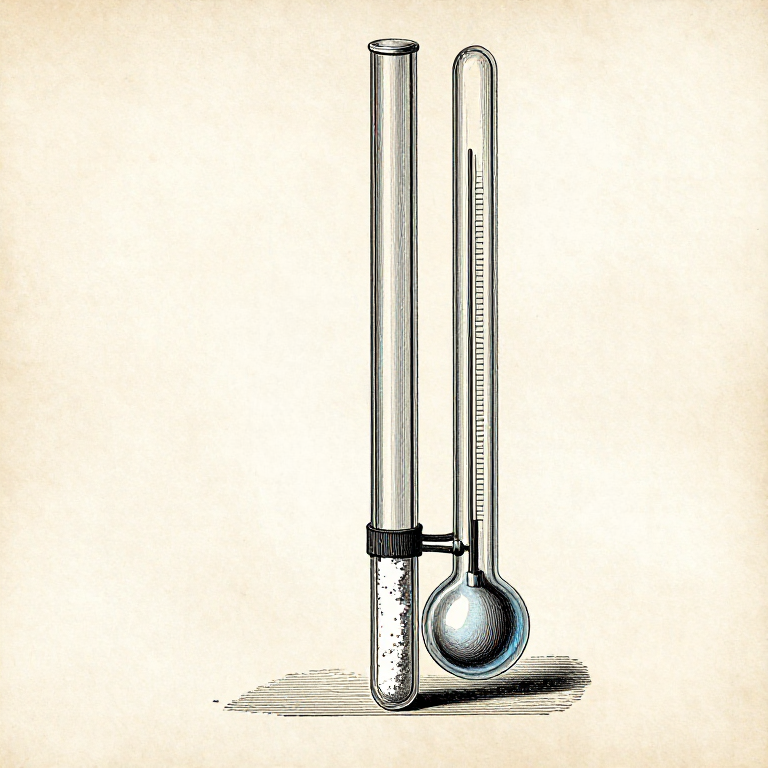


Melting Point: The Range Tells You More Than the Number
A melting point is the cheapest purity test there is. It needs a capillary tube, a heat source and a thermometer, and it answers two questions at once: is this what it is supposed to be, and is it clean?
The key is that an impurity does two things — it lowers the melting point, and it **widens the range**. A pure substance melts over a degree or less; something 5% impure melts several degrees low and over several degrees.
The width is the more useful of the two, because it needs no comparison with a literature value at all.
Ophakathi
2 hours
Imiyalelo
1
1
Taking one properly
Taking one properly
**The sample must be dry and finely powdered.** Solvent in the crystals lowers the melting point exactly as any other impurity does, and this is the commonest cause of a disappointing result on a freshly recrystallised solid.
**Pack a capillary 2 to 3 mm deep**, tapping it down by dropping the tube through a long glass tube onto the bench. A loosely packed sample melts unevenly; too much sample takes too long to heat through and reads high.
**Heat fast to within 15 C of the expected value, then slowly** — one to two degrees per minute through the melting range. This is the step that decides whether the number means anything. Heating fast through the range makes the sample lag behind the thermometer and reads several degrees high.
**Record two temperatures.** The **onset**, when the first drop of liquid appears, and the **clear point**, when the last crystal disappears. Report both: "154 to 157 C".
**Use a fresh tube for a repeat.** A sample that has been melted once has usually changed — decomposed a little, lost solvent, or crystallised in a different form.
**Calibrate the apparatus** with a known substance. Thermometers and heating blocks both read off by a few degrees, and a systematic error is invisible until it is checked.
Izinto zokwakha zalesi sinyathelo:
 I-Alum (I-Potassium Alum)1 ucezu
Amathuluzi adingekayo:
 Ishubhu lengilazi elincane kakhulu
 Ithemomitha Yaselabhorethri
 Ipuleti Elishisayo
2
2
Depression, range and the mixed melting point
Depression, range and the mixed melting point
Ilayisha incwadi ye-Jupyter…
Amathuluzi adingekayo:
 Ikhompyutha Yasetafuleni
3
3
Reading what happens in the tube
Reading what happens in the tube
Several things happen before and during melting, and they are all informative.
**Shrinking or sintering** a few degrees below the melt. The particles soften and slump. Normal, and not the melting point — record it separately if at all.
**Sweating.** A film of liquid appearing on the outside of the packed column before it melts through. Usually trapped solvent.
**Melting over a wide range.** Impurity. The notebook gives the scale.
**Darkening or browning before melting.** Decomposition. Some substances decompose rather than melt, and are reported as "dec." with the temperature at which it starts. A decomposition point depends on the heating rate far more than a melting point does, so it must be quoted with one.
**Bubbling.** Solvent boiling off, or decomposition producing gas.
**Melting, then resolidifying, then melting again higher.** A polymorph converting to a more stable crystal form. Real, and it means the two forms have different melting points — so a literature value can be right and yours can also be right.
**Not melting at all up to the limit of the apparatus.** Either it is not what you think, or it is a salt rather than the neutral form.
Izinto zokwakha zalesi sinyathelo:
I-Alum (I-Potassium Alum)1 ucezuAmathuluzi adingekayo:
Ishubhu lengilazi elincane kakhuluIthemomitha Yaselabhorethri4
4
What it cannot tell you
What it cannot tell you
The test is cheap and it has real limits, and knowing them stops it being trusted too far.
**It says nothing about an impurity that is not soluble in the melt.** Sand, dust and insoluble salts sit there and change nothing. A perfectly sharp melting point is compatible with a visibly dirty sample.
**It says nothing below about half a per cent** on a typical organic, which is the level at which the depression disappears into the reading error.
**A eutectic impurity at high level can melt sharply too.** A mixture at its exact eutectic composition melts at a single temperature, so a sharp melt at a wrong temperature is a real possibility rather than a contradiction.
**It does not work on anything that decomposes first**, on oils, on polymers, or on most inorganic solids, whose melting points are far above ordinary apparatus.
**Two substances can share a melting point.** That is why the mixed melting point exists.
So: a sharp melt at the literature value is strong evidence, a broad or depressed melt is strong evidence against, and neither is proof. Pair it with TLC and the two together are hard to fool.
Amathuluzi adingekayo:
Ishubhu lengilazi elincane kakhuluIzinto
1- 2 izicucuIsibambeli
Amathuluzi Adingekayo
4- Isibambeli
- Isibambeli
- Isibambeli
- Isibambeli
Ama-blueprint ahlobene
Lama-blueprint abelana ngolwazi — amasu, izinto noma izimiso



CC0 Isizinda Somphakathi
Le blueprint ikhishwe ngaphansi kwe-CC0. Ukhululekile ukukopisha, ukuguqula, ukusabalalisa, nokusebenzisa ngaphandle kwemvume.
Sekela uMenzi ngokuthenga imikhiqizo nge-Blueprint yabo IKhomishane Yomenzi kumiswe ngabathengisi, noma dala inguqulo entsha yale Blueprint bese uyifaka njengoxhumaniso ku-Blueprint yakho ukuze wabelane ngemali engenayo.