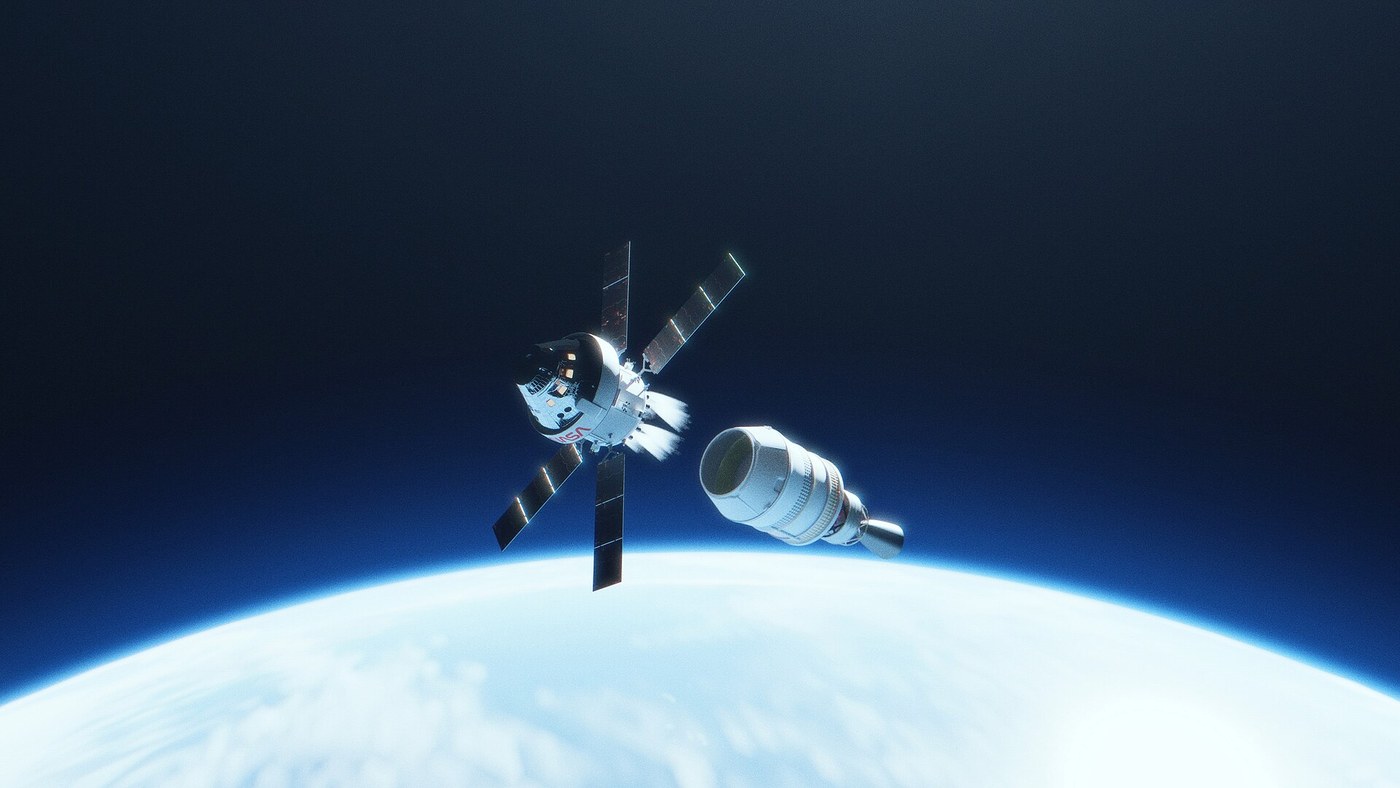


The Multistage Rocket
Imiyalelo
Optimise the staging split arithmetically
Optimise the staging split arithmetically
Decide how to divide the job before designing any hardware.
- Take a total delta-v requirement of 9.4 km/s and a two-stage vehicle.
- Try splitting it 50/50, then 60/40, then 40/60, computing the total launch mass needed for a fixed payload each time.
- Assume a realistic structural fraction — stage dry mass around 8 to 10 percent of its propellant.
- Plot launch mass against the split and find the minimum.
There is a genuine optimum, and it is not an even split. The upper stage carries the payload all the way, so mass there is expensive; the first stage is thrown away early and its inefficiency matters less. The optimum usually gives the upper stage a larger share of the delta-v than a naive split would suggest.
Notice the sensitivity. The curve is shallow near the optimum, meaning a split that is somewhat wrong costs little — which is fortunate, because the structural fractions you assumed are estimates until the vehicle is actually built.Izinto zokwakha zalesi sinyathelo:
 Iphepha Lamagridi1 pad
Amathuluzi adingekayo:
 I-Caliper Yedijithali Yamayintshi Ayi-6
 Isikali Sedijithali
Build an interstage and a separation mechanism
Build an interstage and a separation mechanism
Design the structure whose entire purpose is to stop existing on command.
- Build a model two-stage vehicle with an interstage that carries flight loads between the stages.
- Fit a separation system — at model scale, a spring-loaded pusher released by a servo or a burnwire.
- Test on the bench, measuring the relative velocity the pusher imparts.
- Verify the interstage carries the expected compressive load without the release firing prematurely.
The interstage must be strong enough to transmit the full thrust of the lower stage through the whole vehicle, and weak enough to come apart reliably on command. Those requirements point in opposite directions, which is why the mechanism is separate from the structure — a joint held by frangible bolts, clamp bands or explosive cord, rather than by something that must be broken.
Reverse-engineering note: the relative velocity matters and is designed. Too little and the stages drift together while the upper engine lights, and the exhaust destroys the lower stage or pushes it back into contact; too much and the mechanism itself imparts a tumble. A metre per second or two is typical, and it is provided by springs or by small retro-rockets on the spent stage.Izinto zokwakha zalesi sinyathelo:
 Ishidi Lokhuni Lwe-balsa3 amashidi
 Ipayipi Le-PVC1 ucezu
 Iqoqo lezintambo zokucindezela1 isethi
 I-servo yokuzilibazisa1 isethi
 Isamukeli se-RC1 isethi
Amathuluzi adingekayo:
 Ummese wobuciko onezimpawu ezengeziweI-Caliper Yedijithali Yamayintshi Ayi-6
 Iqoqo Lamafayela
 Ibhola Elimile
 Isikali Sesipringi
 Umakhalekhukhwini Onevidiyo Ehamba Kancane
 I-Oscilloscope
 Izibuko Zokuphepha Ezicwathile
Choose hot staging or cold staging, and understand the trade
Choose hot staging or cold staging, and understand the trade
Two philosophies, and they fail differently.
- Sketch cold staging: lower stage shuts down, stages separate, upper stage ignites in the gap.
- Sketch hot staging: the upper engine ignites BEFORE separation, its exhaust venting through an open lattice interstage, and the thrust itself pushes the stages apart.
- Consider what happens in each case if the upper engine fails to light.
- Consider what happens to propellant settling in each case.
Cold staging is cleaner and has a dangerous gap: during coast the vehicle is unpowered, propellant floats away from the tank outlets, and the engine may ingest gas when it does light. Ullage motors — small thrusters that keep a gentle acceleration during the gap — exist entirely to hold the propellant at the bottom of the tank.
Hot staging eliminates the gap and needs an interstage that survives being blasted by a rocket engine at point-blank range. Soviet designs used it routinely; the lattice interstage on the R-7 is visible in photographs as an open framework rather than a solid tube.
Neither is correct in general. The choice depends on whether you would rather solve a thermal problem or a fluid-settling problem, and both have flown thousands of times.Izinto zokwakha zalesi sinyathelo:
Ishidi Lokhuni Lwe-balsa2 amashidiIphepha Lamagridi1 padAmathuluzi adingekayo:
Ummese wobuciko onezimpawu ezengeziweI-Caliper Yedijithali Yamayintshi Ayi-6Umakhalekhukhwini Onevidiyo Ehamba Kancane Ithemomitha Ye-InfraredIzibuko Zokuphepha Ezicwathile
Fly it, and count the ways it can fail
Fly it, and count the ways it can fail
Test the separation in flight, at a scale where failure is a walk across a field.
- Fly the two-stage model with the upper stage inert first, verifying separation alone.
- Film from the ground at high frame rate.
- Examine the footage for tumbling, recontact, or asymmetric release.
- Only when separation is repeatable, fly with the upper stage live.
Separating one thing at a time is the whole method. A failure with both stages live tells you very little, because you cannot tell whether the separation or the ignition went wrong.
The failure modes to watch for are specific: a release that fires unevenly imparts a tumble; too little push allows recontact; and a stage that separates while still thrusting will chase the one above it.
Model rocketry has a genuine safety code and it is worth following exactly — launch angles away from spectators, established minimum distances, and no metal airframes. The point of testing at this scale is that the consequences stay proportionate to the knowledge gained.Izinto zokwakha zalesi sinyathelo:
Ishidi Lokhuni Lwe-balsa2 amashidi Isokhela likagesi (elithengiwe)4 izicucu
Amathuluzi adingekayo:
Umakhalekhukhwini Onevidiyo Ehamba Kancane Ithephu Lokulinganisa
 Isilinganiso Se-engeli Sedijithali
 IphrothraktaIzibuko Zokuphepha Ezicwathile
 Isivikelo Sobuso
 Isicishamlilo
Plot performance against reliability and find the real optimum
Plot performance against reliability and find the real optimum
More stages always help the arithmetic. Decide whether they help the mission.
- Compute the launch mass needed for a fixed payload with one, two, three, four and five stages.
- Now assign each separation event a success probability — say 0.98 — and each engine start likewise.
- Compute overall mission probability against stage count.
- Plot performance gain and reliability loss on the same axes.
Performance improves steeply from one to two stages, appreciably from two to three, and barely beyond that — while reliability falls with every added event. The curves cross somewhere around two or three, which is exactly where the industry settled without anyone decreeing it.
This is the honest shape of most engineering optimisations and worth naming: the quantity you can calculate improves smoothly, and the quantity you cannot calculate gets worse. The optimum sits where a confident number meets an uncertain one, which is why judgement rather than arithmetic decides it.
Strap-on boosters are a partial escape — they add propellant without adding a separation in series, since they drop away while the core keeps burning. That is why so many vehicles are a two-stage core with boosters rather than a genuine three-stage stack.Izinto zokwakha zalesi sinyathelo:
Iphepha Lamagridi1 padAmathuluzi adingekayo:
I-Caliper Yedijithali Yamayintshi Ayi-6Isikali SedijithaliIzinto
7- 1 padIsibambeli
- 7 amashidiIsibambeli
- Isibambeli
- 1 isethiIsibambeli
- Isibambeli
- 1 isethiIsibambeli
- 4 izicucuIsibambeli
Amathuluzi Adingekayo
15- Isibambeli
- Isibambeli
- Isibambeli
- Isibambeli
- Isibambeli
- Isibambeli
- Isibambeli
- Isibambeli
- Isibambeli
- 1 vendor sell this, none ship to you yetIsibambeli
- Isibambeli
- Isibambeli
- Isibambeli
- Isibambeli
Ama-blueprint ahlobene
Lama-blueprint abelana ngolwazi — amasu, izinto noma izimiso



CC0 Isizinda Somphakathi
Le blueprint ikhishwe ngaphansi kwe-CC0. Ukhululekile ukukopisha, ukuguqula, ukusabalalisa, nokusebenzisa ngaphandle kwemvume.
Sekela uMenzi ngokuthenga imikhiqizo nge-Blueprint yabo IKhomishane Yomenzi kumiswe ngabathengisi, noma dala inguqulo entsha yale Blueprint bese uyifaka njengoxhumaniso ku-Blueprint yakho ukuze wabelane ngemali engenayo.