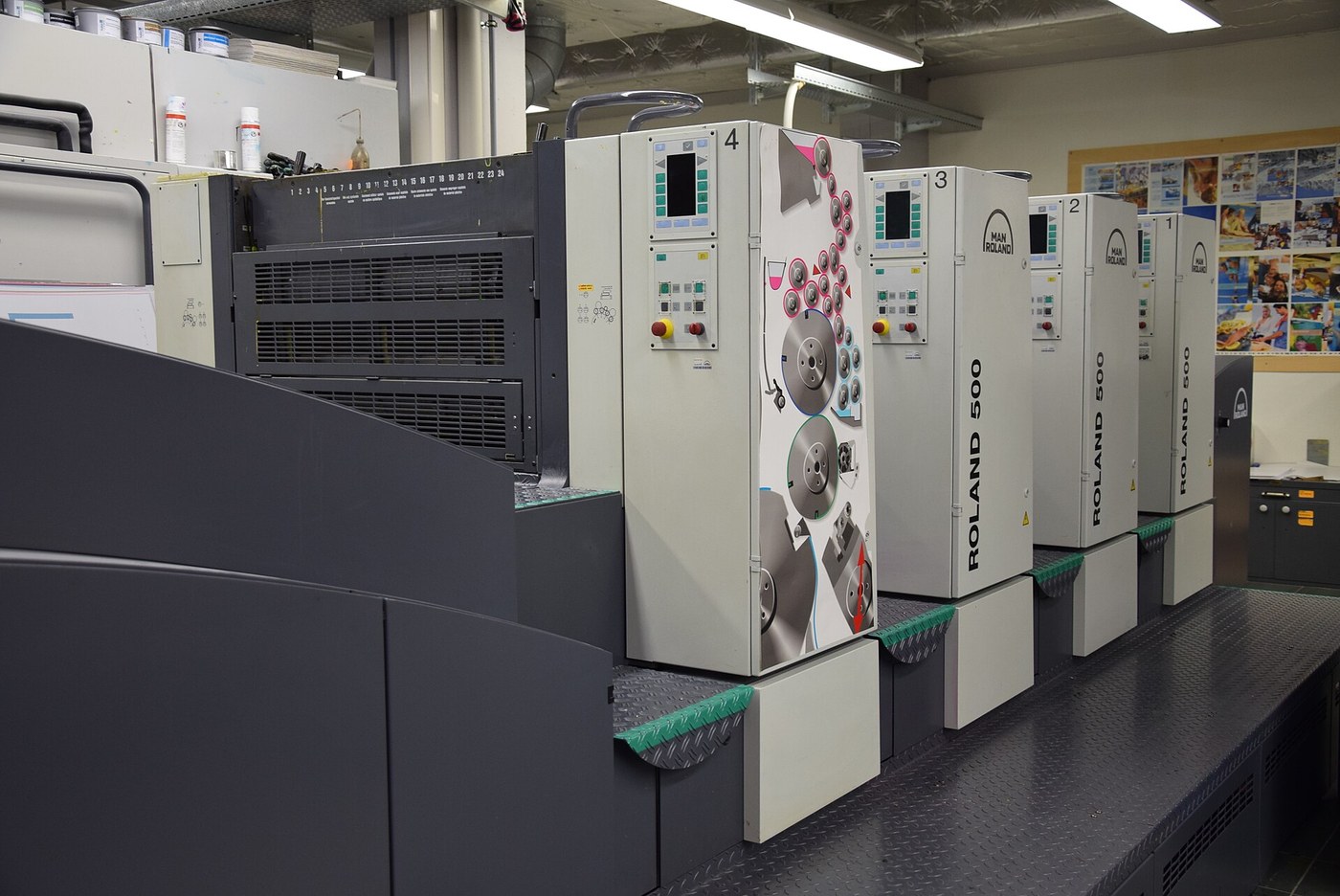


Offset Lithography
Lithography prints from a chemically flat surface, which is a wonderful principle and an awkward machine. Pressing paper directly onto a hard plate needs real force, wears the plate quickly, and demands paper smooth enough to make contact everywhere — because a hard plate cannot reach into the texture of a rough sheet.
Offset inserts one component between plate and paper: a rubber blanket cylinder. The plate never touches the paper at all. It transfers its ink to the rubber, and the rubber transfers it to the sheet.
That single interruption fixes four problems at once, which is why it took over the world.
The rubber conforms. Being soft, it presses ink into the hollows of a textured sheet, so ordinary and even rough papers print cleanly.
The plate stops wearing. It only ever touches smooth rubber under light pressure, so a plate lasts for hundreds of thousands of impressions instead of thousands.
Less pressure is needed, so the press can run much faster.
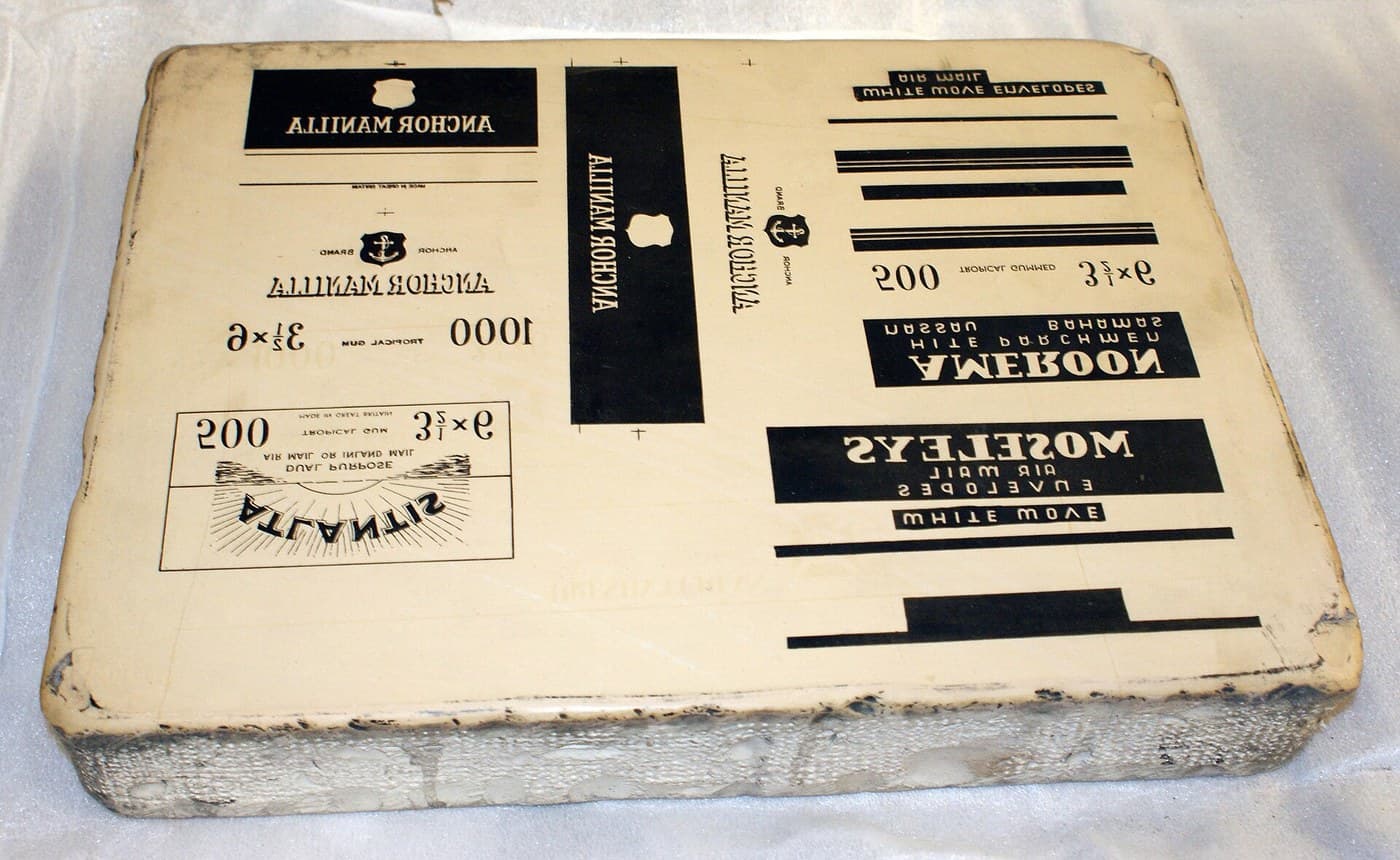
The image flips twice. Plate to blanket reverses it, blanket to paper reverses it back — so the plate reads the right way round, and can be made photographically from artwork without a mirroring step.
An extra cylinder that appears to add complexity actually removes it everywhere else.
Imiyalelo
Prove a hard surface cannot reach a rough one
Prove a hard surface cannot reach a rough one
Ink a hard flat block — glass or metal — and press it onto smooth paper, then onto a rough textured paper, with the same pressure.
Expect the rough sheet to print as broken, speckled coverage, ink landing only on the high points of the texture.
Now do the same with an inked rubber sheet or a soft roller.
Expect solid coverage on both papers.
Record the difference. This is the whole reason for the blanket, and it is why direct lithography demanded expensive smooth stock while offset can print a cereal box.
Izinto zokwakha zalesi sinyathelo:
 Uyinki Wokushicilela Ngamabhulokhi1 ucezu
 Iphepha1 ucezu
Amathuluzi adingekayo:
 Ushidi wengilazi
 Ishidi lerabha
Count the flips
Count the flips
Write a word on an inked plate, print it directly onto paper, and read the result. Then transfer that same inked word first onto a rubber sheet, and from the rubber onto paper.
Expect direct printing to give a mirror image, and the two-stage transfer to read correctly.
Two reversals cancel.
That is not a curiosity — it means a plate can be exposed photographically straight from right-reading artwork or film, with no intermediate mirroring. It removed an entire class of error from platemaking.
Amathuluzi adingekayo:
Ishidi lerabhaFind where the water goes
Find where the water goes
Recall the lithography blueprint's balance: the plate must be damp for the blank areas to repel ink.
Now trace where that water goes on a press. The plate is damped by fountain rollers, inked, and then meets the blanket — so a little water travels with the ink onto the rubber, and some reaches the paper.
Test the consequence with your rubber sheet: damp it slightly, ink it, and print onto paper.
Expect slightly weaker, less crisp ink laydown.
This is why offset ink must be formulated to carry a controlled amount of water without breaking down, and why the ink-water balance remains the press operator's central skill even now.
Izinto zokwakha zalesi sinyathelo:
 Amanzi1 ucezu
Amathuluzi adingekayo:
Ishidi lerabhaRegister four colours and see why it must be exact
Register four colours and see why it must be exact
Print two overlapping shapes in different colours from separate plates, deliberately offsetting one by about a millimetre. Then try to align them precisely.
Expect the misregistered version to show colour fringes and blurred edges immediately.
Full colour is four such passes — cyan, magenta, yellow, black — and the tolerance is a fraction of a millimetre on a sheet travelling at speed.
That is why offset presses carry register marks in the trim, micro-adjustable cylinders, and why paper is conditioned to the pressroom's humidity: paper changes size as it takes up moisture, and a sheet that grows between passes cannot be registered by any amount of care.
Find the economics that decide when to use it
Find the economics that decide when to use it
Work out the cost shape. Making four plates and setting up a press is a large fixed cost paid before the first good sheet. Each additional sheet after that is nearly free.
Compute the per-copy cost for 50 copies, 500, and 50,000.
Expect the curve to fall steeply and then flatten.
This is why offset owns books, packaging and newspapers, and why digital printing — no plates, higher cost per page, zero setup — owns short runs. The crossover point, not the quality, decides which machine a job goes on, and every print buyer is really choosing between two cost curves.
History & Context
History & Context
Discovered by a mistake nobody wasted. The usual account credits Ira Rubel, who was printing on a lithographic press when a sheet failed to feed. The plate printed onto the rubber impression cylinder instead, and the next sheet through picked that image up off the rubber — and it was better than the direct impression. The mechanism was already in the machine; what was missing was somebody noticing that the accident was an improvement. A parallel discovery is credited to Caspar Hermann in Germany around the same period.
It made printing indifferent to the paper. Before offset, quality printing needed quality stock. Afterwards, cheap rough paper printed acceptably, which collapsed the cost of mass-market books, magazines and packaging. Most of the printed matter around you exists in the form it does because of a rubber cylinder.
It completed what lithography started. Senefelder's principle was that an image could be defined by surface chemistry rather than shape. Offset made that principle industrial, and photographic platemaking then removed the hand-drawn stone entirely: expose a light-sensitive coating through a film negative, and the exposed areas become ink-receptive. Today the plate is imaged directly from a computer, with no film at all — but the plate still works exactly as Senefelder's stone did, on grease and water.
The intermediary is a general idea. Putting a compliant transfer stage between a precise master and an imperfect substrate turns up everywhere: pad printing onto curved objects, hot-foil stamping, flexographic printing on film, even the soft-touch rollers in a laser printer's fuser. Where the target is uneven and the master must not wear, insert something soft.
Honest limits. The water is a permanent nuisance — waterless offset exists precisely to avoid it, using silicone-coated plates instead. Setup waste is real: hundreds of sheets can pass before colour and register settle, which is dead cost on a short run. Blankets swell, smash and must be replaced. And nothing about offset makes short runs cheap, which is why digital took the bottom of the market and left offset the top.
Izinto
3- Isibambeli
- 1 ucezuIsibambeli
- 1 ucezuIsibambeli
Amathuluzi Adingekayo
2- Isibambeli
- Isibambeli
Izinto Zokwakha Ze-Blueprint Exhunyiwe

Ama-blueprint ahlobene
Lama-blueprint abelana ngolwazi — amasu, izinto noma izimiso
CC0 Isizinda Somphakathi
Le blueprint ikhishwe ngaphansi kwe-CC0. Ukhululekile ukukopisha, ukuguqula, ukusabalalisa, nokusebenzisa ngaphandle kwemvume.
Sekela uMenzi ngokuthenga imikhiqizo nge-Blueprint yabo IKhomishane Yomenzi kumiswe ngabathengisi, noma dala inguqulo entsha yale Blueprint bese uyifaka njengoxhumaniso ku-Blueprint yakho ukuze wabelane ngemali engenayo.