

Old-Age Stipple Makeup
Painted-on wrinkles never work. Under stage light a drawn line is a drawn line — it sits flat on the skin, it does not move when the actor speaks, and the audience reads it as makeup within about two seconds.
Stipple does not draw the wrinkle. It builds one. You stretch a patch of skin taut, dab liquid latex onto it, dry it, and then let the skin relax. The latex film cannot shrink, so the skin underneath buckles into hundreds of fine creases — real folds with real shadows, which crumple further when the actor moves and smooth when they do not.
It is the oldest trick in the character-makeup kit and it costs almost nothing. The whole skill lies in stretching the right amount, in the right direction, and in drying every layer completely before the next one goes on.
Imiyalelo
Patch test first — latex allergy is real and common
Patch test first — latex allergy is real and common
Natural rubber latex causes genuine allergic reactions in a small but significant number of people, and repeated exposure can create a sensitivity that was not there before. Test a coin-sized patch on the inner forearm 24 hours ahead. If there is any redness or itching, do not proceed — use a gelatin or silicone alternative instead.
Keep it away from eyes, lips and hair
Keep it away from eyes, lips and hair
Latex bonds to hair and removing it takes the hair with it. Stay well clear of eyebrows, lashes and the hairline, and never apply on the eyelid itself.
Work in a ventilated room
Work in a ventilated room
Liquid latex is stabilised with ammonia and smells sharply of it. Open a window — the smell fades as it dries and the ammonia evaporates.
Izinto zokwakha zalesi sinyathelo:
 I-latex eluketshezi (ephephile esikhumbeni)100 ml
Clean and dry the skin completely
Clean and dry the skin completely
Wash off all oil and moisturiser and dry thoroughly. Latex will not key to an oily surface and lifts at the edges within minutes.
Choose the areas that actually age
Choose the areas that actually age
Outer eye corners, the neck, the backs of the hands, the forehead. Study a real older face first — the pattern of ageing is specific and inventing it produces something that reads as damage rather than age.
Stretch the skin taut and hold it
Stretch the skin taut and hold it
Pull the area flat with your free hand, or have the actor hold the stretch themselves. The tension must stay constant from application through to full dry.
Stipple, never brush
Stipple, never brush
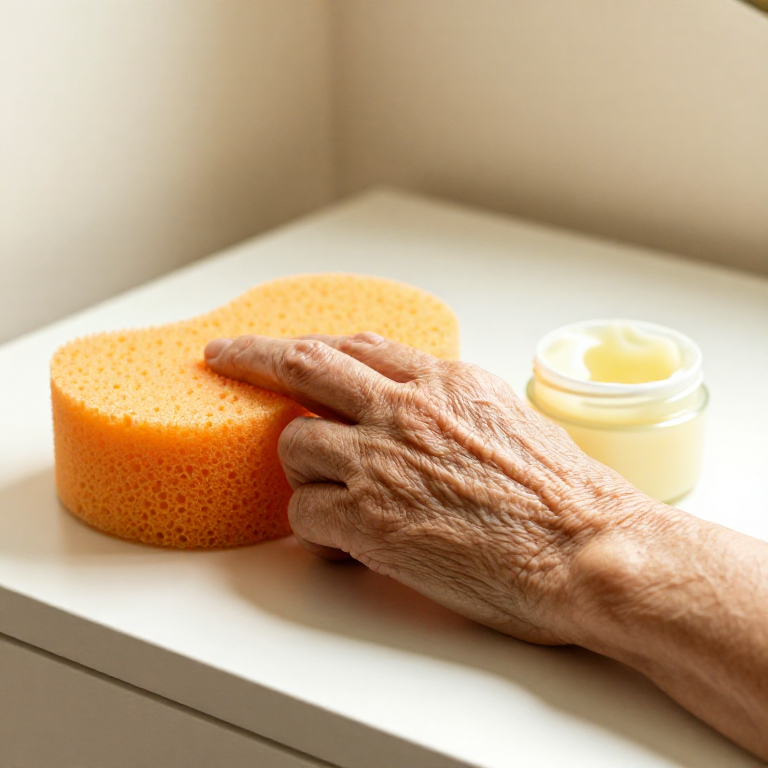
Dab the latex on with a coarse-textured sponge, straight up and down. A brushed-on film dries as a smooth sheet and gives one big wrinkle instead of many small ones.
Izinto zokwakha zalesi sinyathelo:
 Isipontshi sokufaka amachashazi2 izicucu
Keep the coat thin
Keep the coat thin
A barely-there film is what you want. Thick latex dries into a rubbery skin that looks like a burn scar, not like age.
Dry it completely while the skin is still stretched
Dry it completely while the skin is still stretched
Use a hairdryer on cool, or wait. Releasing the stretch before it is fully dry destroys the effect entirely — the film simply flows back flat.
Powder the surface to kill the tack
Powder the surface to kill the tack
Dust translucent setting powder over the dried latex. Untreated latex is sticky and will grab at itself and at clothing.
Izinto zokwakha zalesi sinyathelo:
 Impuphu yokubambelela (ecwebezelayo)20 g
Release the stretch and look at what appeared
Release the stretch and look at what appeared
Let the skin relax. It buckles into fine creases under the film — and these are genuine folds that catch light and shadow from any angle.
Build depth with two or three more layers
Build depth with two or three more layers
Repeat stretch, stipple, dry, powder. Each pass deepens the texture, but stop before the area stops moving naturally.
Colour over the top with foundation and shadow
Colour over the top with foundation and shadow
Latex takes makeup readily once powdered. Add a sallow base, darken the hollows and lighten the ridges — the texture is built, the colour still has to be painted.
Remove with remover and warm water, never by picking
Remove with remover and warm water, never by picking
Soften the edges with a purpose-made latex remover or an oil-based cleanser and roll the film off gently. Tearing dried latex off dry skin hurts and takes fine hairs with it.
History & Context — building the wrinkle instead of drawing it
History & Context — building the wrinkle instead of drawing it
Why the trick works. Latex dries by evaporation into a continuous elastic film that is bonded to the skin surface but cannot shrink back below the area it covered while drying. Applied over stretched skin, it captures that stretched area as its own resting size. When the skin relaxes and its surface area reduces, the film has nowhere to go and the composite buckles — the same wrinkling instability that appears when any stiff thin layer sits on a compressing soft substrate. The effect is entirely mechanical, which is why it survives close inspection: the shadows are cast by real geometry.
Stipple, not brush. Dabbing with a coarse open-cell sponge leaves a film of uneven thickness. Thicker islands buckle at a different scale from the thin areas between them, giving a spread of crease sizes rather than one uniform fold — and that variation is what reads as skin rather than as rubber. It is the same reasoning behind stippling a stipple sponge for beard stubble or for broken capillaries: irregularity is the point.
Where it sits in the makeup kit. Old-age stipple is the cheapest and fastest of the ageing techniques. Above it sit prosthetics — foam latex, gelatin or silicone appliances sculpted, moulded and glued on, which can change the face's actual shape and which cost far more in time and money. Stipple cannot alter a jawline or build a hooked nose; it only textures what is already there. On stage, seen from beyond the third row, that is usually enough. On camera in close-up it rarely is, and modern film work leans on silicone appliances for the same reason it abandoned greasepaint.
The material and its drawbacks, honestly stated. Liquid latex is an aqueous dispersion of natural rubber particles, stabilised with ammonia to stop them coagulating in the bottle. Two limitations follow. First, natural rubber proteins are a well-documented allergen, and sensitisation can develop with repeated exposure — hence the patch test, and hence the shift in professional practice toward gelatin and silicone for performers in daily makeup. Second, latex on skin does not breathe, so extended wear over large areas is uncomfortable and unwise. It is a superb technique for a two-hour performance and a poor one for an eight-hour shoot.
Izinto
3- Isibambeli
- 2 izicucuIsibambeli
- Isibambeli
Izinto Zokwakha Ze-Blueprint Exhunyiwe

Ama-blueprint ahlobene
Lama-blueprint abelana ngolwazi — amasu, izinto noma izimiso

CC0 Isizinda Somphakathi
Le blueprint ikhishwe ngaphansi kwe-CC0. Ukhululekile ukukopisha, ukuguqula, ukusabalalisa, nokusebenzisa ngaphandle kwemvume.
Sekela uMenzi ngokuthenga imikhiqizo nge-Blueprint yabo IKhomishane Yomenzi kumiswe ngabathengisi, noma dala inguqulo entsha yale Blueprint bese uyifaka njengoxhumaniso ku-Blueprint yakho ukuze wabelane ngemali engenayo.