Ukusebenzisana
UBUCIKO
UBUHLE NEMPILO
UBUCIKO BEZANDLA
AMASIKO NOMLANDO
EZOKUZIJABULISA
IMVELO
UKUDLA NEZIPHUZO
REVERSE ENGINEERING
IZAYENSI
EZEMIDLALO
UBUCHWEPHESHE
IZINTO EZIGQOKWAYO
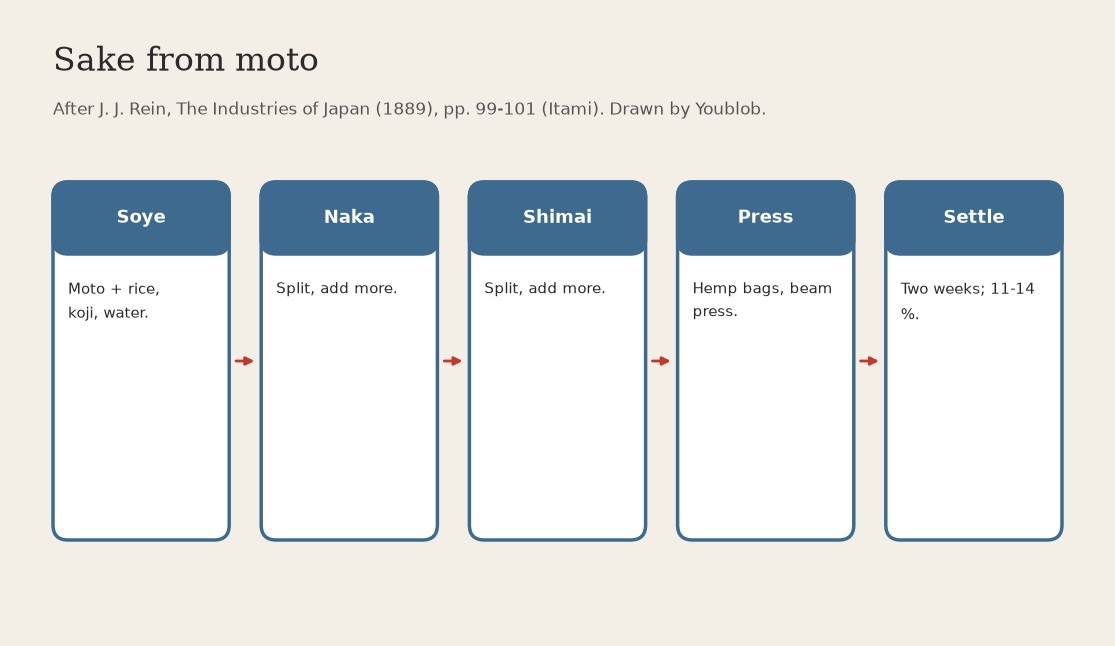


Sake from Moto: the Mash Built Up in Three Additions, Soye, Naka and Shimai, Pressed and Settled (Itami, after Rein 1889)
The brewers of Itami never put all the rice in at once. They fed the moto in three steps, roughly doubling the mash each time, so the yeast always stayed ahead of the sugar the koji made. Then they pressed the mash in a beam press and let the sake settle clear.
Result: sake of 11 to 14 % alcohol.
Source: J. J. Rein, The Industries of Japan (1889), pp. 99-101. The beam press is replaced by any press. Picture drawn by Youblob.
Osezingeni eliphezulu
4 weeks
Imiyalelo
1
1
Soye: first addition
Soye: first addition
In a three-foot tub mix 1.30 koku steamed rice, 1.30 koku moto, 0.35 koku koji and 1.30 koku water (4.25 koku). Stir thoroughly every two hours for two or three days; it warms to about 20 C and smells pleasant and pungent. Ours: steam the rice over a pot.
Izinto zokwakha zalesi sinyathelo:
 Ilayisi laseJapane elinezinhlamvu ezimfushane1.3 koku
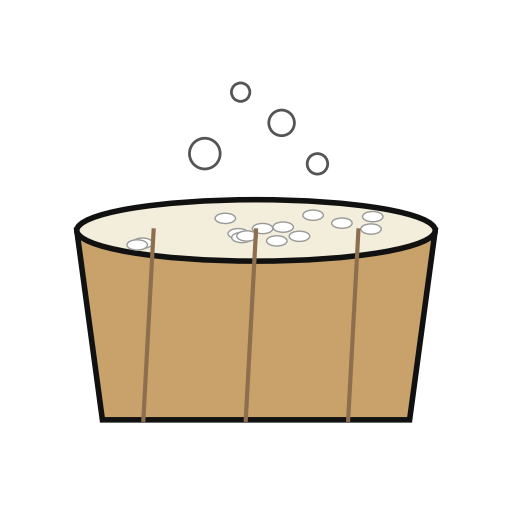 I-moto (isiqalo se-sake)1.3 koku
 Ilayisi le-koji (Aspergillus oryzae)0.35 koku
 Amanzi1.3 koku
Amathuluzi adingekayo:
 Ubhavu wokhuni
 Isigoqozi eside sokhuni
 Ibhodwe Elikhulu
 Ithemomitha
2
2
Naka: second addition
Naka: second addition
Split the soye between two tubs and add 2.00 koku steamed rice, 0.65 koku koji and 2.90 koku water (9.80 koku, 4.90 per tub). Stir vigorously every other hour for one day.
Izinto zokwakha zalesi sinyathelo:
Ilayisi laseJapane elinezinhlamvu ezimfushane2 kokuIlayisi le-koji (Aspergillus oryzae)0.65 kokuAmanzi2.9 kokuAmathuluzi adingekayo:
Ubhavu wokhuniIsigoqozi eside sokhuniIbhodwe Elikhulu3
3
Shimai: last addition
Shimai: last addition
Split again into four tubs and add 3.30 koku steamed rice, 1.00 koku koji and 4.20 koku water (Rein prints the naka here as 9.90; total 18.40 koku). Treat as before; keep tubs no more than half full.
Izinto zokwakha zalesi sinyathelo:
Ilayisi laseJapane elinezinhlamvu ezimfushane3.3 kokuIlayisi le-koji (Aspergillus oryzae)1 kokuAmanzi4.2 kokuAmathuluzi adingekayo:
Ubhavu wokhuniIsigoqozi eside sokhuniIbhodwe Elikhulu4
4
Main fermentation
Main fermentation
After three days pour all four tubs into one big six-foot tub. A brisk fermentation follows and eases in two or three days; the scum settles and the liquor is strongly alcoholic.
Amathuluzi adingekayo:
Ubhavu wokhuni5
5
Press
Press
Fill close-woven hemp bags with the mash, lay them crosswise in a strong box and press. Rein's press is a beam lever weighted with 600-900 kg; ours: any wine press. Collect the turbid sake.
Amathuluzi adingekayo:
 Isikhwama sikanoni
 Umshini wokukhama amagilebhisi
6
6
Settle and draw off
Settle and draw off
Let the sake stand quiet two weeks in a standing cask with two taps near the bottom, then draw it off clear by the upper tap. Store in barrels or closed tubs; heat it when warm weather comes to keep it.
Amathuluzi adingekayo:
 Umgqomo wokhuni
Izinto
4- Isibambeli
- 1.3 kokuIsibambeli
- Isibambeli
- 8.4 kokuIsibambeli
Amathuluzi Adingekayo
7- Isibambeli
- Isibambeli
- Isibambeli
- Isibambeli
- Isibambeli
- Isibambeli
- Isibambeli
Le blueprint yenza

Ama-blueprint ahlobene
Lama-blueprint abelana ngolwazi — amasu, izinto noma izimiso

CC0 Isizinda Somphakathi
Le blueprint ikhishwe ngaphansi kwe-CC0. Ukhululekile ukukopisha, ukuguqula, ukusabalalisa, nokusebenzisa ngaphandle kwemvume.
Sekela uMenzi ngokuthenga imikhiqizo nge-Blueprint yabo IKhomishane Yomenzi kumiswe ngabathengisi, noma dala inguqulo entsha yale Blueprint bese uyifaka njengoxhumaniso ku-Blueprint yakho ukuze wabelane ngemali engenayo.