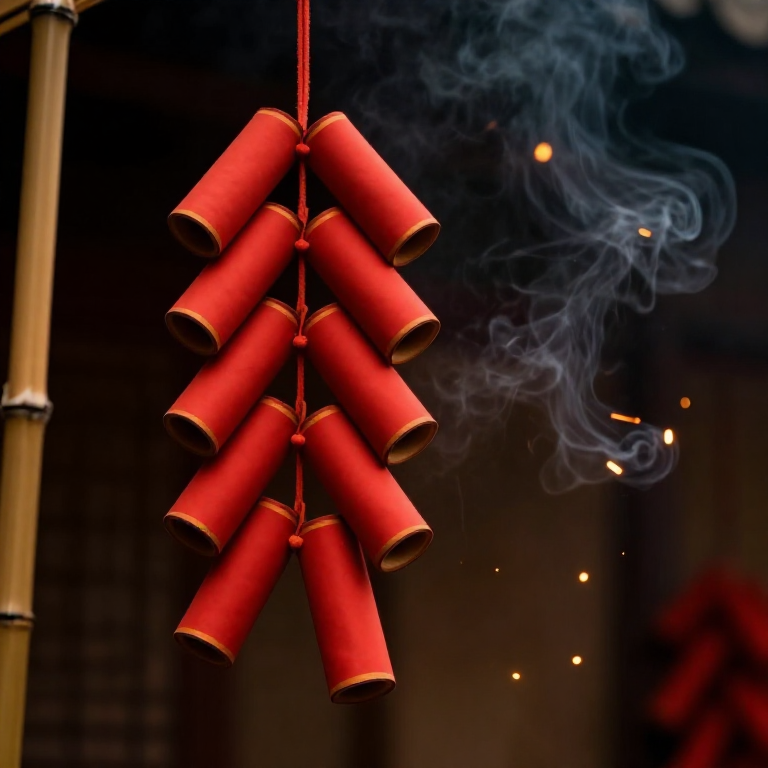


Making Song Dynasty Fireworks — Bamboo Firecrackers and Ground Salutes
Chinese fireworks (烟花, yānhuā — literally 'smoke flowers') evolved alongside military gunpowder applications during the Song dynasty (960-1279 AD). While soldiers were building fire lances and fire arrows, festival organizers discovered that stuffing black powder into sealed bamboo tubes produced spectacular explosions of noise, light, and colored sparks — terrifying evil spirits and delighting crowds.
The earliest firecrackers were literally that: sections of green bamboo thrown into bonfires. The moisture trapped inside the bamboo nodes would boil and burst the tube with a sharp crack — 'bao zhu' (爆竹, exploding bamboo). When gunpowder became available, artisans began filling dried bamboo tubes with black powder and sealing both ends, creating far more powerful explosions. By the 12th century, Chinese pyrotechnicians had developed ground salutes (ground-level crackers strung together on a fuse), aerial shells launched from mortars, and colored spark compositions using iron filings for gold sparks and copper compounds for blue-green effects.
Marco Polo described Chinese fireworks displays with astonishment when he visited the Yuan court around 1275 AD. The technology spread westward along the Silk Road, reaching the Arab world by the 13th century and Europe by the 14th century. Today, China still produces over 90% of the world's fireworks — a craft tradition spanning more than a thousand years from those first bamboo tubes packed with black powder in Song dynasty workshops.
Okuqukethwe okuyingozi
Le blueprint iqukethe izinqubo eziyingozi. Ngena ngemvume bese uvula okuqukethwe okuyingozi kuzilungiselelo ze-akhawunti yakho ukuze ubone iziqondiso zesinyathelo ngesinyathelo.
NgenaLe blueprint yenza
Ama-blueprint ahlobene
Lama-blueprint abelana ngolwazi — amasu, izinto noma izimiso

CC0 Isizinda Somphakathi
Le blueprint ikhishwe ngaphansi kwe-CC0. Ukhululekile ukukopisha, ukuguqula, ukusabalalisa, nokusebenzisa ngaphandle kwemvume.
Sekela uMenzi ngokuthenga imikhiqizo nge-Blueprint yabo IKhomishane Yomenzi kumiswe ngabathengisi, noma dala inguqulo entsha yale Blueprint bese uyifaka njengoxhumaniso ku-Blueprint yakho ukuze wabelane ngemali engenayo.