
Ukusebenzisana
UBUCIKO
UBUHLE NEMPILO
UBUCIKO BEZANDLA
AMASIKO NOMLANDO
EZOKUZIJABULISA
IMVELO
UKUDLA NEZIPHUZO
REVERSE ENGINEERING
IZAYENSI
EZEMIDLALO
UBUCHWEPHESHE
IZINTO EZIGQOKWAYO
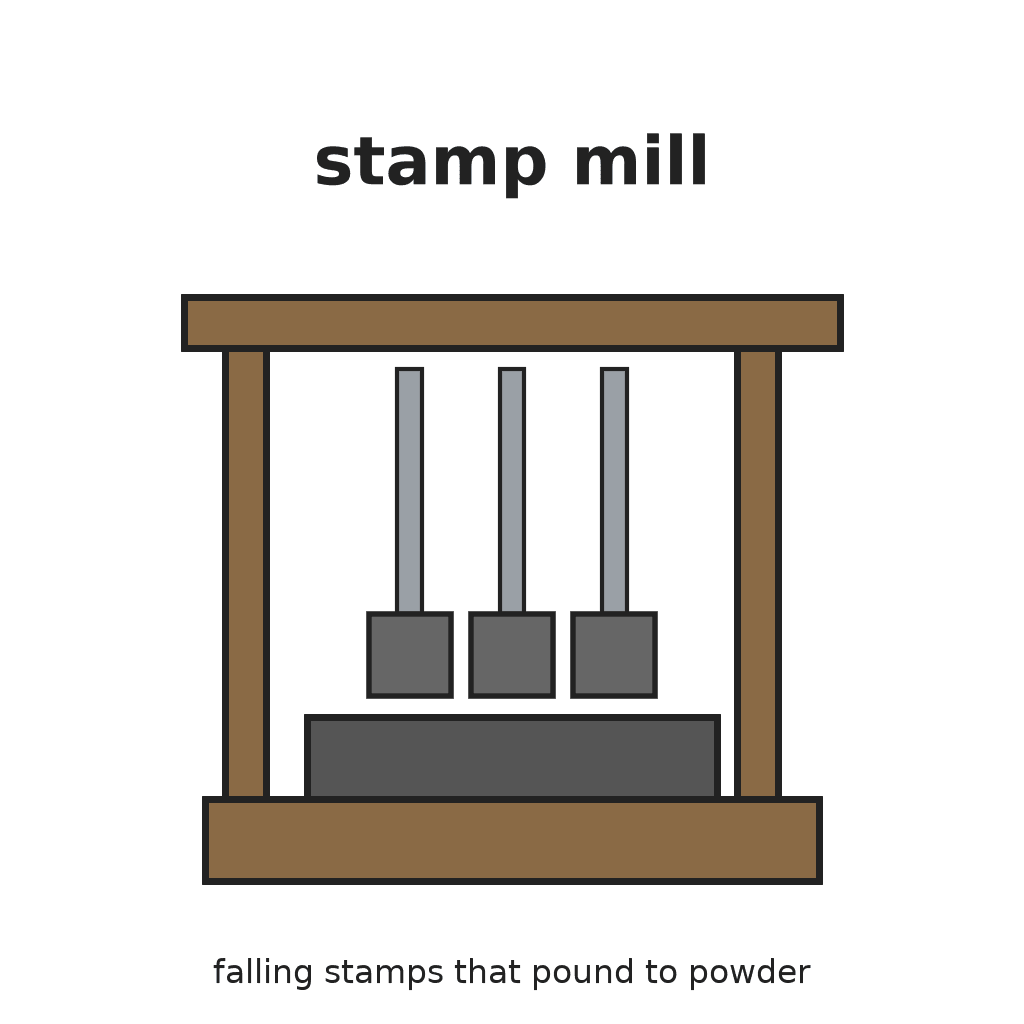
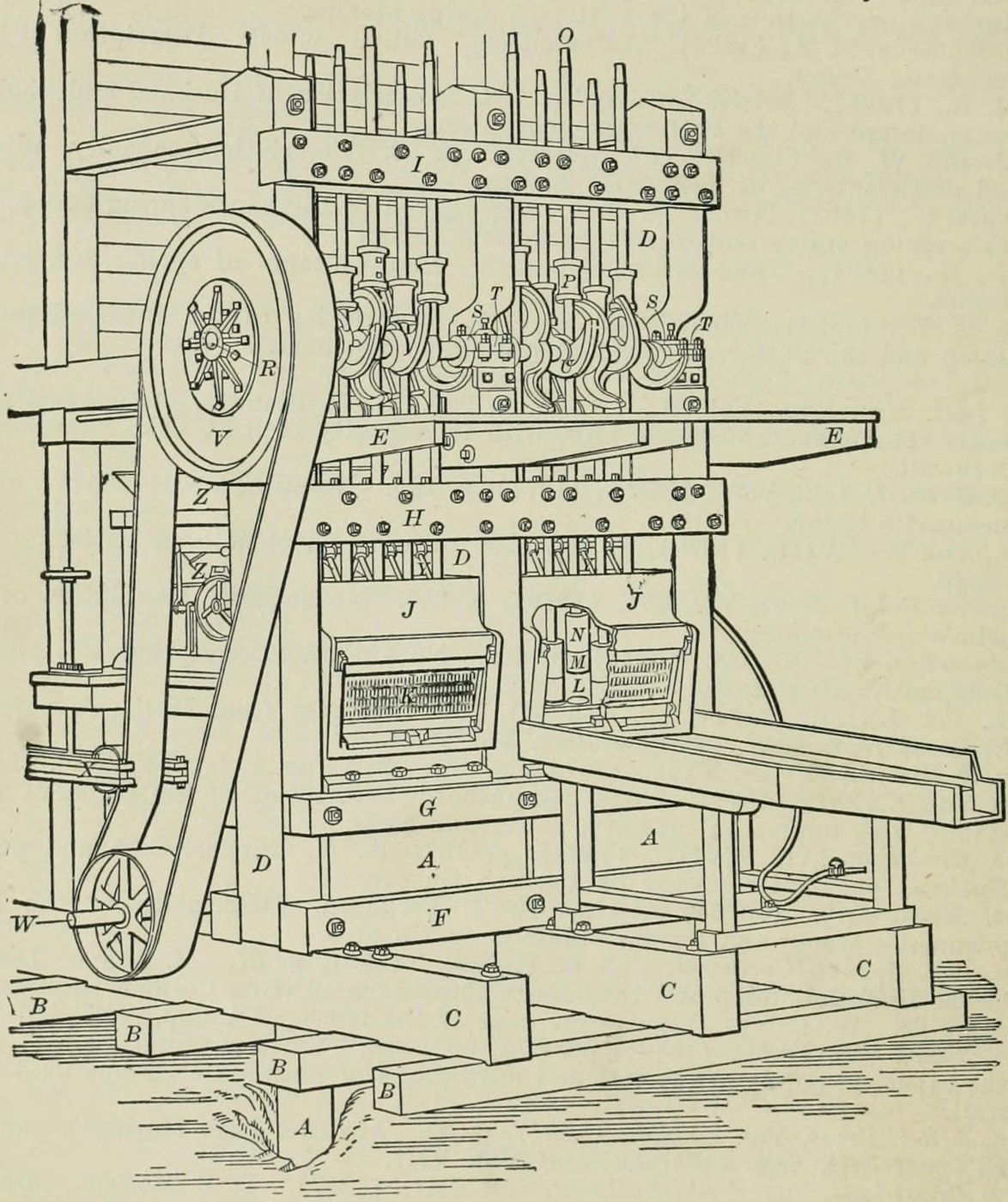
Stamp Mill: California Five-Stamp Battery (Richards, Ore Dressing 1903)
Forge

Yenziwe ngu-

Forge

3. uLwezi 2026NO
9
0
0
0
0

Stamp Mill: California Five-Stamp Battery (Richards, Ore Dressing 1903)

The gravity stamp mill: five heavy iron stamps stand in a cast-iron mortar on a timber block. Cams on a turning shaft lift each stamp by its tappet and let it fall by its own weight onto the ore on a die. Water washes the crushed ore out through a screen. Result: a stamp battery that pounds ore to sand, at 80 to 110 drops a minute. Source: R. H. Richards, Ore Dressing, vol. I (1903), Chapter V, Gravity Stamps. Unknown: one complete set of sizes; Richards gives the range found in the mills. Picture: Fig. 90 of the book.
Osezingeni eliphezulu
Unknown

Imiyalelo

1

Dig and level the foundation

Dig a trench in gravel, or blast one in rock, about 2 feet longer than the mortar block at each end and about 2 feet wider at each side. Level the bottom with tamped concrete, sand or clay. Concrete should be at least 30 inches thick, or it may crumble. Two layers of 2-inch plank spiked together may go on top.

Izinto zokwakha zalesi sinyathelo:

UkhonkoloUkhonkolo1 levelling layer
Ipulangwe lokhuniIpulangwe lokhuni1 two layers of 2-inch plank

Amathuluzi adingekayo:

IfosholoIfosholo
IsandoIsando
2

Stand the mortar block

Stand timbers or planks on end in the trench as the mortar block, sized for one five-stamp mortar. The mills used everything from 30 x 30 inch squared timbers to 2 x 12 inch planks bolted together. Set vertical bolts 3 to 4 feet long into the block to hold the mortar down. Not given: the bolts' metal.

Izinto zokwakha zalesi sinyathelo:

Ukhuni olubaziwe lwaba yisikweleUkhuni olubaziwe lwaba yisikwele1 mortar block

Insimbi engaziwaInsimbi engaziwa1 hold-down bolts

Amathuluzi adingekayo:

Isethi yamaspanelaIsethi yamaspanela
Izilinganiso ezingaziwaIzilinganiso ezingaziwa
3

Build the frame

On mud sills and cross sills, stand the posts (end posts 12 x 24 inches in most mills) with buckstaves, a platform, and lower and upper guide timbers. The guides keep the stamp stems vertical. Fit finger bars on a jack shaft between the posts, so each stamp can be propped up under its tappet. The frame carries the cam shaft and the drive.

Izinto zokwakha zalesi sinyathelo:

Ukhuni olubaziwe lwaba yisikweleUkhuni olubaziwe lwaba yisikwele1 sills, posts, guide timbers, platform
Insimbi engaziwaInsimbi engaziwa1 bolts and jack shaft

Amathuluzi adingekayo:

Isethi yamaspanelaIsethi yamaspanela
Izilinganiso ezingaziwaIzilinganiso ezingaziwa
4

Set the mortar, dies and screen

Bed the cast-iron mortar on tarred blankets or sheet rubber on the mortar block, for an even bearing, and bolt it down. Put the dies in its bottom: cylinders on square foot plates that fill the floor of the mortar. Mount a screen of punched Russia sheet iron in a wooden frame over the opening in front.

Izinto zokwakha zalesi sinyathelo:

Izinto zensimbi ethelwayoIzinto zensimbi ethelwayo1 mortar and five dies

Ishidi lerabha yemveloIshidi lerabha yemvelo1 packing
Ishidi lensimbi yaseRussiaIshidi lensimbi yaseRussia1 screen

Amathuluzi adingekayo:

Isethi yamaspanelaIsethi yamaspanela
5

Make the five stamps

Each stamp has four parts. The shoe is chilled cast iron, its butt cast in heavy chills and its shank in sand. The boss is tough cast iron, the shoe's diameter and often 18 inches long, with sockets for the shoe shank and the stem and two keyways for knock-out wedges. The stem is solid wrought iron or mild steel, turned true and tapered at both ends so it can be reversed. The tappet is cast iron, with a flange above and below, locked on the stem by a gib and keys. Put the extra weight in the boss. Louis designs for 11 to 14 pounds of stamp per square inch of die; the mills used stamps of 650 to 1,100 pounds.

Izinto zokwakha zalesi sinyathelo:

Izinto zensimbi ethelwayoIzinto zensimbi ethelwayo1 shoes, bosses, tappets
Insimbi yokukhandwa eyindukuInsimbi yokukhandwa eyinduku1 stems, gibs, keys

Amathuluzi adingekayo:
Umshini Wokuphendula InsimbiUmshini Wokuphendula Insimbi
Izilinganiso ezingaziwaIzilinganiso ezingaziwa
6

Fit the cam shaft and drive

Turn a wrought-iron or steel cam shaft true, with a key seat, and key on five cams. Each cam usually has two arms with spiral lifting faces, cast iron with chilled faces or cast steel. Drive the shaft by a rubber belt from the main shaft, over a pulley of wood built on a cast-iron hub and flanges, with a tightener. Not given: the engine or wheel that turns the main shaft.

Izinto zokwakha zalesi sinyathelo:

Insimbi yokukhandwa eyindukuInsimbi yokukhandwa eyinduku1 cam shaft
Izinto zensimbi ethelwayoIzinto zensimbi ethelwayo1 cams, pulley hub and flanges
Ipulangwe lokhuniIpulangwe lokhuni1 pulley rim
Ibhande lokushayelaIbhande lokushayela1 rubber belt

Amathuluzi adingekayo:

Umshini Wokuphendula InsimbiUmshini Wokuphendula Insimbi
Isethi yamaspanelaIsethi yamaspanela
7

Add the water and the feed

Run one or two 1-inch water pipes into the back of the mortar, each with a plug cock that stays where it is set. Feed ore from the bin by a chute to an automatic feeder. One stamp trips the feeder when the ore layer on its die gets too thin, and a hand screw adjusts the point where it trips. Ore can also be fed by hand with a shovel.

Izinto zokwakha zalesi sinyathelo:

Ipayipi LamanziIpayipi Lamanzi1 water pipes
Ivalvu engaziwaIvalvu engaziwa1 plug cocks
Insimbi engaziwaInsimbi engaziwa1 feeder and chute

Amathuluzi adingekayo:

Isethi yamaspanelaIsethi yamaspanela
IfosholoIfosholo
8

Set up each stamp

Lay a 3-inch plank on the dies and set the bosses on it. Lower the stems into them and tap each stem down with a hammer, a board guarding its top, then drop it a few times at a very low drop. Hoist the stamp, put the shoe in place with wooden staves around its shank, and drop it on the plank to drive the shoe home; the staves swell when wet and hold it. Swap the plank for a block as high as the drop. Slip the tappet on, turn the cam until the tappet rests on its point, drive the keys home and drop the stamp gently a few times.

Izinto zokwakha zalesi sinyathelo:

Amabhamuza okhuniAmabhamuza okhuni1 staves

Amathuluzi adingekayo:

Ipulangwe lokhuniIpulangwe lokhuni
IsandoIsando
Amapuli nentambo yokuphakamisaAmapuli nentambo yokuphakamisa
9

Run the battery

Drop the stamps in order 1, 3, 5, 2, 4 (numbered from the left, standing behind the battery), so no two neighbours fall one after the other. The California practice is 80 to 110 drops a minute with a 5 to 9 inch drop. The cams turn the stamps as they lift, which evens out wear on shoes and dies. Lubricate the cams; soft soap with graphite is best. As shoes and dies wear, reset the tappets to restore the drop, and keep the height of discharge, from die to screen, the same.

Amathuluzi adingekayo:

Impushana Ye-graphiteImpushana Ye-graphite
Okokwakha okungaziwaOkokwakha okungaziwa
Isethi yamaspanelaIsethi yamaspanela

Izinto

12

Amathuluzi Adingekayo

10

CC0 Isizinda Somphakathi

Le blueprint ikhishwe ngaphansi kwe-CC0. Ukhululekile ukukopisha, ukuguqula, ukusabalalisa, nokusebenzisa ngaphandle kwemvume.

Sekela uMenzi ngokuthenga imikhiqizo nge-Blueprint yabo IKhomishane Yomenzi kumiswe ngabathengisi, noma dala inguqulo entsha yale Blueprint bese uyifaka njengoxhumaniso ku-Blueprint yakho ukuze wabelane ngemali engenayo.

Ingxoxo

(0)

Ngena ukuze ujoyine ingxoxo

Kulayishwa amazwana...