UBUCIKO
UBUHLE NEMPILO
UBUCIKO BEZANDLA
AMASIKO NOMLANDO
EZOKUZIJABULISA
IMVELO
UKUDLA NEZIPHUZO
REVERSE ENGINEERING
IZAYENSI
EZEMIDLALO
UBUCHWEPHESHE
IZINTO EZIGQOKWAYO


The Ball Valve, and the Seat That Made It Work
A ball with a hole through it, turned a quarter turn by a lever: full bore when open, shut when closed, and you can see at a glance which it is. The idea is obvious enough that it was patented in 1871 — and it went nowhere for eighty years.
The reason is the **seat**. Metal on metal has to be lapped, still leaks, and is finished by the first piece of grit. What finally made the ball valve the default was PTFE, soft enough to conform to the ball without any lapping at all.
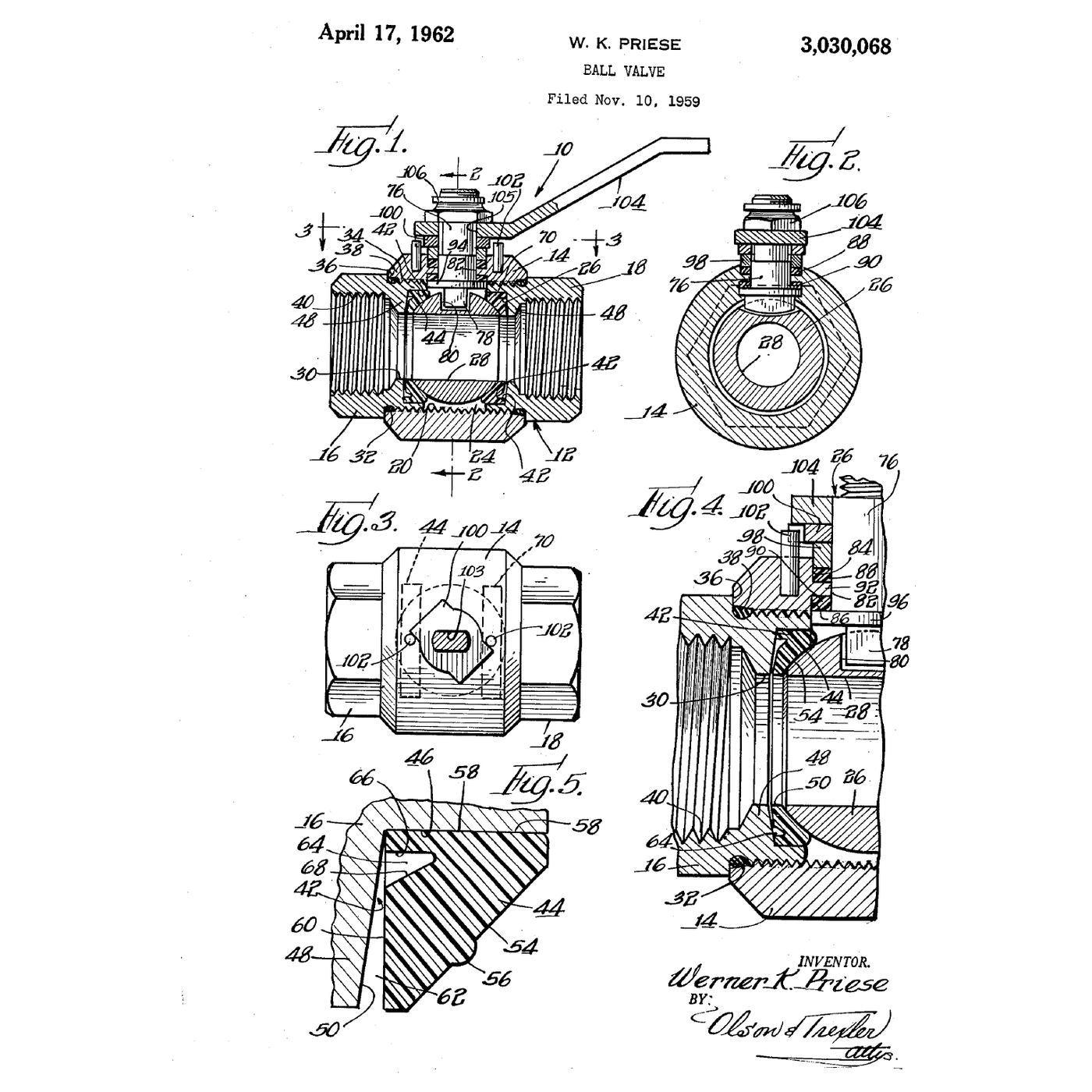
PTFE brought its own defect, and the patent on this page names it: a seat material *subject to cold flow*. It creeps under sustained load and the seal goes. This rung measures the stress in a seat, finds where PTFE gives up, and shows why the same valve that shuts off perfectly should never be left half open.
Ophakathi
About 3 hours
Imiyalelo
1
1
Read the claim, and take a ball valve apart
Read the claim, and take a ball valve apart
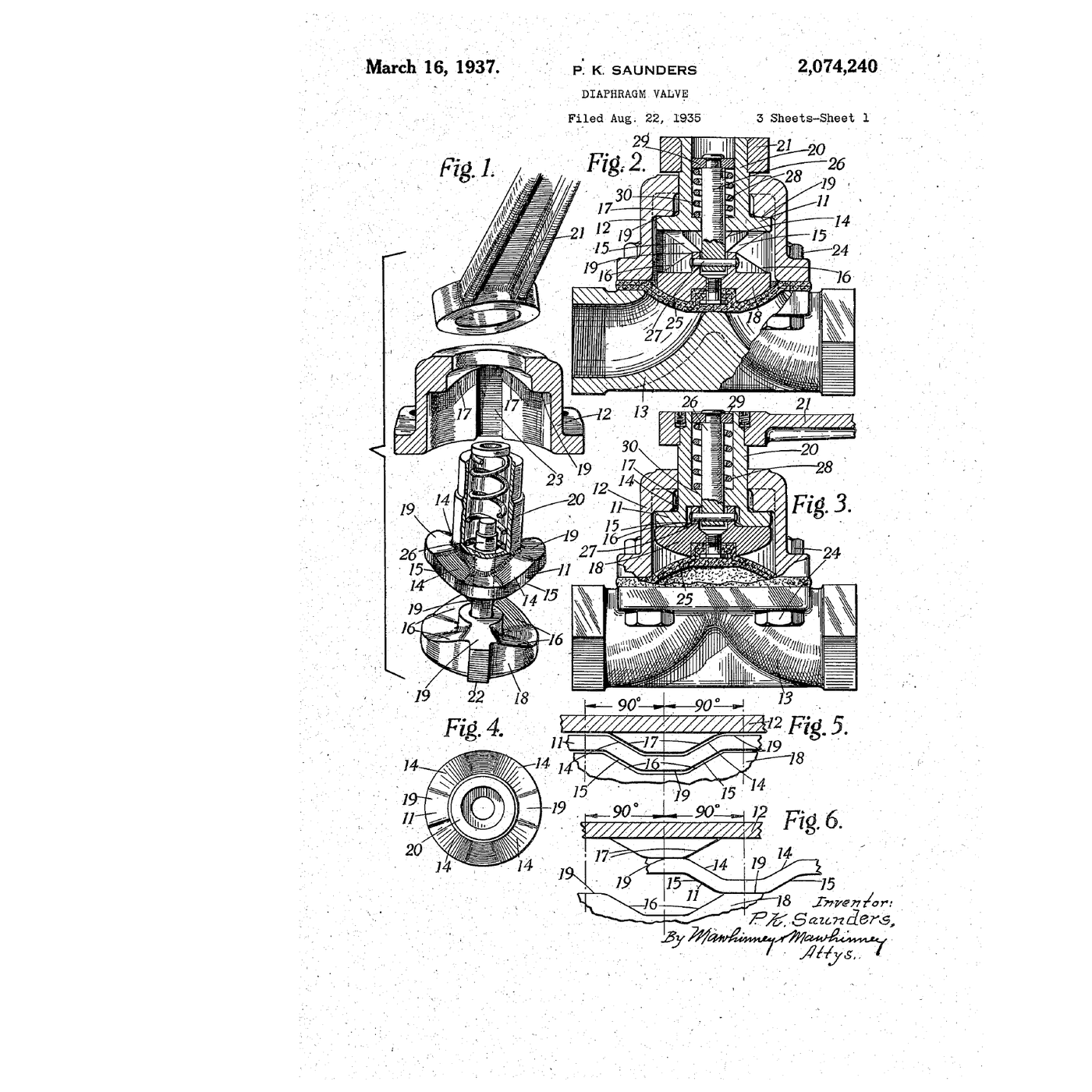
**US 3,030,068**, *Ball valve*, **Werner K. Priese** of Barrington, Illinois, assignor to Hills-McCanna; filed **10 November 1959**, Serial No. 852,144, patented **17 April 1962**; 8 claims, US class 251-214. Expired. The drawing on this page is the patent's own sheet 1.
The specification's objects are worth reading in order, because they are the problem statement: an improved ball valve with *a most efficient seating of the valve ball against coacting valve seats formed of a highly advantageous valve seat material which is, nevertheless, subject to* — and then it names the catch, which is **cold flow**. It goes on to want *reliable sealing of the seats against the ball over a remarkable* range.
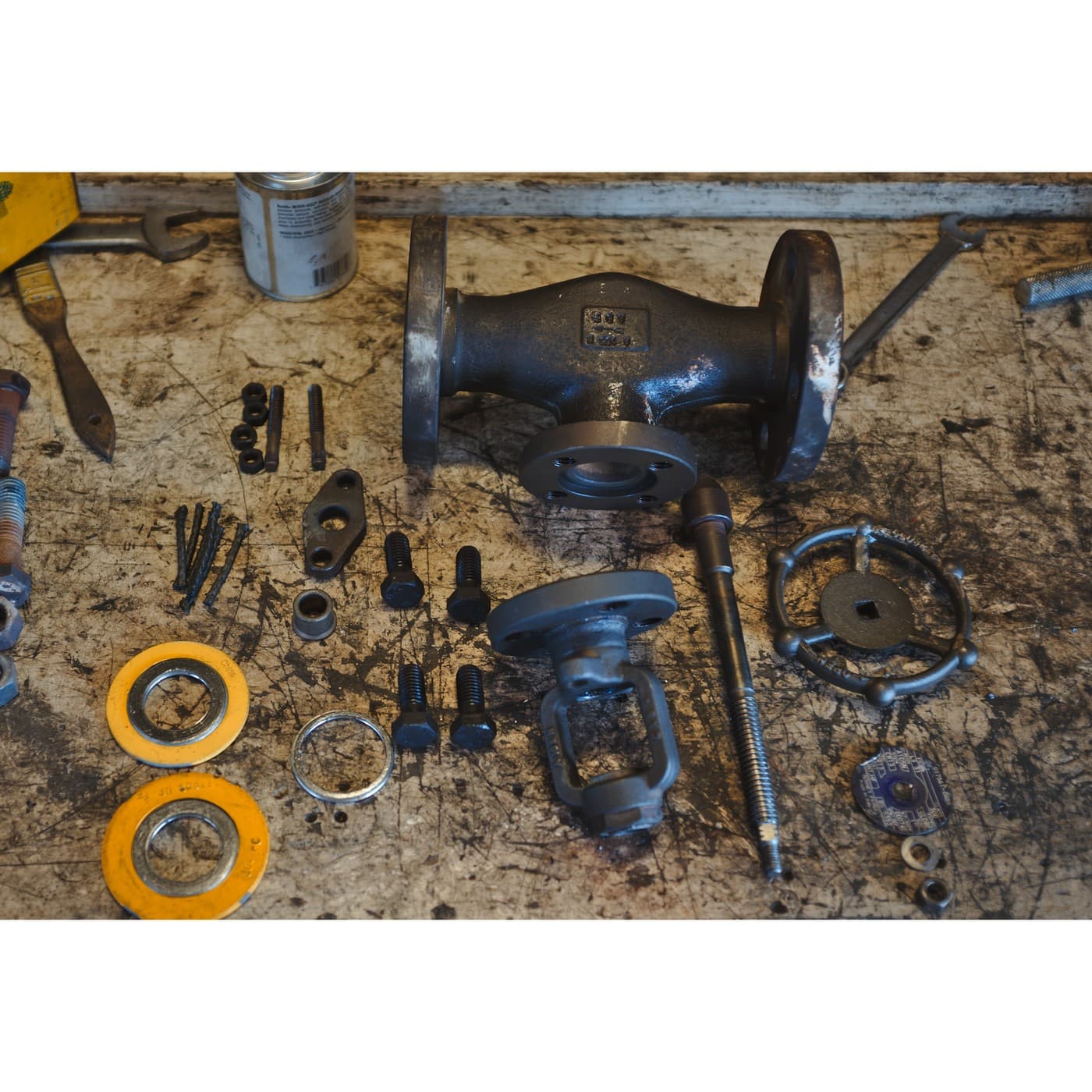
Now take a cheap brass ball valve apart. Most unscrew: the end cap comes off, and the ball and two seat rings come out.
Handle the seats. They are white, waxy, slightly greasy PTFE, and they are **not flat** — each is machined with a spherical face to match the ball. Measure the seat's contact width with the calipers: it is a millimetre or two, and step 4 shows that this width is the whole design.
Look at the ball. Note that there is nothing holding it central — in a **floating ball** valve, line pressure pushes the ball downstream against the far seat, and that is what makes the seal. The valve seals *because* of the pressure it is holding.
Amathuluzi adingekayo:
 Ivalvu eyibhola yethusi
 Isipanela esilungisekayo
 Isethi yamaspanela
 Isibambo Sebhentshi
 I-Caliper Yedijithali Yamayintshi Ayi-6
 I-Micrometer
 Isibonakhulu Sedijithali
2
2
Measure the torque, and find where it goes
Measure the torque, and find where it goes
A ball valve's operating torque tells you most of what is happening inside it.
Clamp the valve in the vise and turn it with a torque wrench on the stem flats, reading the peak. Do it in this order and record each:
1. **Dry, no pressure.** This is the seats squeezing the ball plus the stem seal.
2. **With water at line pressure, valve shut.** Higher — the pressure is pressing the ball into the downstream seat, which is what makes it seal, so the torque to break it free rises with pressure.
3. **Straight after cycling it fifty times.** Often *lower*, as the seats bed in.
4. **After it has sat shut under pressure for a day.** Often noticeably higher — the seats have crept slightly into the ball's shape and have to be broken out of it.
That last one is cold flow, measured with a torque wrench.
Then try the classic failure: leave the valve **shut** and warm it gently with hot water poured over it, let it cool, and measure again. PTFE creeps far faster warm. A ball valve left closed in a hot line for months can need real force to move, and when it does move it may then leak, because the seat that conformed to the ball in one position no longer matches it in another.
Keep pressure domestic, restrain the valve, and keep fingers off the lever when applying torque.
Amathuluzi adingekayo:
Ivalvu eyibhola yethusi Isipanela Se-torqueIsibambo Sebhentshi
 Isilinganiso Sengcindezi
 Ipayipi Le-silicone
 Ibhakede
 Iwashi Lokumisa Isikhathi
 Izibuko Zokuphepha Ezicwathile
 Amagilavu E-nitrile
3
3
Destroy a seat by throttling with it
Destroy a seat by throttling with it
This is rung 1's gate-valve lesson repeated in a different material, and the result is faster and more dramatic.
Set a ball valve about a tenth open — just off the seat — and run the highest flow you can through it for twenty minutes. Then shut it fully and test for leak-through.
Take it apart. Under the microscope the **upstream** seat will show a scoured crescent where the jet has been playing on it. PTFE has no hardness to resist that; it is simply washed away.
Note where the damage is and why. At small openings the whole flow passes through a narrow crescent between the ball's port and the body bore, and that jet is aimed straight at the seat's inner edge. Fully open or fully shut, nothing touches the seat at speed.
This is why the shop rule is **a ball valve is an on-off valve**. It is not that it cannot be set part-open; it is that doing so consumes the one part that made it worth having.
One exception worth knowing: a **V-port** or **characterised** ball valve has a shaped notch in the ball and a hard seat, and is designed for throttling. It is a different valve that happens to share a shape, and it costs several times as much.
Amathuluzi adingekayo:
Ivalvu eyibhola yethusiIpayipi Le-siliconeIbhakedeIsibonakhulu SedijithaliIsipanela esilungisekayoIsibambo SebhentshiI-Caliper Yedijithali Yamayintshi Ayi-6Izibuko Zokuphepha EzicwathileAmagilavu E-nitrile4
4
Seat stress, cold flow, and the handle that does nothing
Seat stress, cold flow, and the handle that does nothing
Ilayisha incwadi ye-Jupyter…
5
5
History and context
History and context
**Attribution.** US 3,030,068, *Ball valve*, Werner K. Priese, assignor to Hills-McCanna; filed 10 November 1959, granted 17 April 1962, expired. The drawing on this page is the patent's own.
**Why 1962 and not 1871.** A spherical plug valve was patented by John Warren in 1871 and assigned to Chapman Valve — and Chapman's own catalogues for the next fifty years do not mention it, which is the clearest possible evidence that it did not work commercially. The geometry was never the problem. Sealing a hard ball against a hard seat, in a valve that must be cheap, is the problem.
**PTFE is the enabling material**, and it arrives by accident: Roy Plunkett found it at du Pont in 1938, and it became available in quantity through wartime work where its chemical inertness was the point. The catalogue already holds the polymer rungs around it. Once a seat could be soft, conformable and chemically indifferent, the ball valve stopped being a clever idea and became the default.
**The idea to keep.** A long-standing mechanical problem was solved not by better geometry or tighter tolerances but by **a material with a different failure mode**. PTFE is worse than brass in almost every way — softer, weaker, creeping, more expensive — and one property, conformability, made all of that irrelevant. When a design has been stuck for eighty years, the thing that unsticks it is usually not in the drawing.
**Honest limits.** Cold flow is real and it sets the temperature and pressure envelope of every soft-seated valve. Filled PTFE resists creep better and seals less well; that trade is the difference between the cheap valve and the expensive one. A floating-ball valve seals *because* of line pressure, so it seals poorly at very low pressure — which surprises people testing with air at a few hundred millibars. And throttling ruins it, for the reasons step 3 demonstrates.
Amathuluzi Adingekayo
14- Isibambeli
- Isibambeli
- Isibambeli
- Isibambeli
- Isibambeli
- Isibambeli
- Isibambeli
- Isibambeli
- Isibambeli
- Isibambeli
- Isibambeli
- Isibambeli
- Isibambeli
- Isibambeli
Ama-blueprint ahlobene
Lama-blueprint abelana ngolwazi — amasu, izinto noma izimiso


CC0 Isizinda Somphakathi
Le blueprint ikhishwe ngaphansi kwe-CC0. Ukhululekile ukukopisha, ukuguqula, ukusabalalisa, nokusebenzisa ngaphandle kwemvume.
Sekela uMenzi ngokuthenga imikhiqizo nge-Blueprint yabo IKhomishane Yomenzi kumiswe ngabathengisi, noma dala inguqulo entsha yale Blueprint bese uyifaka njengoxhumaniso ku-Blueprint yakho ukuze wabelane ngemali engenayo.