UBUCIKO
UBUHLE NEMPILO
UBUCIKO BEZANDLA
AMASIKO NOMLANDO
EZOKUZIJABULISA
IMVELO
UKUDLA NEZIPHUZO
REVERSE ENGINEERING
IZAYENSI
EZEMIDLALO
UBUCHWEPHESHE
IZINTO EZIGQOKWAYO
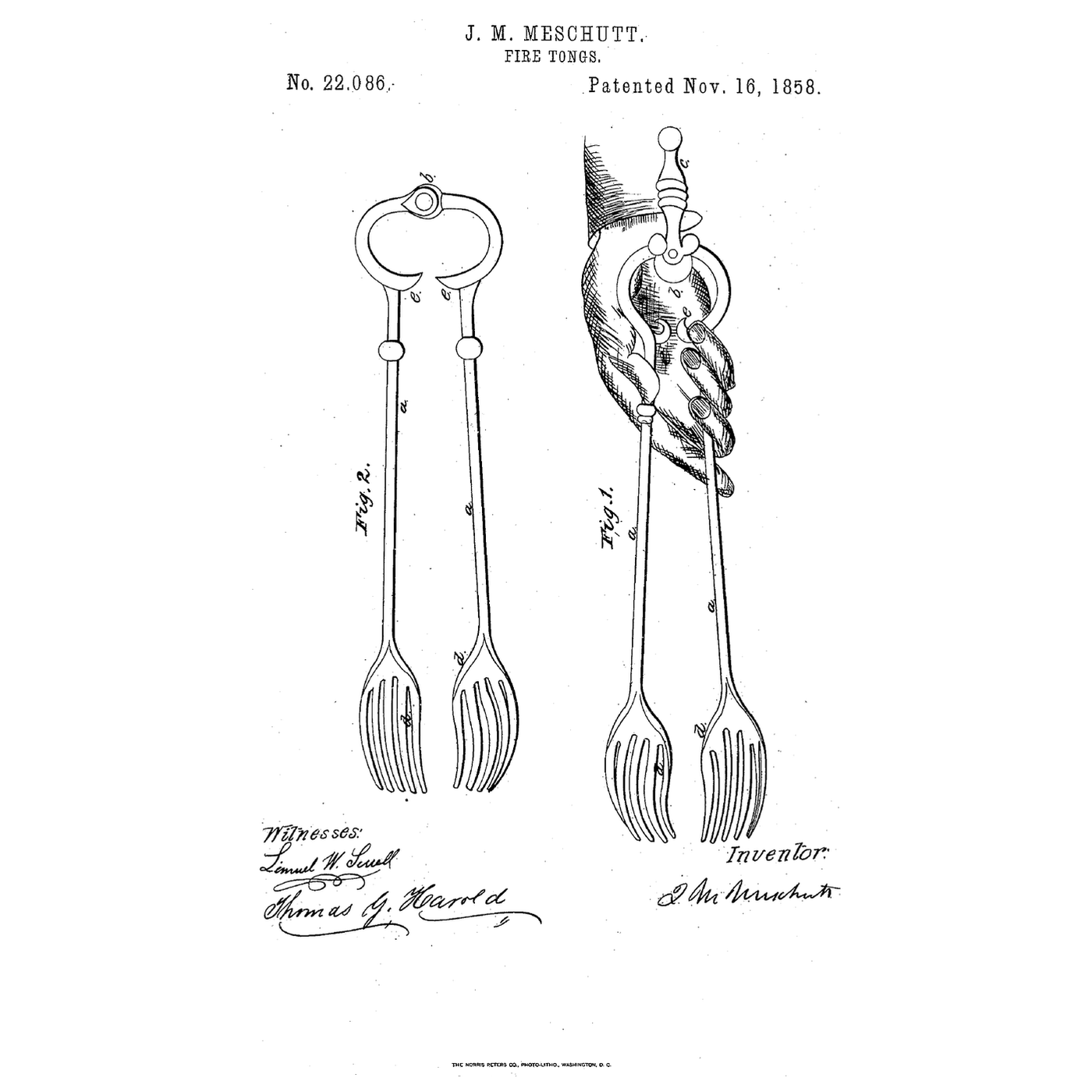

The Forked Fire Tongs: Curved Prongs for Coal, and Stops That Keep Them From Crossing
Flat-ended fire tongs made for wood fires slip off lumps of coal and clinker, and cannot let the ashes fall away.
James M. Meschutt of New York received US 22,086, dated 16 November 1858, for tongs for coal fires in which, "In place of the ordinary flat ends to the legs, I make use of fingers or curved prongs d, d, which setting opposite to each other enable the party using the same to take hold of coals, clinkers, cinders and similar articles with great facility", with projections e, e close to where the hand holds them, "to prevent pressure by the hand, forcing the prongs or fingers d, d, past each other so as to overlap and stick or bind together".
This rung works out how the stops set the prongs' closest approach and how much of the squeeze reaches them, then forges the tongs from steel rod with forked prongs and stops, and sorts cold clinker and coal with them.
Ophakathi
About 4 hours
Imiyalelo
1
1
Stops and squeeze
Stops and squeeze
Ilayisha incwadi ye-Jupyter…
2
2
Tongs before it
Tongs before it
The embedded blueprint forges a blacksmith's tongs. Meschutt's are for the household coal fire, with forked prongs and stops that keep them from crossing.
3
3
Read US 22,086
Read US 22,086
"a, a, are the legs of my tongs jointed together at b, and a handle c, (Fig. 1,) may be provided at this point if desired. In place of the ordinary flat ends to the legs, I make use of fingers or curved prongs d, d, which setting opposite to each other enable the party using the same to take hold of coals, clinkers, cinders and similar articles with great facility; my tongs however would not be perfect without the projections e, e, close to that part of the legs at which the hand of the operator seizes the tongs"
"said tongs are applicable under a variety of circumstances in household affairs such as removing the burning coals from a fire no longer needed to be burning, cleaning out cinders, clinkers &c. from grates instead of using the hands, at the same time permitting the ashes to fall away"
4
4
Forge the tongs and sort a grate
Forge the tongs and sort a grate
**Legs.** Cut two 55 cm lengths of 8 mm mild steel rod. Heat one end of each and bend it into a half loop, so the two loops together make the bow at the top, and flatten their ends where they overlap for the joint.
**Prongs.** Flatten the other end of each leg for 8 cm to about 25 mm wide, saw it into four fingers with the hacksaw, round them, and bend them into a curve so the two sets face each other.
**Joint and stops.** Drill the overlapping ends and rivet them loosely as the joint b. Silver-solder a short stud of rod to each leg just below the bow, where the hand holds them, so the studs meet when the prongs are about 5 mm apart; file the studs to adjust.
**Test.** From a cold grate or barbecue, pick out lumps of charcoal and clinker and lift them into a bucket, shaking the ashes off. Squeeze hard and check that the prongs never cross.
Izinto zokwakha zalesi sinyathelo:
 Ubhamu Oluyindilinga Lwensimbi Ethambile1.2 amamitha
 Isoda Lesiliva1 ucezu
 Ifulaksi1 ucezu
 Amalahle Achotshoziwe1 ucezu
Amathuluzi adingekayo:
 Isaha Sensimbi
 Isibani Se-propane
 Insimbi Yokukhandela
 Isando
 Isibambo Sebhentshi
 Izinsimbi zokuhlikihla (ezesandla)
 Ibhola Elingenantambo
 Iqoqo Lamakhanda Ebhola
 Ibhakede
 Amagilavu Amelana Nokushisa
 Izibuko Zokuphepha Ezicwathile
5
5
Tongs that cross, slip or bend
Tongs that cross, slip or bend
Forked fire tongs troubleshooting.
Flow
Loading...
6
6
History and honest limits
History and honest limits
**James M. Meschutt** of New York, New York, received US 22,086, dated 16 November 1858. He noted that oyster rakes and sugar tongs had been made with fingers before, but held his tongs to be a new article for coal fires, and that ordinary tongs for wood were useless with coal. His claim is metallic tongs for coal fires with fingers or curved prongs and the projections that keep the fingers from coming too close together.
**Honest limits.** Hand-forged rod and soldered studs stand in for his made tongs, and the test uses a cold grate. The notebook treats the legs as rigid and turning about one joint; its lengths and forces are examples. Your sorted grate is the result.
Izinto
4- 1.2 amamithaIsibambeli
- 1 ucezuIsibambeli
- 1 ucezuIsibambeli
- 1 ucezuIsibambeli
Amathuluzi Adingekayo
11- Isibambeli
- Isibambeli
- Isibambeli
- Isibambeli
- Isibambeli
- Isibambeli
- 1 vendor sell this, none ship to you yetIsibambeli
- Isibambeli
- Isibambeli
- Isibambeli
- Isibambeli
Le blueprint yenza
Ama-blueprint ahlobene
Lama-blueprint abelana ngolwazi — amasu, izinto noma izimiso
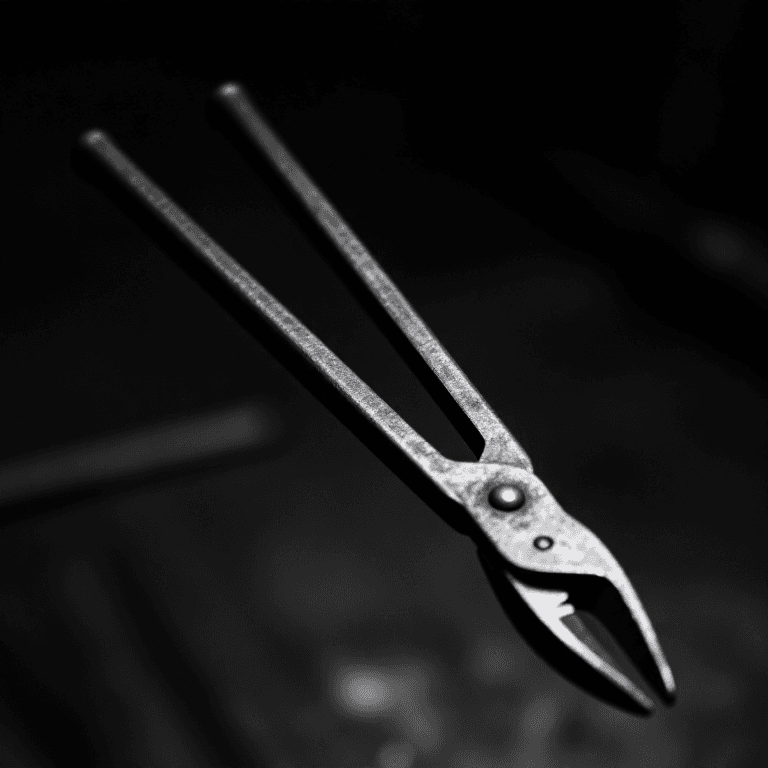
Forging a Pair of Iron Tongs — The Blacksmith's Essential Gripping Tool
ngu-Forge
Amathuluzi Ensimbi
27
0
0
0
1
0
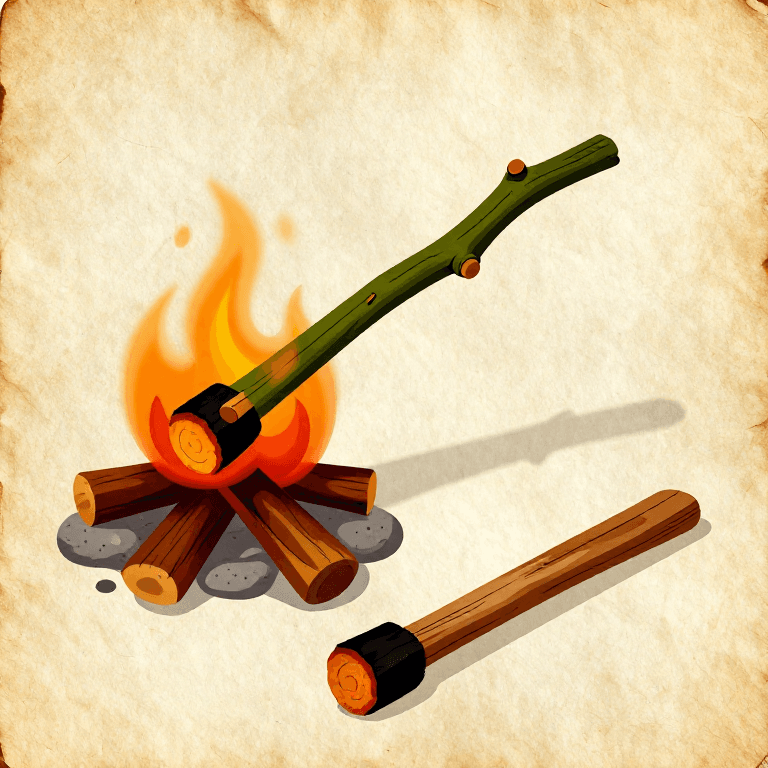
Making Wooden Fire Tongs — Split-Stick Spring Tongs for Handling Hot Stones and Coals
ngu-Woody
Umsebenzi Wokhuni
47
0
0
0
0
0

The Law of the Lever — Archimedes' Balance of Weight and Distance
ngu-Martin
I-Physics
65
0
0
0
1
0
CC0 Isizinda Somphakathi
Le blueprint ikhishwe ngaphansi kwe-CC0. Ukhululekile ukukopisha, ukuguqula, ukusabalalisa, nokusebenzisa ngaphandle kwemvume.
Sekela uMenzi ngokuthenga imikhiqizo nge-Blueprint yabo IKhomishane Yomenzi kumiswe ngabathengisi, noma dala inguqulo entsha yale Blueprint bese uyifaka njengoxhumaniso ku-Blueprint yakho ukuze wabelane ngemali engenayo.