UBUCIKO
UBUHLE NEMPILO
UBUCIKO BEZANDLA
AMASIKO NOMLANDO
EZOKUZIJABULISA
IMVELO
UKUDLA NEZIPHUZO
REVERSE ENGINEERING
IZAYENSI
EZEMIDLALO
UBUCHWEPHESHE
IZINTO EZIGQOKWAYO
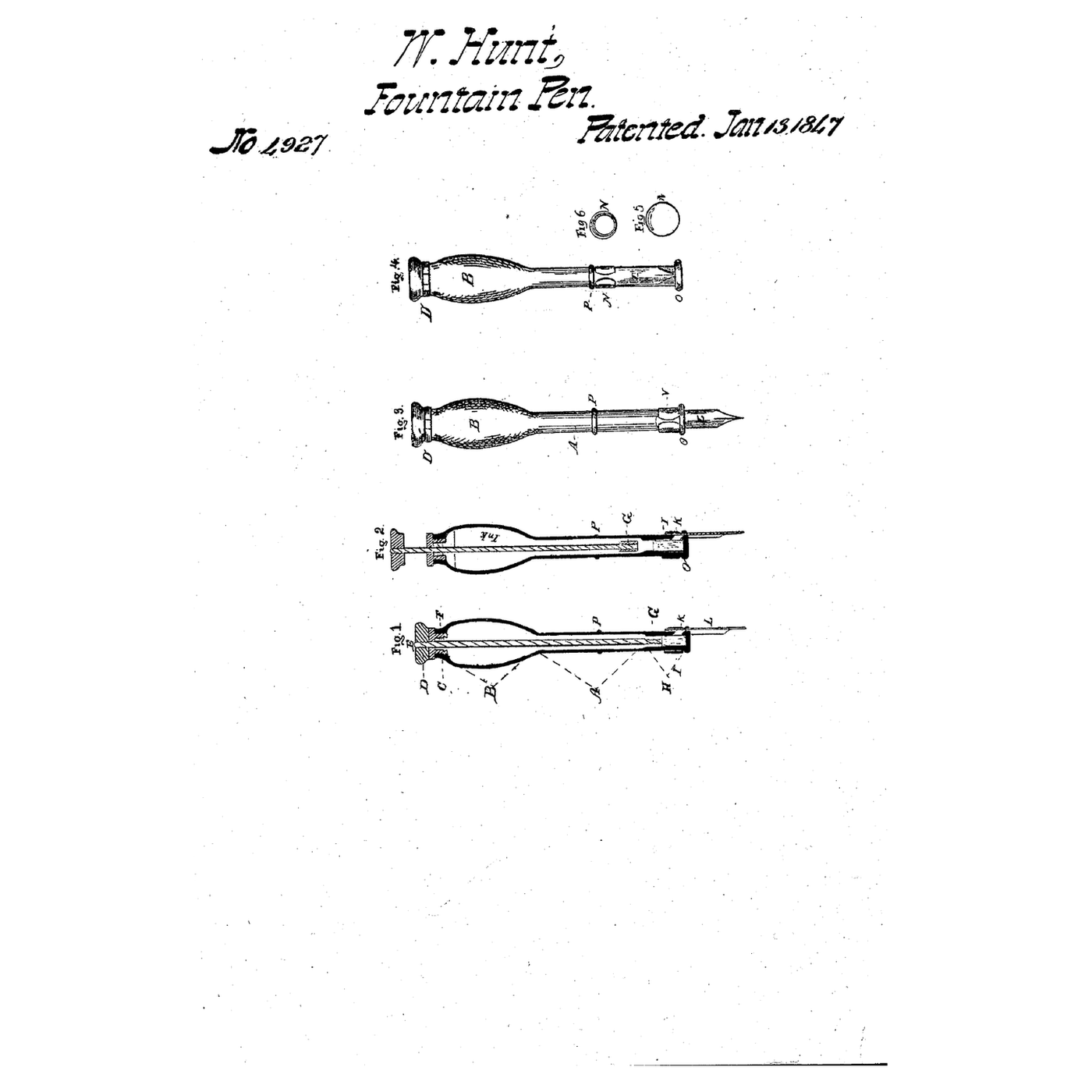


The Plunger-Filled Fountain Pen: A Measured Dose of Ink per Stroke
Carrying ink meant carrying an inkstand, and early reservoir pens either flooded or ran dry.
Walter Hunt of New York received US 4,927, dated 13 January 1847, for a fountain pen that is "the combination of all in one of inkstand, pen, shaft, and pen holder, so arranged as to be convenient for the pocket, and adapted to the common steel pen". A rubber plunger drawn back lets ink fall from the reservoir into a small filling tube; returned suddenly, it "forces the ink in said tube into the barrel of the pen" through a sponge stopper, so each stroke gives the same dose. "It never dries up, nor leaks, and is certain to throw out the requisite quantity of ink".
This rung works out the dose and the number of fillings from Hunt's sizes, then builds a fixed-dose filler from a syringe and an acrylic reservoir and weighs its strokes.
Ophakathi
About 3 hours
Imiyalelo
1
1
Dose and fillings
Dose and fillings
Ilayisha incwadi ye-Jupyter…
2
2
The pen that had to be dipped
The pen that had to be dipped
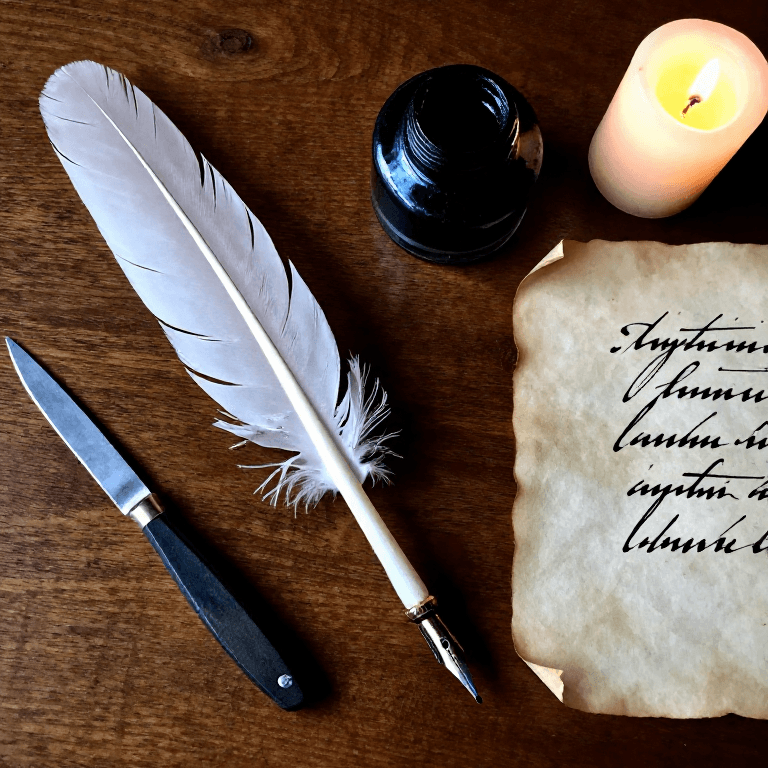
The embedded blueprint cuts a quill that must be dipped every few words. Hunt carries the ink with the pen and feeds a fixed dose to a common steel nib.
3
3
Read US 4,927
Read US 4,927
"The manner of filling and using, is as follows: when the pen is to be filled, the plunger is drawn back by the thumb and finger, hold of the nut D, which allows the ink to fall from the reservoir B, into the filling tube H. The plunger is then suddenly returned, which forces the ink in said tube into the barrel of the pen, through the aperture K, said plunger forming a perfect stopper in said tube which prevents the escape of the ink until another supply for the pen is required."
"Felting, or woolen cloth, will probably answer in the room of sponge, for the purpose of the stopper, as its office is to check the flow of the ink through the aperture K, except under the pressure of the piston as before stated."
4
4
Build the filler and weigh its doses
Build the filler and weigh its doses
**Reservoir.** Cut 5 cm of clear acrylic tube as the reservoir and seal a disc of rubber sheet across its lower end with a hole in the middle.
**Filling tube and plunger.** Take a Luer syringe: its barrel is the filling tube, its plunger the piston. Cut a side port in the barrel near its top with the craft knife, below where the plunger sits when drawn back, and seal the reservoir's hole over that port with epoxy, so ink falls in when the plunger is drawn back.
**Stopper and nib.** Push a plug of sponge into the syringe's nozzle and fit a dip-pen nib against it.
**Test.** Fill the reservoir with ink. Draw the plunger back past the port, wait a moment, and push it home once. Weigh the assembly before and after with the kitchen scale; 1 g of ink is about 1 ml. Do ten strokes and compare the spread with a free squeeze of a syringe. Then write with the nib until it runs dry, and count the words.
Izinto zokwakha zalesi sinyathelo:
 Ishubhu le-acrylic (elicacile)0.05 imitha
 Inaliti yokujova - Luer1 ucezu
 Ishidi lerabha1 ucezu
 Isipontshi1 ucezu
 I-epoxy resin5 ml
 Uyinki wokubhala30 ml
Amathuluzi adingekayo:
 Isaha Sensimbi
 Ummese Womsebenzi Wezandla
 Ibhola Elingenantambo
 Iqoqo Lamakhanda Ebhola
 Isikali Sedijithali Sasekhishini
 Isethi yamapeni okubhala okuhle
5
5
A filler that floods, runs dry or gives uneven doses
A filler that floods, runs dry or gives uneven doses
Plunger-filled fountain pen troubleshooting.
Flow
Loading...
6
6
History and honest limits
History and honest limits
**Walter Hunt** of New York signed US 4,927 on 12 September 1845; it is dated 13 January 1847. His plunger was india rubber, or leather saturated with india-rubber paste, on a wire piston rod through a stuffing box; a band with a crescent opening held the pen, and a sliding holder let the pen be drawn back and shielded for the pocket. His claim is the filling tube of graduated capacity combined with the fountain pen. The same Walter Hunt patented the float inkstand in 1845 and later the safety pin.
**Honest limits.** A Luer syringe and an acrylic tube stand in for his shaft, reservoir and plunger. The notebook uses his printed sizes, taking the bulb as a cylinder. Your dose weighings are the result.
Izinto
6- 0.05 imithaIsibambeli
- 1 ucezuIsibambeli
- 1 ucezuIsibambeli
- 1 ucezuIsibambeli
- 5 mlIsibambeli
- 30 mlIsibambeli
Amathuluzi Adingekayo
6- Isibambeli
- Isibambeli
- 1 vendor sell this, none ship to you yetIsibambeli
- Isibambeli
- Isibambeli
- Isibambeli
Le blueprint yenza

Ama-blueprint ahlobene
Lama-blueprint abelana ngolwazi — amasu, izinto noma izimiso



CC0 Isizinda Somphakathi
Le blueprint ikhishwe ngaphansi kwe-CC0. Ukhululekile ukukopisha, ukuguqula, ukusabalalisa, nokusebenzisa ngaphandle kwemvume.
Sekela uMenzi ngokuthenga imikhiqizo nge-Blueprint yabo IKhomishane Yomenzi kumiswe ngabathengisi, noma dala inguqulo entsha yale Blueprint bese uyifaka njengoxhumaniso ku-Blueprint yakho ukuze wabelane ngemali engenayo.