UBUCIKO
UBUHLE NEMPILO
UBUCIKO BEZANDLA
AMASIKO NOMLANDO
EZOKUZIJABULISA
IMVELO
UKUDLA NEZIPHUZO
REVERSE ENGINEERING
IZAYENSI
EZEMIDLALO
UBUCHWEPHESHE
IZINTO EZIGQOKWAYO


The Spindle Cotton Picker: Wind the Lint Off the Boll
Cotton opens unevenly and the lint clings in its boll, so for a century after the gin it was still picked by hand. Inventors had tried combs, suction and barbed spindles, which wound the lint up but held on to it and choked.
John Rust found that a **smooth, moist spindle** turning in the open boll would wind the lint off without trapping it, so a doffer could strip it clean. He filed for a patent in 1928 and received his first in 1933; he and his brother Mack eventually held 47 on cotton picking. On 31 August 1936 their machine picked cotton in public at the Delta Experiment Station in Stoneville, Mississippi.
This rung works out how the drum is timed so the spindles do not drag through the plant, and repeats Rust's wet-against-dry test on real bolls.
Oqalayo
About 2 hours
Imiyalelo
1
1
Timing the drum to the ground speed
Timing the drum to the ground speed
Ilayisha incwadi ye-Jupyter…
2
2
Read the drum from above
Read the drum from above
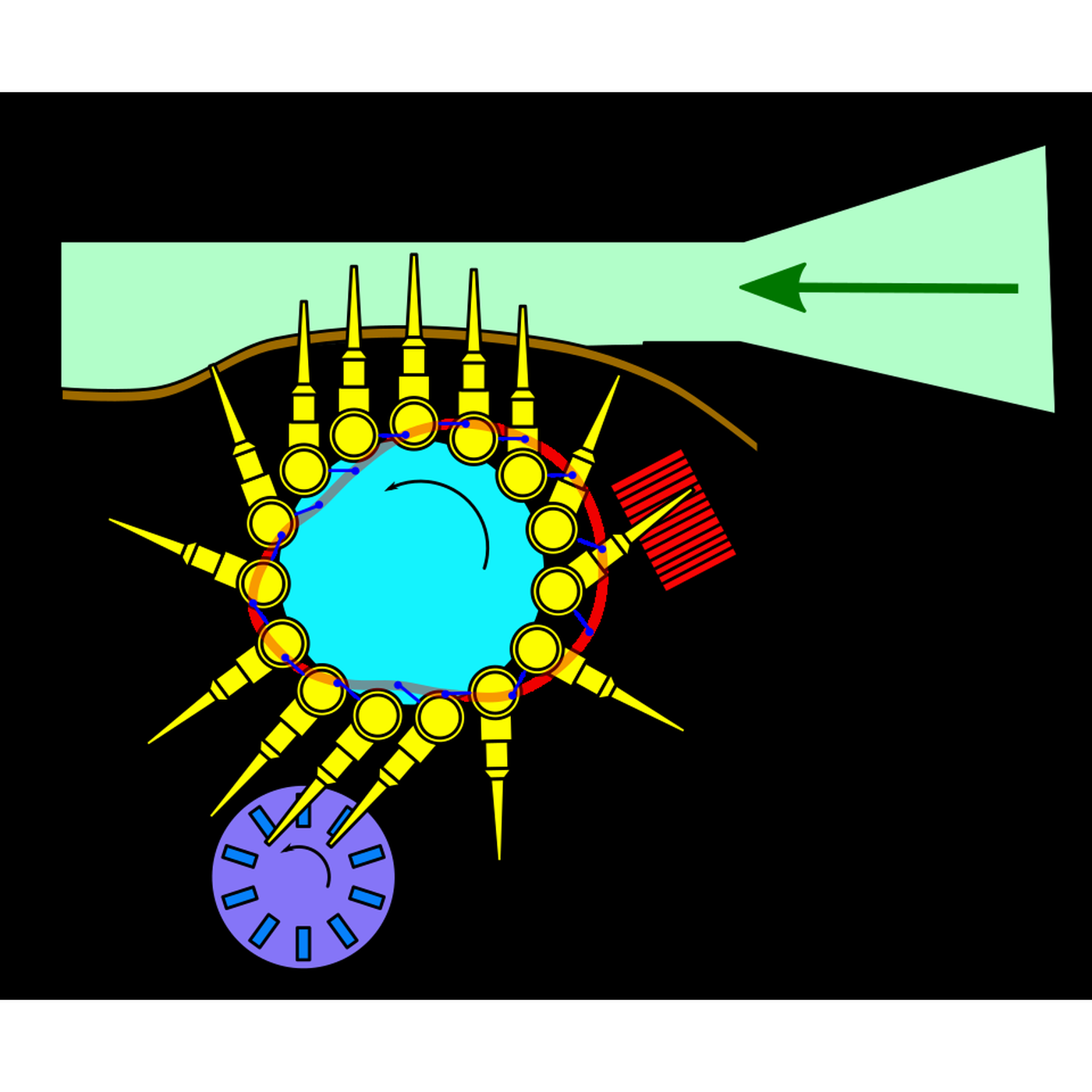
The thumbnail shows one spindle drum from above. The machine moves to the right, so the cotton plants (pale green), squeezed sideways into the row unit, move to the left past it. The drum (pale blue) carries rows of spindles (yellow); a cam — the ends of the arms following the pink track — turns them so they reach straight into the plants through the slots between the brown ribs, and wind on the lint.
As the drum carries them round and away from the row, they pass the **doffer** (violet, with blue pads) that unwinds the lint off them, and then the **moistener** (red) that wets them again before they return to the plants.
Each spindle also spins on its own axis, driven through gears in the drum, so the lint winds on as it touches the boll.
3
3
Repeat Rust's wet spindle test
Repeat Rust's wet spindle test
Chuck a smooth hardwood dowel, about 10 mm across, in a cordless drill on its lowest speed. Hold an open cotton boll in one hand and touch the turning dowel to the lint for two seconds, then pull back.
Do it ten times with a **dry** dowel, weighing the lint wound on each time. Then mist the dowel with water from a spray bottle and do it ten times again. Then try stripping the wound lint off each by sliding a gloved hand along the dowel against its rotation — the job of the doffer.
Record the grams per touch for dry and wet, and whether the lint comes off cleanly. Rust's finding was that the moist smooth spindle both takes the lint and gives it up; your numbers are the test. Keep the lint for the cotton gin blueprint.
Izinto zokwakha zalesi sinyathelo:
 Izikhwama zikakotini eziluhlaza20 izicucu
 Izikhonkwane zokhuni oluqinile2 izicucu
 Amanzi1 ilitha
Amathuluzi adingekayo:
 Ibhola Elingenantambo
 Isikali Sedijithali Sasekhishini
 Iwashi Lokumisa Isikhathi
 Amagilavu Omsebenzi Esikhumba
 Izibuko Zokuphepha Ezicwathile
 Ibhodlela lokufafaza amanzi
4
4
Next the seed comes out
Next the seed comes out
What the picker delivers is seed cotton. The embedded blueprint separates lint from seed — the step that must follow every picker, by hand or by machine.
5
5
A picker leaving cotton in the field
A picker leaving cotton in the field
Losses in the field point to a small number of causes.
Flow
Loading...
6
6
History and context
History and context
**John Daniel Rust** filed for a moistened-spindle picker patent in **1928** and received his first patent in **1933**. With his brother **Mack Rust** he founded the Rust Cotton Picker Company in Memphis in 1935 and demonstrated the machine at Stoneville on **31 August 1936**. Its first version had serious faults, but it picked cotton, and the public demonstration drew national attention. Other manufacturers developed spindle pickers of their own, and machine picking spread through the American cotton belt after the Second World War.
Modern spindles are barbed rather than smooth, but they are still moistened, and still stripped by doffers.
**Honest limits.** Machine-picked cotton carries more leaf and trash than hand-picked, so gins added cleaning stages. The picker also removed the work of hundreds of thousands of hand pickers — a social upheaval the Rust brothers themselves worried about.
Izinto
3- 20 izicucuIsibambeli
- 2 izicucuIsibambeli
- 1 ilithaIsibambeli
Amathuluzi Adingekayo
6- 1 vendor sell this, none ship to you yetIsibambeli
- Isibambeli
- Isibambeli
- Isibambeli
- Isibambeli
- Isibambeli
Ama-blueprint ahlobene
Lama-blueprint abelana ngolwazi — amasu, izinto noma izimiso


CC0 Isizinda Somphakathi
Le blueprint ikhishwe ngaphansi kwe-CC0. Ukhululekile ukukopisha, ukuguqula, ukusabalalisa, nokusebenzisa ngaphandle kwemvume.
Sekela uMenzi ngokuthenga imikhiqizo nge-Blueprint yabo IKhomishane Yomenzi kumiswe ngabathengisi, noma dala inguqulo entsha yale Blueprint bese uyifaka njengoxhumaniso ku-Blueprint yakho ukuze wabelane ngemali engenayo.