UBUCIKO
UBUHLE NEMPILO
UBUCIKO BEZANDLA
AMASIKO NOMLANDO
EZOKUZIJABULISA
IMVELO
UKUDLA NEZIPHUZO
REVERSE ENGINEERING
IZAYENSI
EZEMIDLALO
UBUCHWEPHESHE
IZINTO EZIGQOKWAYO



The Spring-Wedge Bootjack: Press the Wedge and the Platform Clamps the Heel
An open bootjack holds the heel only while the boot is pulled against it, and a tight boot slips out.
Franklin J. French of Whitingham, Vermont, received US 13,002, dated 5 June 1855, for "a new and useful Machine for Holding Boots to be Drawn Off, which I call Spring Boot-jack": a platform in two sections of wood, about fourteen inches long, hinged together on an iron hinge and closed by a spiral spring, raised on a cleat to the height of a heel. A wooden wedge on a steel spring is pressed down between the sections at the far end, which opens them there and "closes the other end around a boot at the heel", section B acting as a lever to clamp it.
This rung works out the wedge and the lever, with a work check, then builds the jack from pine to his dimensions and draws off a boot with it.
Ophakathi
About 4 hours
Imiyalelo
1
1
Wedge and lever
Wedge and lever
Ilayisha incwadi ye-Jupyter…
2
2
A lever bootjack before it
A lever bootjack before it
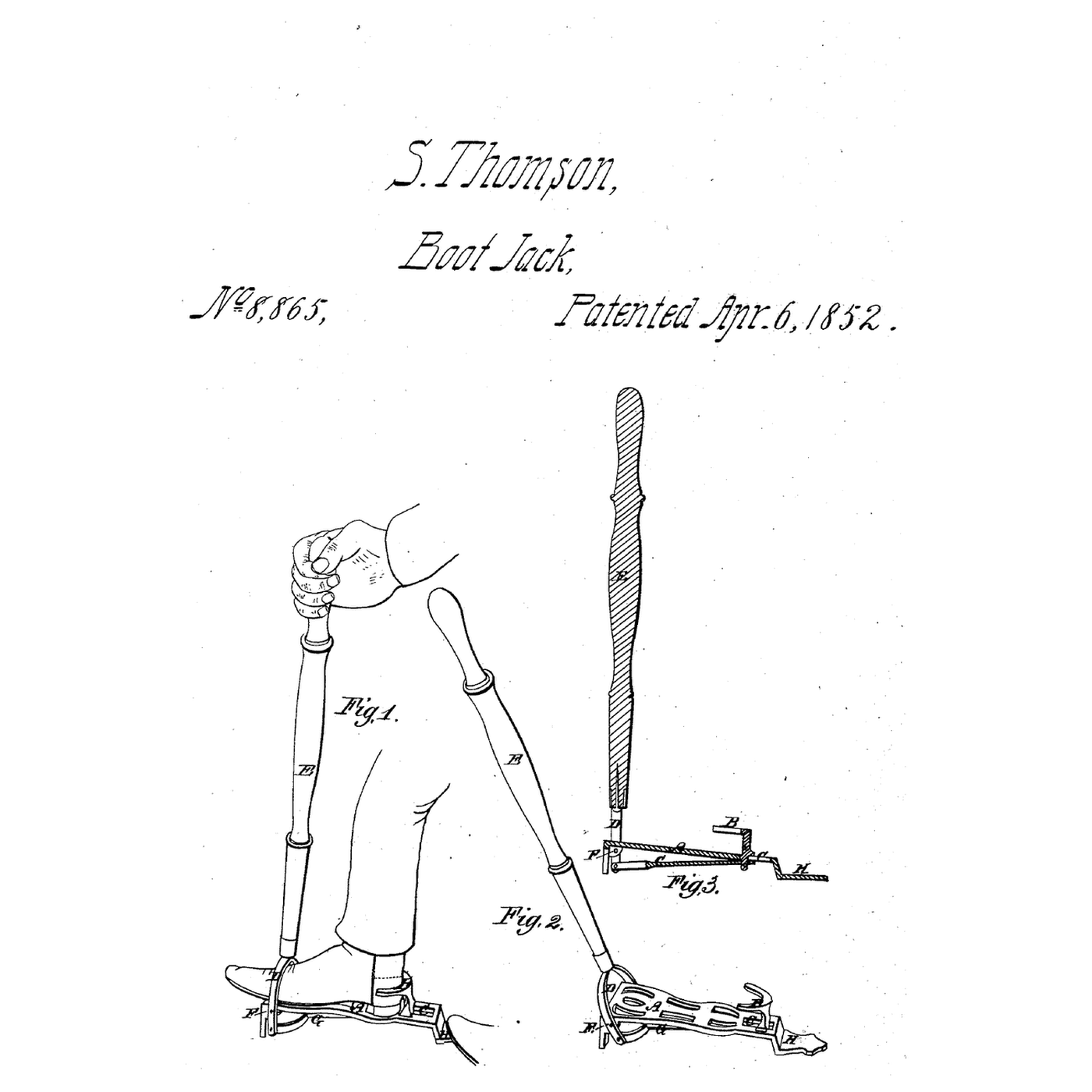
The embedded blueprint holds the heel with a lever and stirrup. French clamps it between two platform sections, closed by a wedge on a spring.
3
3
Read US 13,002
Read US 13,002
"Letters A and B represent the platform or inclined plane in two sections about fourteen inches long and seven-eighths of an inch thick made of wood straight on the edges except about four inches at one end, which end is shaped out on a circle to receive the heel of a boot, the part B of the platform acting as a lever so as to clamp or clasp the heel of the boot when the spring wedge D is pressed down, hereafter described."
"This wedge is to pass in between the two sections of the platforms A, and B, at o, o, there being a small notch cut off the corners of these two sections at o, o, to allow the wedge to enter. As this wedge is pressed down or in between these two sections it opens them and closes the other end around a boot at the heel."
4
4
Build the jack and draw off a boot
Build the jack and draw off a boot
**Sections.** Saw two strips of 22 mm pine (his seven-eighths of an inch) about 36 cm long (fourteen inches), straight-edged, and shape a semicircle in the facing edges of one end to take a heel. Cut small notches off the facing corners at the other end, as o o.
**Hinge and spring.** Near the heel end, under where the cleat will go, join the sections with a 75 mm strip of flat bar as the hinge, let into both and screwed through holes elongated so the sections can move apart, as French's iron hinge through the cleat G. Put a spiral spring of steel wire between them near the heel end so it closes the jack ready for use.
**Cleat.** Screw a hardwood cleat about 11 cm long under the heel end to raise it to a heel's height, and a thin cleat F under section A that supports the end of section B.
**Spring wedge.** Carve a wooden wedge about 45 mm long and 30 mm deep (his 1 3/4 and 1 1/4 inches), screw it to the end of a strip of spring steel about 20 cm long, and screw the strip's other end to section A so the wedge stands over the notches.
**Test.** Set the boot's heel in the opening, stand on the platform with the other foot so it presses the wedge, and draw the foot out of the boot.
Izinto zokwakha zalesi sinyathelo:
 Ipulangwe lomphayini1 ucezu
 Ibhulokhi Lokhuni Oluqinile1 ucezu
 Ibha Eyisicaba Yensimbi Ethambile0.1 imitha
 Izikulufu zokhuni12 izicucu
 Ucingo lwensimbi ye-spring0.3 imitha
 Umucu wensimbi yensipho0.25 imitha
 Izicathulo zesikhumba1 ucezu
Amathuluzi adingekayo:
 Isaha Sesandla
 Insimbi yokuhlikihla enamazinyo
 Isethi yezisebenzi zokhuni
 Ibhola Elingenantambo
 Iqoqo Lamakhanda Ebhola
 Isaha Sensimbi
 Isibambo Sebhentshi
 Isando
 Udlawu Olunezihloko Eziyindilinga
 Isethi yezikulufudrayiva
 Iphrothrakta
5
5
A jack that slips, sticks or will not open
A jack that slips, sticks or will not open
Spring-wedge bootjack troubleshooting.
Flow
Loading...
6
6
History and honest limits
History and honest limits
**Franklin J. French** of Whitingham, Windham County, Vermont, received US 13,002, dated 5 June 1855. His iron hinge was about three inches long, five-eighths of an inch wide and three-sixteenths thick, with holes that let a screw be shifted to alter the size; the spiral spring E of iron wire was about two inches long after bending; the wedge D was about 1 1/8 inch thick; the steel spring C was about eight inches long, 1 1/8 wide and 1/16 thick. His claim is the spring wedge D in combination with the lever B and spring E.
**Honest limits.** Pine, flat bar and bought spring steel stand in for his wood and iron. The notebook treats the wedge as frictionless; its push, angles and lengths are examples. Your drawn-off boot is the result.
Izinto
7- 1 ucezuIsibambeli
- 1 ucezuIsibambeli
- 0.1 imithaIsibambeli
- 12 izicucuIsibambeli
- 0.3 imithaIsibambeli
- 0.25 imithaIsibambeli
- 1 ucezuIsibambeli
Amathuluzi Adingekayo
11- Isibambeli
- Isibambeli
- Isibambeli
- 1 vendor sell this, none ship to you yetIsibambeli
- Isibambeli
- Isibambeli
- Isibambeli
- Isibambeli
- Isibambeli
- Isibambeli
- Isibambeli
Ama-blueprint ahlobene
Lama-blueprint abelana ngolwazi — amasu, izinto noma izimiso


CC0 Isizinda Somphakathi
Le blueprint ikhishwe ngaphansi kwe-CC0. Ukhululekile ukukopisha, ukuguqula, ukusabalalisa, nokusebenzisa ngaphandle kwemvume.
Sekela uMenzi ngokuthenga imikhiqizo nge-Blueprint yabo IKhomishane Yomenzi kumiswe ngabathengisi, noma dala inguqulo entsha yale Blueprint bese uyifaka njengoxhumaniso ku-Blueprint yakho ukuze wabelane ngemali engenayo.