UBUCIKO
UBUHLE NEMPILO
UBUCIKO BEZANDLA
AMASIKO NOMLANDO
EZOKUZIJABULISA
IMVELO
UKUDLA NEZIPHUZO
REVERSE ENGINEERING
IZAYENSI
EZEMIDLALO
UBUCHWEPHESHE
IZINTO EZIGQOKWAYO
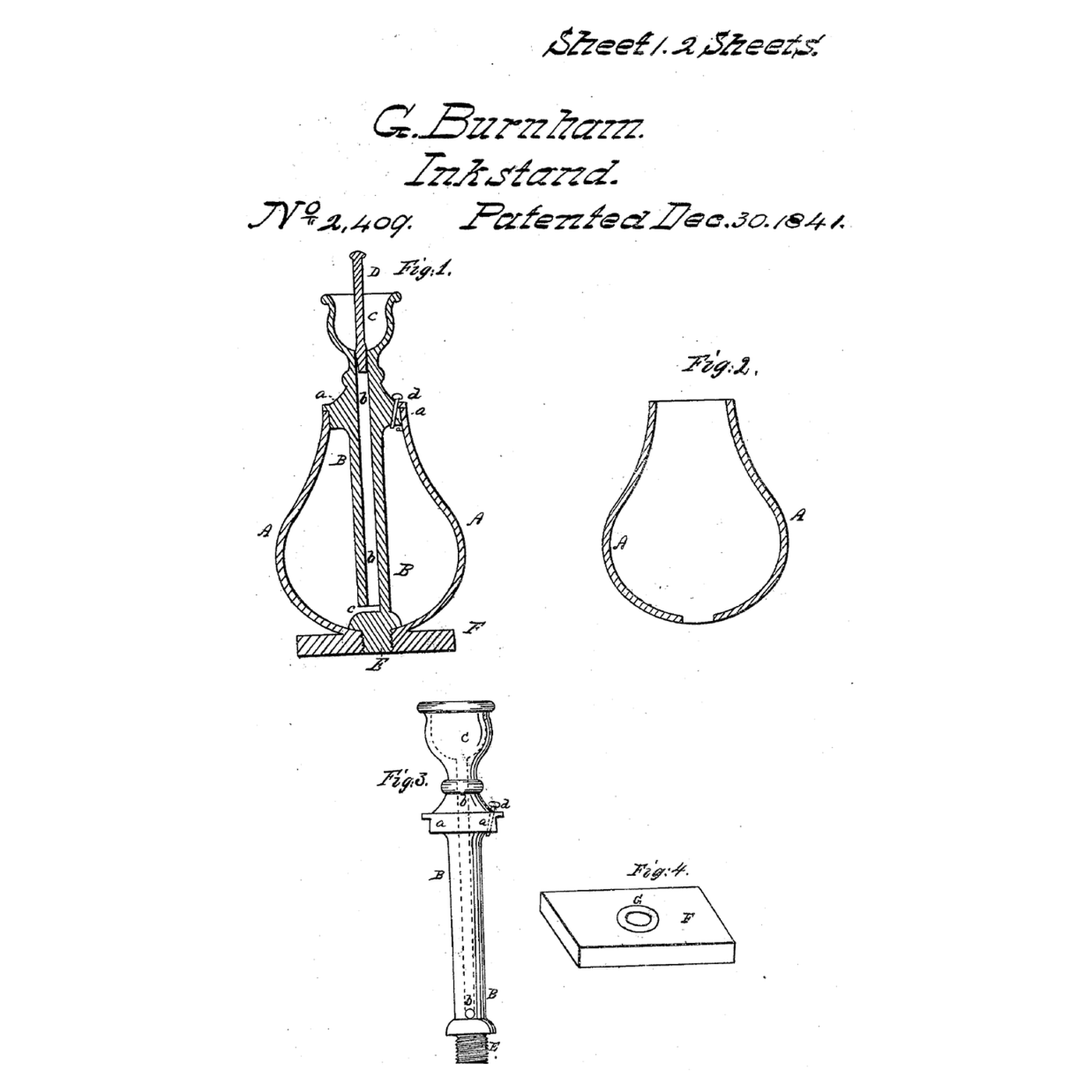


The Squeeze-Bottle Inkstand: Press the Rubber, Fill the Cup
An open inkwell dries out, lets the pen go too deep, and spills if it is packed for a journey.
George Burnham of Philadelphia received US 2,409, dated 30 December 1841, for inkstands whose body is "a vessel or bottle of caoutchouc or india-rubber": a tubular shaft passes through the bottle and ends in a cup, and "by pressing the bottle, the required quantity of ink may be forced up into the cup C and retained there by means of the stopper; and by removing this stopper it will instantly descend into the bottle." With the stopper in, the inkstand "may be put into a trunk, and packed among clothes with perfect safety."
This rung works out the squeeze needed, then builds the inkstand from a rubber bulb, a tube and a cup, and weighs its ink against an open well for a week.
Oqalayo
About 2 hours, then a week of weighing
Imiyalelo
1
1
Squeeze pressure and volume
Squeeze pressure and volume
Ilayisha incwadi ye-Jupyter…
2
2
The ink it holds
The ink it holds
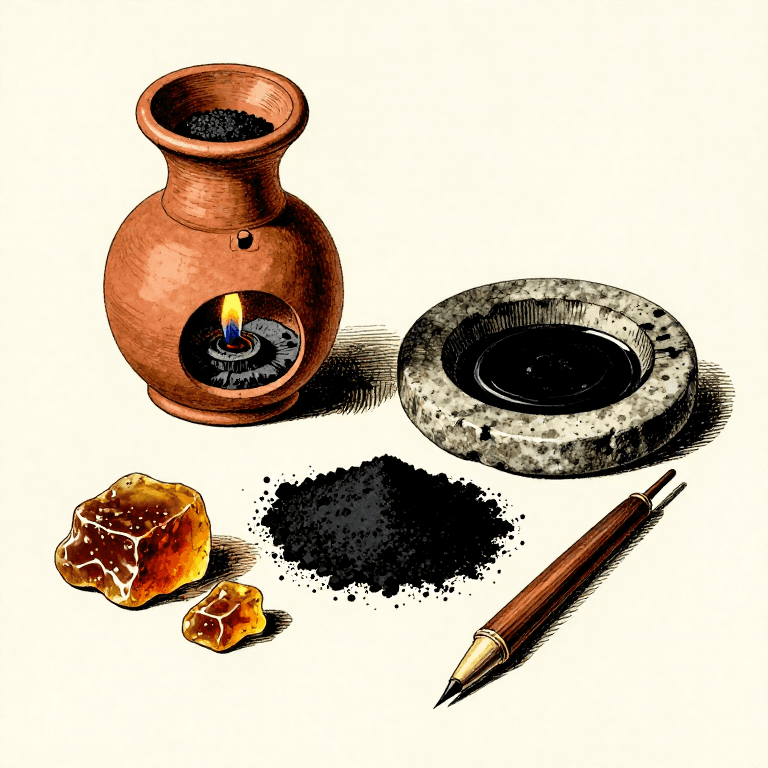
The embedded blueprint makes carbon ink, which thickens as its water evaporates. Burnham's rubber bottle keeps all but the cupful out of the air.
3
3
Read US 2,409
Read US 2,409
"A, A, is a common india rubber bottle, which composes the body or reservoir, of the inkstand, and which is shown separately in Fig. 2. Through this bottle passes a shaft of metal, wood, ivory, horn, or other suitable substance, which is tubular through the greater part of its length, and has at its upper end a cup into which the ink contained in the bottle may be forced whenever it may be required."
"It will be seen that by this arrangement the ink will be effectually preserved from evaporation, and from exposure to the air, excepting in the small quantity contained in the cup; its depth in this may be readily regulated, so that there shall not be any danger of dipping the pen too deeply in it."
4
4
Build the inkstand and test it
Build the inkstand and test it
**Shaft.** Cut 12 cm of 3/8" brass tube. Drill a 3 mm hole through its wall 1 cm from one end: the side opening the ink enters by.
**Bottle.** Push the drilled end of the tube down through the neck of the rubber bulb until it nearly touches the bottom, and seal the neck round the tube with epoxy. Drill a hardwood block, set the bulb in it as a foot, and glue it.
**Cup.** Epoxy a PVC reducer from the fittings assortment on the tube's top as the cup. Cut a cork to plug the tube's upper end inside the cup.
**Test.** With the cork out, squeeze the bulb, dip the tube end in ink and let the bulb draw it in; repeat until full. Squeeze until the cup holds ink, then put the cork in: the ink stays. Pull the cork: it drops back. Turn the stand on its side for a minute with the cork in and check for leaks. Then weigh it and an open jar of ink every day for a week.
Izinto zokwakha zalesi sinyathelo:
 I-bulb yerabha engu-60 ml1 ucezu
 Ishubhu lethusi elinobubanzi obungaphandle obungu-9,5 mm0.12 imitha
 Iqoqo Lezixhumanisi Zepayipi Le-PVC1 ucezu
 Ama-cork1 ucezu
 I-epoxy resin5 ml
 Ibhulokhi Lokhuni Oluqinile1 ucezu
 Uyinki wokubhala60 ml
 Ijeke Lengilazi1 ucezu
Amathuluzi adingekayo:
 Isaha Sensimbi
 Ibhola Elingenantambo
 Iqoqo Lamakhanda Ebhola
 Izinsimbi zokuhlikihla (ezesandla)
 Ummese Womsebenzi Wezandla
 Isikali Sedijithali Sasekhishini
 Irula
Irula Isethi yamapeni okubhala okuhle
5
5
An inkstand that leaks, will not rise or will not fall back
An inkstand that leaks, will not rise or will not fall back
Squeeze-bottle inkstand troubleshooting.
Flow
Loading...
6
6
History and honest limits
History and honest limits
**George Burnham** of Philadelphia received US 2,409, dated 30 December 1841, for the construction of inkstands. His shaft screwed into a foot through a hole in the bottle's bottom, a sliding cover could close the cup for travelling, a small cock could replace the stopper, and an air hole in the shaft's enlarged neck helped filling. His claim is the elastic bottle with the tubular shaft and cup.
**Honest limits.** A rubber bulb, brass tube and PVC reducer stand in for his rubber bottle, shaft and cup, and epoxy for his tight fit. The notebook takes ink as dense as water; its sizes are examples. Your weighings are the result.
Izinto
8- 1 ucezuIsibambeli
- Isibambeli
- Isibambeli
- 1 ucezuIsibambeli
- 5 mlIsibambeli
- 1 ucezuIsibambeli
- 60 mlIsibambeli
- 1 ucezuIsibambeli
Amathuluzi Adingekayo
8- Isibambeli
- 1 vendor sell this, none ship to you yetIsibambeli
- Isibambeli
- Isibambeli
- Isibambeli
- Isibambeli
- Isibambeli
- Isibambeli
Ama-blueprint ahlobene
Lama-blueprint abelana ngolwazi — amasu, izinto noma izimiso


CC0 Isizinda Somphakathi
Le blueprint ikhishwe ngaphansi kwe-CC0. Ukhululekile ukukopisha, ukuguqula, ukusabalalisa, nokusebenzisa ngaphandle kwemvume.
Sekela uMenzi ngokuthenga imikhiqizo nge-Blueprint yabo IKhomishane Yomenzi kumiswe ngabathengisi, noma dala inguqulo entsha yale Blueprint bese uyifaka njengoxhumaniso ku-Blueprint yakho ukuze wabelane ngemali engenayo.