UBUCIKO
UBUHLE NEMPILO
UBUCIKO BEZANDLA
AMASIKO NOMLANDO
EZOKUZIJABULISA
IMVELO
UKUDLA NEZIPHUZO
REVERSE ENGINEERING
IZAYENSI
EZEMIDLALO
UBUCHWEPHESHE
IZINTO EZIGQOKWAYO
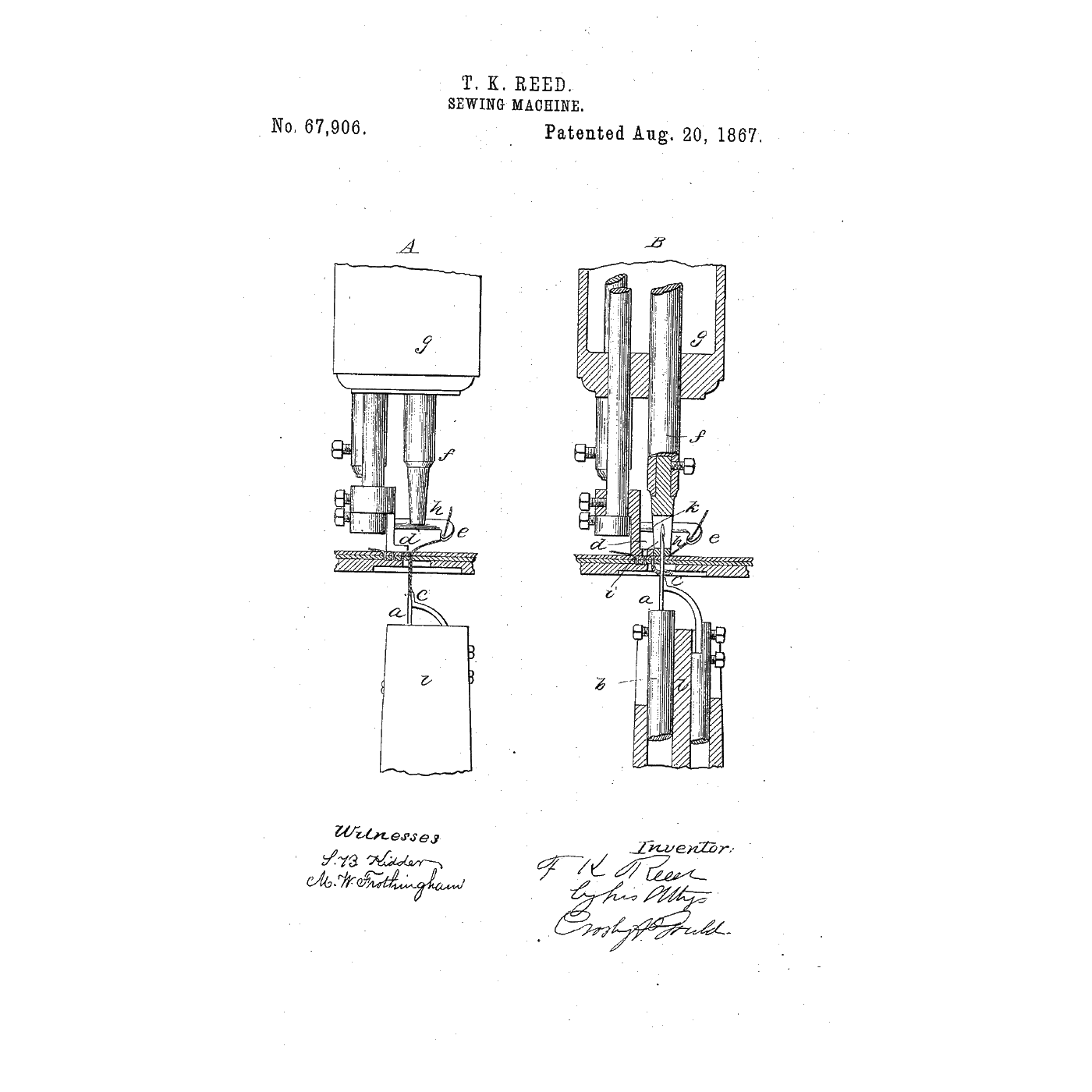


The Tubular Presser Foot: Hold the Leather Flat Round the Hole So the Needle Raises No Burr
A hook-needle machine sewing leather from below pierces it with the needle rising, and the leather pushed up round the hole forms a burr on the face of the work.
T. K. Reed of East Bridgewater, Massachusetts, received US 67,906, dated 20 August 1867, for "a tubular foot, arranged above the table, and in vertical line with the needle, and having a vertical movement to and away from the table, this foot after each feed movement of the leather, coming down upon the leather, and before the needle enters the leather, and pressing it firmly against the table, the tube in the foot being of size just sufficient to allow the needle to pass freely up into it". The leather round the needle is held and made to expand radially, "in contradistinction to being pressed up in the form of a burr".
This rung works out the pressure the foot puts on the leather, then makes a tubular foot and pierces leather from below with and without it, and compares the face.
Ophakathi
About 4 hours
Imiyalelo
1
1
The foot's pressure
The foot's pressure
Ilayisha incwadi ye-Jupyter…
2
2
Holding the work at the needle before it
Holding the work at the needle before it
The embedded blueprint braces the needle at the cloth. Reed holds the leather itself flat round the needle with a tube, so its face stays clean.
3
3
Read US 67,906
Read US 67,906
"In that class of sewing machines in which a hook or crochet-needle is employed, such needle working up through the table or work-supporting surface, and drawing the thread (in its hook) down through the work, and through the loop last formed, (such machines being used particularly for sewing leather with waxed thread,) there is generally combined with the needle and other mechanism an awl or piercing instrument"
"The face side of the leather is uppermost, and where the needle in its rise pierces the leather, and forms the hole through which the thread is to pass, the leather displaced in making such hole is thrown up in the form of a burr, (the hole being made by displacement, and not by removal of the leather,) and this burr or ragged edge comes upon the upper side of the work and defaces it."
4
4
Make the foot and pierce leather
Make the foot and pierce leather
**Table.** Drill a small hole through a hardwood block as the work table, just large enough for an awl or a stout needle to come up through it.
**Foot.** Cut a short length of steel tube, or drill a 1.5 mm bore through the end of a 5 mm steel rod, and file the end flat, as Reed's foot h. Mount it on a rod sliding in a hardwood guide above the table, in line with the hole, with a spring pressing it down.
**Test.** Lay a strip of leather face up on the table. Lower the foot onto it and push an awl up through the hole from below into the tube; lift the foot and move the leather. Make a row of holes with the foot, then a row without it, and look at the face of each hole with a magnifier.
Izinto zokwakha zalesi sinyathelo:
 Ibhulokhi Lokhuni Oluqinile2 izicucu
 Ubhamu Oluyindilinga Lwensimbi Ethambile0.15 imitha
 Iqoqo lezintambo zokucindezela1 ucezu
 Izikulufu zokhuni4 izicucu
 Isikhumba1 ucezu
Amathuluzi adingekayo:
 Ibhola Elingenantambo
 Iqoqo Lamakhanda Ebhola
 Isaha Sensimbi
 Izinsimbi zokuhlikihla (ezesandla)
 Isibambo Sebhentshi
 Usungulo
 Isethi yezisebenzi zokhuni
 I-Caliper Yedijithali Yamayintshi Ayi-6
5
5
A foot that marks, slips or still leaves a burr
A foot that marks, slips or still leaves a burr
Tubular presser foot troubleshooting.
Flow
Loading...
6
6
History and honest limits
History and honest limits
**T. K. Reed** of East Bridgewater, assignor to David Whittemore of North Bridgewater, Massachusetts, received US 67,906, dated 20 August 1867. His foot h on the rod f was slotted at k to the sides of the foot just above its lower end, but its face was plain and flat with only the tube's opening; the foot descended after each feed and rose before the needle moved forward with the work. He noted the needle could then act as the piercing instrument without an awl. His claim is the supplemental presser-foot combined with the hook, needle and cast-off.
**Honest limits.** A hand-held awl and a sprung tube stand in for his machine's needle and foot. The notebook spreads the force evenly over the ring; its sizes and forces are examples. Your compared holes are the result.
Izinto
5- 2 izicucuIsibambeli
- 0.15 imithaIsibambeli
- Isibambeli
- 4 izicucuIsibambeli
- 1 ucezuIsibambeli
Amathuluzi Adingekayo
8- 1 vendor sell this, none ship to you yetIsibambeli
- Isibambeli
- Isibambeli
- Isibambeli
- Isibambeli
- Isibambeli
- Isibambeli
- Isibambeli
Ama-blueprint ahlobene
Lama-blueprint abelana ngolwazi — amasu, izinto noma izimiso
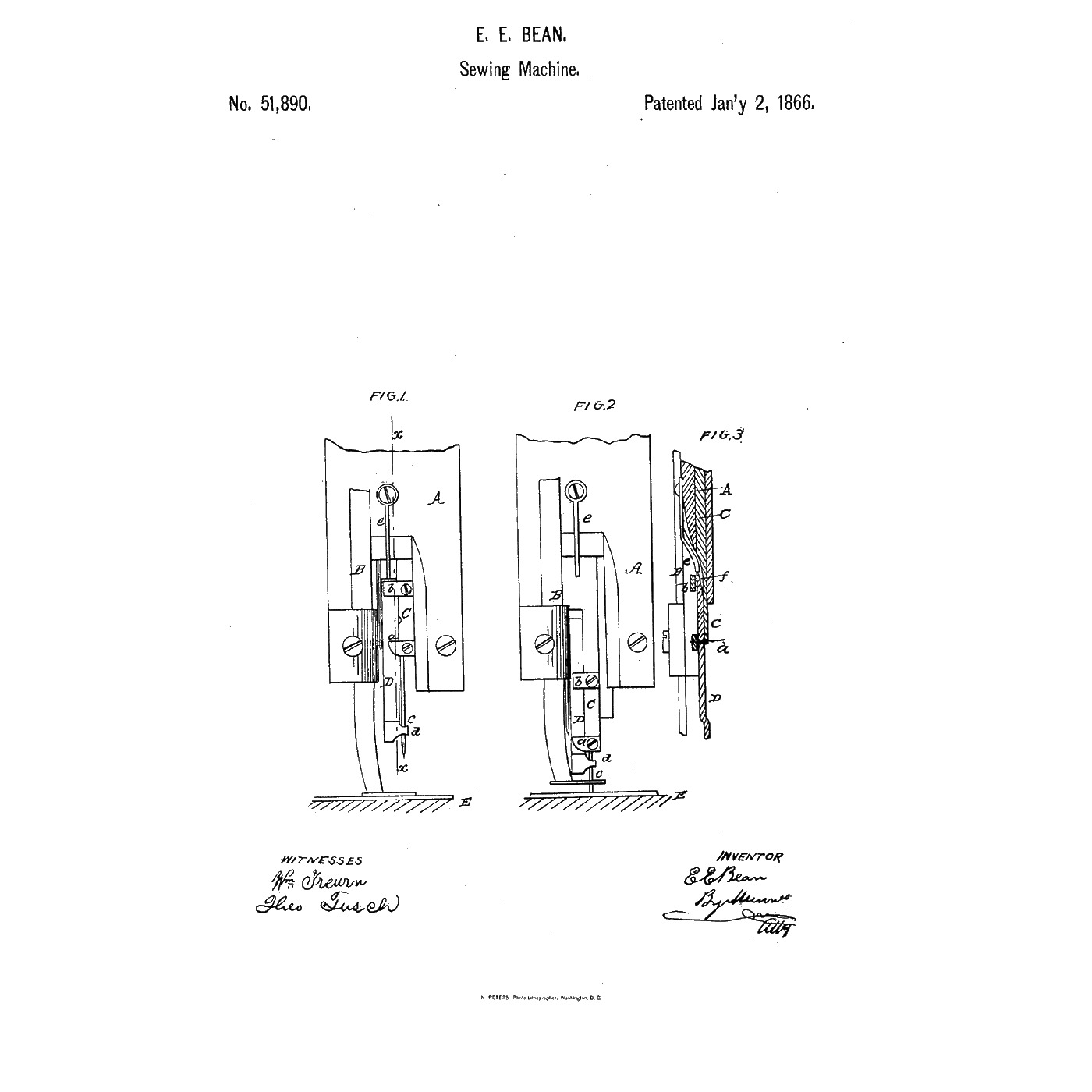
The Needle Brace Bar: A Sliding Bar That Holds the Needle Near the Cloth While It Feeds
ngu-Tex
Ukuthunga
34
0
0
0
0
0
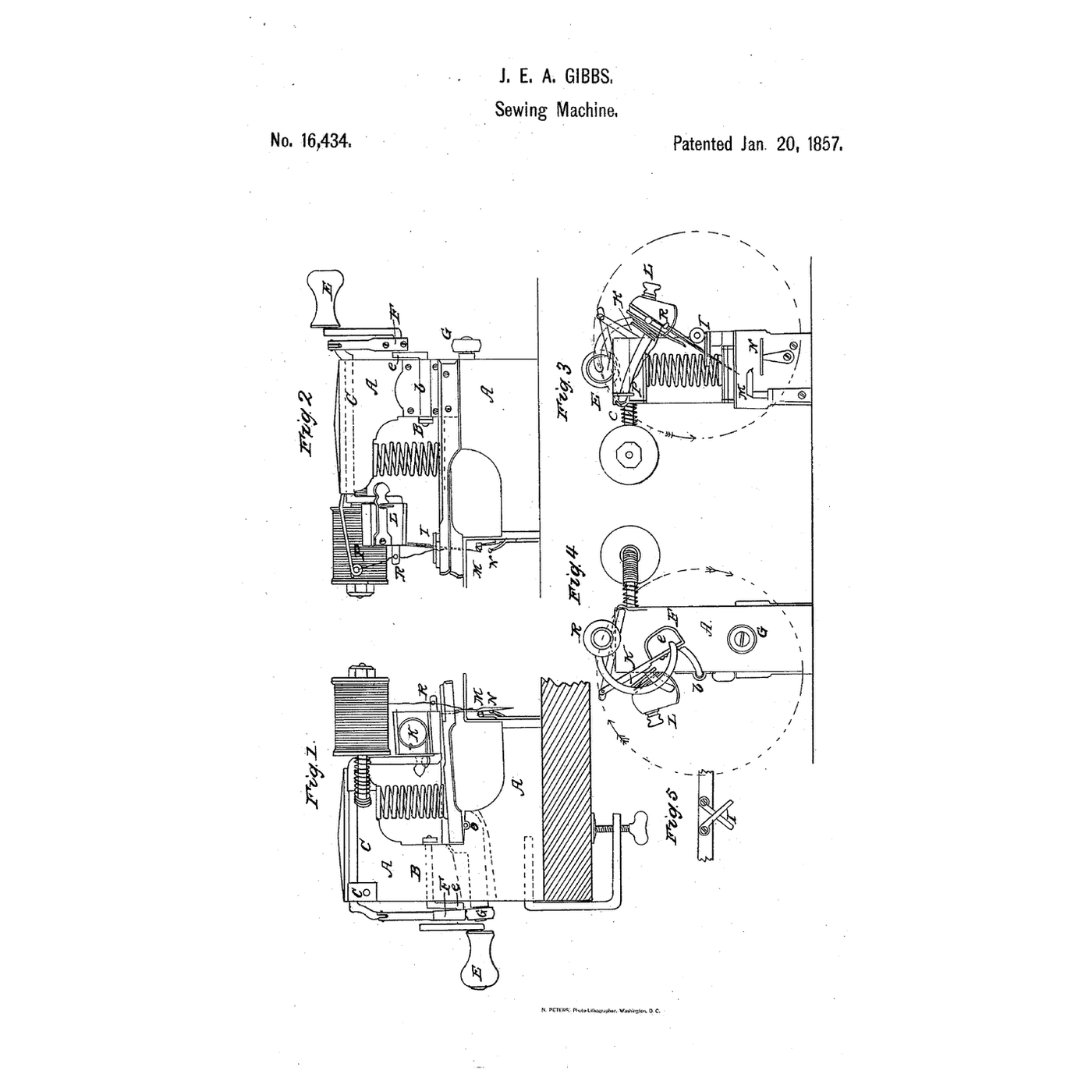
The Stationary-Hook Chain Stitcher: A Vibrating Needle Lays Its Loop Over a Fixed Hook
ngu-Tex
Ukuthunga
40
0
0
0
0
0
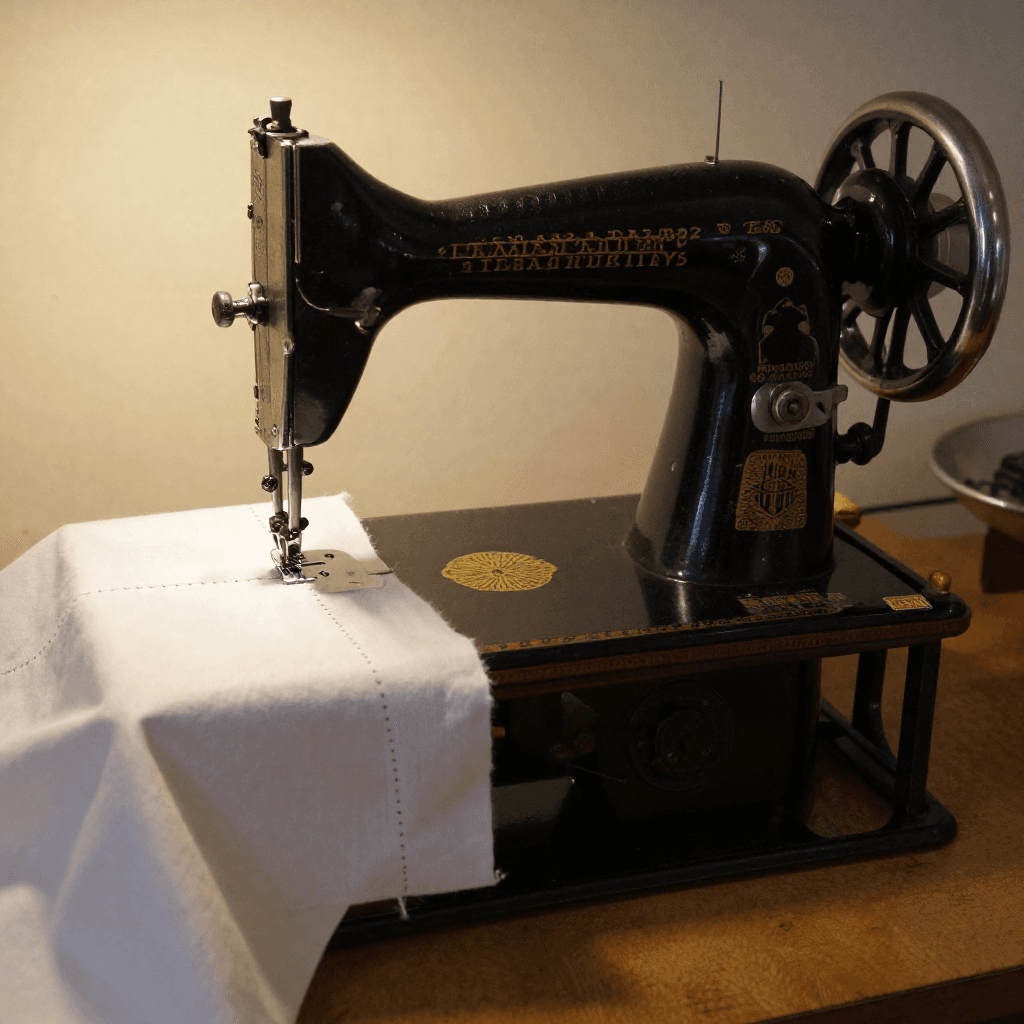
The Lock Stitch Sewing Machine — Mechanized Garment Construction
ngu-Tex
Indwangu Nesikhumba
52
0
0
0
0
0
CC0 Isizinda Somphakathi
Le blueprint ikhishwe ngaphansi kwe-CC0. Ukhululekile ukukopisha, ukuguqula, ukusabalalisa, nokusebenzisa ngaphandle kwemvume.
Sekela uMenzi ngokuthenga imikhiqizo nge-Blueprint yabo IKhomishane Yomenzi kumiswe ngabathengisi, noma dala inguqulo entsha yale Blueprint bese uyifaka njengoxhumaniso ku-Blueprint yakho ukuze wabelane ngemali engenayo.