UBUCIKO
UBUHLE NEMPILO
UBUCIKO BEZANDLA
AMASIKO NOMLANDO
EZOKUZIJABULISA
IMVELO
UKUDLA NEZIPHUZO
REVERSE ENGINEERING
IZAYENSI
EZEMIDLALO
UBUCHWEPHESHE
IZINTO EZIGQOKWAYO
Ihumuswe


Cold-Process Soap from Lye and Oils: the Open University's 250 g Recipe
Make 250 g of bar soap the cold way: dissolve sodium hydroxide in distilled water, warm vegetable fat, olive oil and coconut oil to 45 °C, combine and stir to trace, pour into moulds and cure. Every quantity and rule follows the Open University's published recipe, including its two different water figures and two curing times.
Ophakathi
about 3 hours, then weeks of curing
Imiyalelo
1
1
Watch cold-process soap being made
Watch cold-process soap being made
Bramble Berry shows the whole cold process: lye solution into warm oils, stirring to trace, pouring into a mould. This blueprint follows the Open University's 250 g recipe; its quantities and steps are below.
Izinto zokwakha zalesi sinyathelo:
 I-caustic soda (i-sodium hydroxide)32 g
 Vegetable Fat125 g
 Uwoyela womnqumo55 g
 Amafutha ekhokhonathi55 g
 Amanzi Acwengisisiwe100 ml
 Essential Oil5 g
 Ujusi kalamula (omusha)1 ucezu
Amathuluzi adingekayo:
 Izibuko Zokuphepha Ezivalekile
 Amagilavu erabha
 Cotton Apron
 Isikali Sedijithali Sasekhishini
 Ujeke wokukala
 Isitsha sengilazi
 Plastic Spoon
 Ithemomitha
 Isikhunta sensipho
 Iphephandaba (okokuqhilika)
 Amanzi
2
2
What you need for 250 g of soap
What you need for 250 g of soap
32 g solid sodium hydroxide; 125 g vegetable fat; 55 g pure olive oil (50 cm³); 55 g white coconut oil; distilled or rain water, not tap water; optional 5 g essential oil or the juice of a lemon. **The water is given twice:** 100 cm³ in the ingredient list and 200 cm³ in step 1 of the same recipe. The source does not say which vegetable fat. Equipment: goggles, rubber gloves, a cotton apron (not nylon), kitchen scales, a measuring jug, two 1-litre heat-resistant glass bowls, two plastic tablespoons, a 0-100 °C thermometer, plastic moulds and newspaper.
Izinto zokwakha zalesi sinyathelo:
I-caustic soda (i-sodium hydroxide)32 gVegetable Fat125 gUwoyela womnqumo55 gAmafutha ekhokhonathi55 gAmanzi Acwengisisiwe100 mlEssential Oil5 gUjusi kalamula (omusha)1 ucezuAmathuluzi adingekayo:
Izibuko Zokuphepha EzivalekileAmagilavu erabhaCotton ApronIsikali Sedijithali SasekhishiniUjeke wokukalaIsitsha sengilaziPlastic SpoonIthemomithaIsikhunta sensiphoIphephandaba (okokuqhilika)Amanzi3
3
Safety first
Safety first
Sodium hydroxide (caustic soda) and its solution burn skin and damage most kitchen surfaces. Wear rubber gloves and eye protection the whole time, with a cotton apron. Read the warnings on the container. Never use aluminium or zinc utensils: they react with the solution. Keep a large bowl of clean cold water at hand. Clear all food and drink away, keep children and animals well away, work where the air moves (outside if you can) and not alone. On skin: rinse with plenty of running water until it no longer feels soapy. In an eye: cold running water at once, then hospital. In the mouth: rinse with water until the taste has gone.
Amathuluzi adingekayo:
Izibuko Zokuphepha EzivalekileAmagilavu erabhaCotton ApronAmanzi4
4
Make the lye solution
Make the lye solution
Outside if possible. Weigh 32 g sodium hydroxide. Add it a little at a time to the cold distilled water in one glass bowl, stirring all the time with a plastic spoon (the recipe's step 1 uses 200 cm³; its ingredient list says 100 cm³). Never pour water onto the pellets, and do not breathe the fumes. The solution gets hot as it dissolves. Let it cool to about 45 °C.
Izinto zokwakha zalesi sinyathelo:
I-caustic soda (i-sodium hydroxide)32 gAmanzi Acwengisisiwe100 mlAmathuluzi adingekayo:
Isikali Sedijithali SasekhishiniUjeke wokukalaIsitsha sengilaziPlastic SpoonIthemomithaIzibuko Zokuphepha EzivalekileAmagilavu erabhaCotton Apron5
5
Warm the fats and oils
Warm the fats and oils
Weigh 125 g vegetable fat, 55 g olive oil and 55 g coconut oil into the second bowl. Stand it in hot water and stir until the mixture reaches 45 °C. Do not let it rise above 50 °C.
Izinto zokwakha zalesi sinyathelo:
Vegetable Fat125 gUwoyela womnqumo55 gAmafutha ekhokhonathi55 gAmathuluzi adingekayo:
Isikali Sedijithali SasekhishiniIsitsha sengilaziPlastic SpoonIthemomithaAmanzi6
6
Combine and stir
Combine and stir
When both bowls are at about 45 °C, pour the lye solution slowly into the fats and oils. Stir thoroughly for 15 minutes with the spoon.
Amathuluzi adingekayo:
Plastic SpoonIthemomithaIzibuko Zokuphepha EzivalekileAmagilavu erabha7
7
Stir to trace
Stir to trace
The reaction (saponification) is not instant, but within 5 to 10 minutes the mixture starts to thicken. Lift some on the back of the spoon and let it run off: when the soap that forms floats and leaves a trace on the surface, it has reached "trace". Stir gently for about 5 minutes, leave it for 15 minutes, and repeat. After about an hour it thickens to the consistency of custard. Lighter fats and oils take longer.
Amathuluzi adingekayo:
Plastic Spoon8
8
Add scent (optional)
Add scent (optional)
Stir in 5 g of an essential oil of your choice, or the juice of a lemon.
Izinto zokwakha zalesi sinyathelo:
Essential Oil5 gUjusi kalamula (omusha)1 ucezuAmathuluzi adingekayo:
Plastic Spoon9
9
Pour into moulds and clean up
Pour into moulds and clean up
Pour the thickened mixture into plastic moulds and put them in an airing cupboard (a warm, dry cupboard). Tidy up straight away and wash every utensil thoroughly in hot soapy water.
Amathuluzi adingekayo:
Isikhunta sensiphoAmagilavu erabha10
10
Unmould and cure
Unmould and cure
After a week or so the soap should be hard enough to take out of the moulds. Wear rubber gloves: it still contains some unreacted sodium hydroxide. Stand the bars on newspaper in the open air at room temperature. **The curing time is given twice:** two to three weeks in the recipe's step 8, and a four- to six-week maturing period in its introduction. The longer it is left, the better. Do not use the soap until you are sure it contains no unreacted caustic soda, and then only on your hands, never your face.
Amathuluzi adingekayo:
Iphephandaba (okokuqhilika)Amagilavu erabha11
11
The recipe in numbers
The recipe in numbers
Ilayisha incwadi ye-Jupyter…
12
12
Troubleshooting
Troubleshooting
Problems and what the recipe says to do.
Flow
Loading...
13
13
The chemistry
The chemistry
Fats and oils are mostly triglycerides: three fatty-acid chains joined to one glycerol. Sodium hydroxide splits them (standard chemistry): triglyceride + 3 NaOH → glycerol + 3 sodium salts of the fatty acids. Those salts are soap. As the reaction runs, heat is given off, water evaporates and the soap hardens (the source). The glycerine stays in the bar. The same reaction with potassium hydroxide gives a soft soap.
14
14
Sources and honest limits
Sources and honest limits
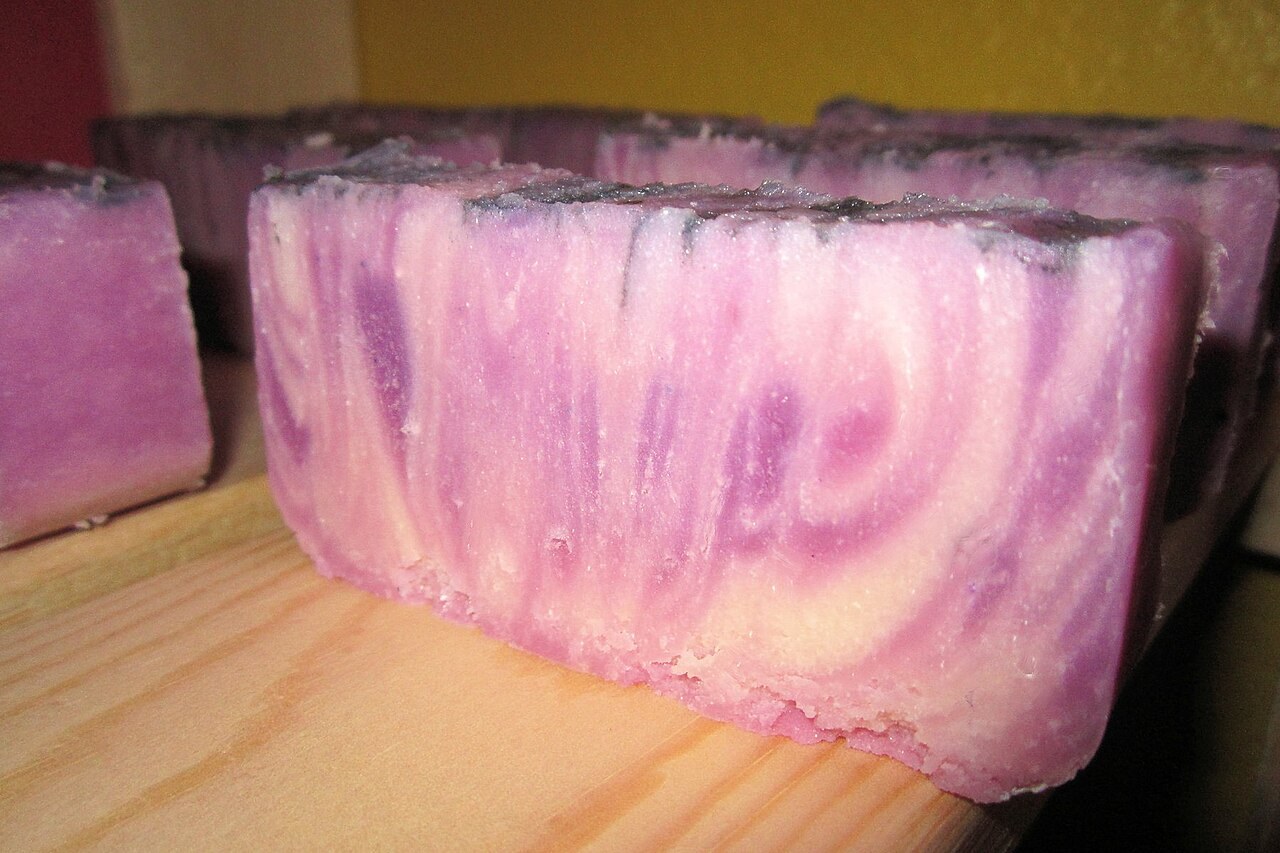
The Open University, OpenLearn, "DIY: Make Your Own Soap" (2010, updated 2021), CC BY-NC-SA 4.0: every quantity, temperature, time and safety rule here. The source gives the water as 100 cm³ and as 200 cm³, and curing as 2-3 and as 4-6 weeks; both are quoted, neither is ours. It does not say which vegetable fat. The notebook arithmetic, the troubleshooting tree and the chemistry equation are ours. Video: Bramble Berry. Cover: "Lavender Vanilla Cold Process Soap" by Erin Costa, CC BY 2.0, Wikimedia Commons (a coloured bar; this recipe makes a plain one unless you add colour).
Izinto
7- Isibambeli
- 125 gIsibambeli
- 55 gIsibambeli
- Isibambeli
- 300 mlIsibambeli
- Isibambeli
- 1 ucezuIsibambeli
Amathuluzi Adingekayo
11- Isibambeli
- Isibambeli
- Isibambeli
- Isibambeli
- Isibambeli
- Isibambeli
- Isibambeli
- Isibambeli
- Isibambeli
- Isibambeli
- Isibambeli
Le blueprint yenza

CC0 Isizinda Somphakathi
Le blueprint ikhishwe ngaphansi kwe-CC0. Ukhululekile ukukopisha, ukuguqula, ukusabalalisa, nokusebenzisa ngaphandle kwemvume.
Sekela uMenzi ngokuthenga imikhiqizo nge-Blueprint yabo IKhomishane Yomenzi kumiswe ngabathengisi, noma dala inguqulo entsha yale Blueprint bese uyifaka njengoxhumaniso ku-Blueprint yakho ukuze wabelane ngemali engenayo.