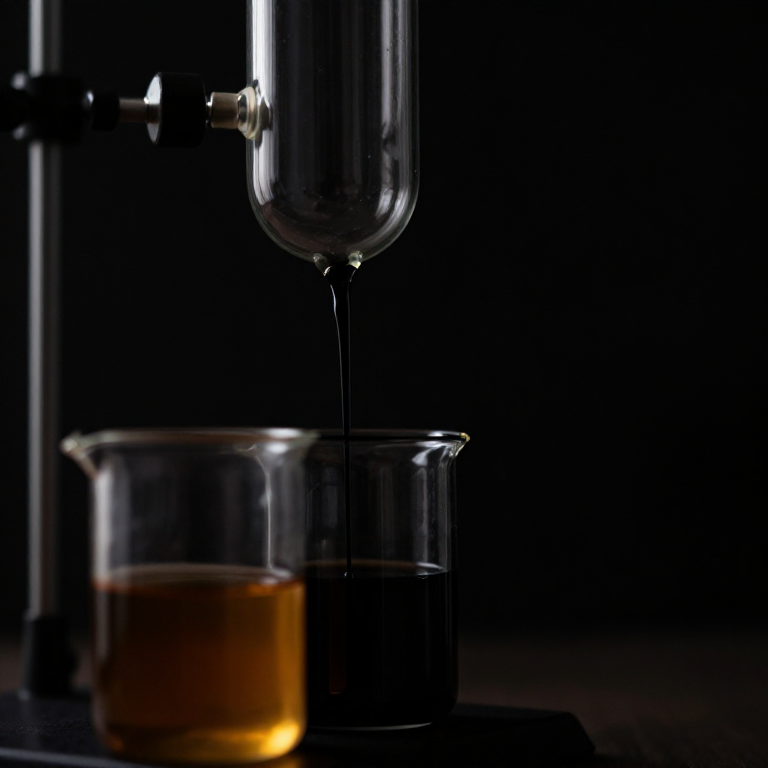


Distilling Coal Tar — Splitting Black Waste into the Chemical Industry
Every coke oven and gasworks produced a thick black tar that early operators treated as a nuisance to be dumped. Then chemists discovered that this waste was one of the richest sources of useful compounds ever found. Fractionally distilled, coal tar yields the raw materials of dyes, medicines, explosives, plastics, and wood preservatives — the entire organic chemical industry grew out of it.
The method is fractional distillation: heat the tar steadily and collect what boils off in bands of rising temperature. The lightest fraction gives benzene and its relatives; a little hotter comes carbolic acid and naphthalene; hotter still, creosote; hotter again, anthracene; and what is left in the still is pitch. Each band is a different family of chemicals with a different use.
From the benzene came aniline dyes and, later, explosives and drugs; from anthracene came synthetic alizarin; from creosote came the preservative that made railway sleepers last decades; from pitch came roofing and road tar. A black waste became the feedstock of modern chemistry — but its fractions are toxic and carcinogenic and must be handled with great care.
Instructions
Understand the prize
Understand the prize
Collect the coal tar
Collect the coal tar
Materials for this step:
 Coal Tar20 liters
Dewater the tar
Dewater the tar
Tools needed:
 Settling Tank
Charge the still
Charge the still
Tools needed:
 Fractionating Still
 Thermometer
Take the light oil
Take the light oil
Materials for this step:
Take the carbolic oil
Take the carbolic oil
Tools needed:
 Collection Flask
Take the creosote oil
Take the creosote oil
Tools needed:
Collection FlaskTake the anthracene oil
Take the anthracene oil
Tools needed:
Collection FlaskRecover the pitch
Recover the pitch
Purify the fractions
Purify the fractions
Tools needed:
 Separating Funnel
Handle the hazards
Handle the hazards
See the industry it founded
See the industry it founded
Tools Required
5- Placeholder
- Placeholder
- Placeholder
- Placeholder
- Placeholder
Related Blueprints
These blueprints share knowledge with this one — techniques, materials, or principles that connect them in the learning graph.
Related blueprints
Other builds that share materials, tools, or techniques with this one.
CC0 Public Domain
This blueprint is released under CC0. You are free to copy, modify, distribute, and use this work for any purpose, without asking permission.
Support the Maker by purchasing products through their Blueprint where they earn a Maker Commission set by Vendors, or create a new iteration of this Blueprint and include it as a connection in your own Blueprint to share revenue.