ARTE
BELEZA E BEM-ESTAR
ARTESANATO
CULTURA E HISTÓRIA
ENTRETENIMENTO
MEIO AMBIENTE
COMIDA E BEBIDAS
ENGENHARIA REVERSA
CIÊNCIAS
ESPORTES
TECNOLOGIA
TECNOLOGIA VESTÍVEL
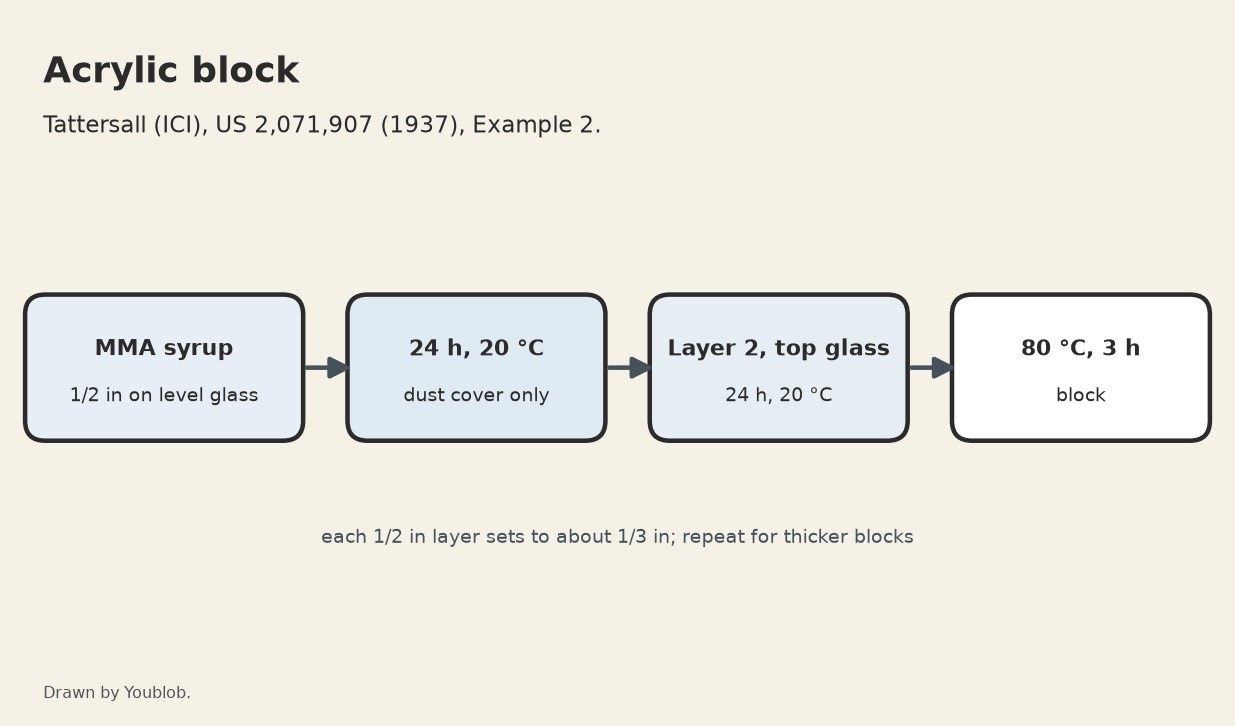


Acrylic Block: Methyl Methacrylate Syrup Cast in Layers between Glass
A thick acrylic block cannot be cast flawless in one pour. Tattersall (ICI, US 2,071,907, 1937) built it up in layers: pour 1/2 inch of syrup on a level glass plate, let it set for a day at room temperature, pour the next 1/2 inch on top, cover with a second glass plate, wait another day, then heat the sandwich at 80 °C. Each 1/2 inch layer shrinks to about 1/3 inch. The glass gives both faces a finished polish with no grinding.
The picture: our diagram.
Intermediário
3 days
Instruções
1
1
Level the bottom plate
Level the bottom plate
Set a glass plate on a ledge in a wooden frame, on a body of plaster of Paris, and level it carefully. The example sheet was 10 by 18 inches.
Ferramentas necessárias:
 Vidraça
 Caixilho de madeira
 Gesso de estuque
 Nível de bolha de 1,5 m
2
2
Pour the first 1/2 inch
Pour the first 1/2 inch
Pour room-temperature syrup 1/2 inch deep (about 1.5 litres for 10 by 18 inches; our figure). Cover against dust, but do not put the top plate on yet. Leave 24 hours at about 20 °C.
Materiais para este passo:
 Xarope de metacrilato de metilo3 l
Ferramentas necessárias:
 Luvas de borracha
 Termómetro de laboratório
3
3
Pour the next layer and cover
Pour the next layer and cover
Pour a second 1/2 inch layer on the first. Lower the top glass plate onto it so it rests on the syrup and keeps pressing on it. Leave another 24 hours at about 20 °C. For a thicker block repeat the layers, a day apart, and put the plate on the last one.
Ferramentas necessárias:
Vidraça4
4
Heat at 80 °C
Heat at 80 °C
Take the glass sandwich out of the frame and heat it for three hours at 80 °C to finish the polymerisation.
Ferramentas necessárias:
 Estufa de secagemTermómetro de laboratório
 Luvas resistentes ao calor
5
5
Spring off the glass
Spring off the glass
Spring the glass plates off the block with a knife blade. Both faces come out smooth and polished.
Ferramentas necessárias:
 X-ato (faca de precisão)Luvas de borracha
Materiais
1- Referência
Ferramentas necessárias
9- Referência
- Referência
- Referência
- Referência
- Referência
- Referência
- Referência
- Referência
- Referência
Este projeto faz
Blueprints relacionados
Estes blueprints compartilham conhecimento — técnicas, materiais ou princípios

CC0 Domínio Público
Este blueprint é liberado sob CC0. Você é livre para copiar, modificar, distribuir e usar este trabalho para qualquer finalidade, sem pedir permissão.
Apoie o Maker comprando produtos através do Blueprint, onde ele ganha uma Comissão Maker definida pelos vendedores, ou crie uma nova versão deste Blueprint e inclua-o como conexão no seu próprio Blueprint para compartilhar receita.