

Insulated Shipping Container
Freezing food well is worth nothing if it thaws between the factory and the kitchen. A cold chain is only as cold as its warmest link, and in 1925 the warmest link was everything in the middle — the lorry, the platform, the shop, the walk home.
The problem is unlike a refrigerator's. A fridge has a power supply and can fight heat continuously. A shipping container has no energy at all. It cannot remove heat; it can only delay it, using two things: the insulation around the walls, and the thermal mass of the frozen cargo itself.
That second one is what people miss. Ice absorbs about 334 kJ per kilogram just to melt, without changing temperature at all. A full load of frozen goods is therefore an enormous reservoir that holds itself at 0°C until the last of it has melted — which is why a full cold box outlasts a half-empty one dramatically, and why the honest way to keep a container cold is to fill it.
The rest is geometry and joinery. Heat enters through whatever is thinnest, so the design problem is finding the leaks: corners, the lid seal, and every fixing that bridges the wall.
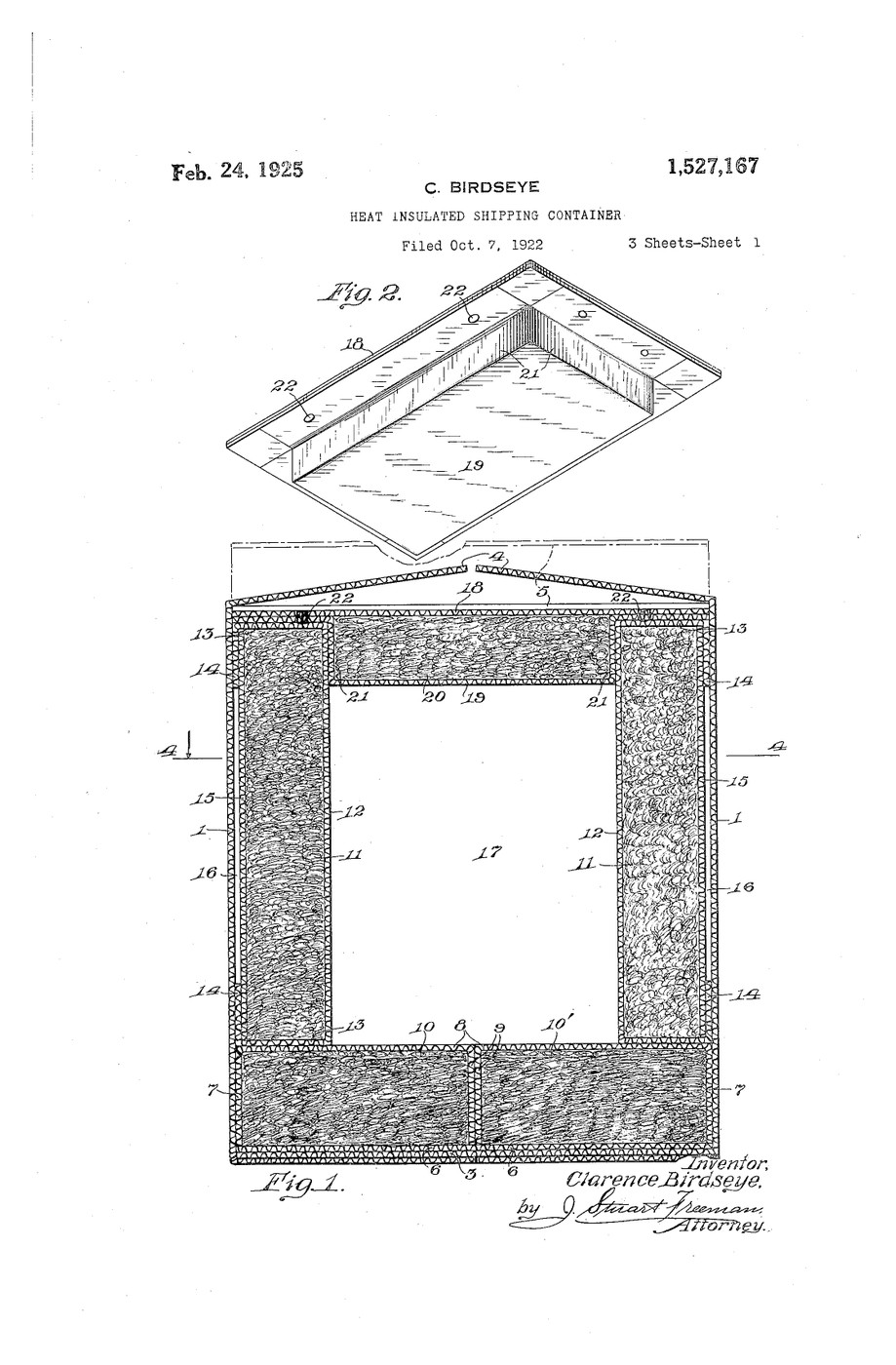
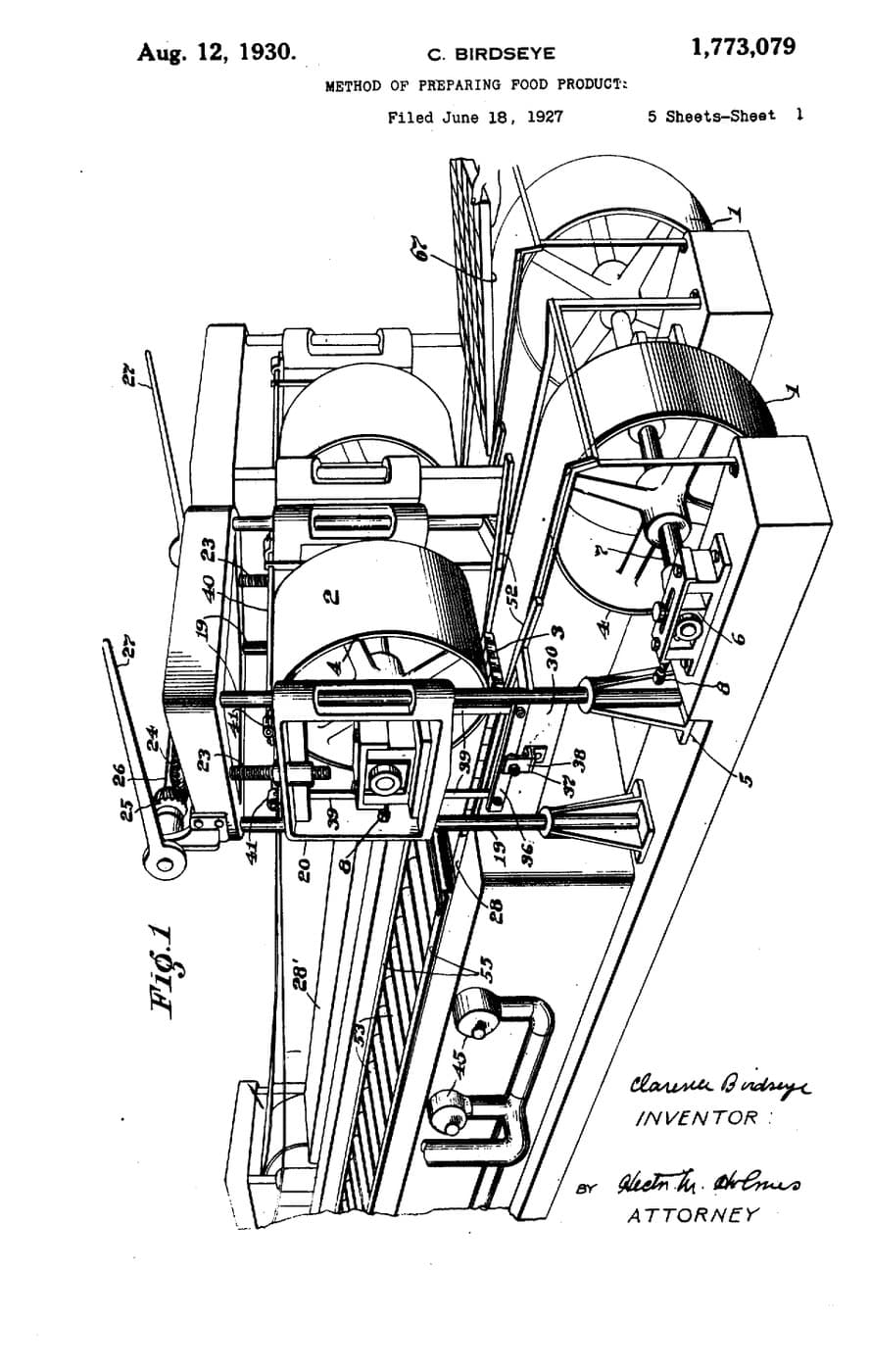
Clarence Birdseye, US 1,527,167, "Heat-insulated shipping container", granted 24 February 1925 — filed before the quick-freezing patent that made him famous, because the chain had to exist before the product could.
Instruções
Show that a full box beats an empty one
Show that a full box beats an empty one
Take two identical insulated boxes. Put 1 kg of ice in one, and 1 kg of ice plus enough frozen bottles to fill the space in the other. Log the meltwater from each over a day.
Expect the full box to keep its ice far longer.
The extra frozen mass is not cargo taking up room — it is stored cold, and every kilogram of it must absorb 334 kJ before it can start warming.
Note the practical rule this gives: never ship a half-full cold box. Fill the void with more frozen product, or with something already cold.
Materiais para este passo:
 Cubos de gelo
Ferramentas necessárias:
 Balança digital de cozinha
 Caixa isolante
Find where heat actually gets in
Find where heat actually gets in
Load a cold box, close it, and after an hour scan the whole outside with the infrared thermometer — faces, corners, edges, the lid seam, and any handle or fixing.
Mark the warm spots on a sketch.
Expect corners, the lid joint and any through-fixing to read colder on the outside than the flat faces — meaning heat is flowing there fastest.
Insulation is easy on a flat wall. Every leak is a discontinuity: a joint, an edge, a screw that bridges the two skins. Improving the flat panels while ignoring the seams is the commonest mistake in insulated design.
Ferramentas necessárias:
 Termómetro de infravermelhos
Measure what doubling the wall really buys
Measure what doubling the wall really buys
Test the same box with one layer of insulation, then two, then four, measuring melt rate each time.
Expect the first layer to help enormously and the fourth to add very little.
Heat flow is inversely proportional to thickness, so going from 1 to 2 halves it, while going from 3 to 4 removes only a twelfth. Meanwhile each layer costs the same money and steals the same internal volume.
Every insulated container ever designed sits at the point where more insulation stops being worth the space it takes from the cargo.
Test the difference between insulation and a seal
Test the difference between insulation and a seal
Run the same well-insulated box twice: once sealed, once with the lid resting on but not clamped.
Expect the unclamped one to lose its cold far faster than the small gap seems to justify.
Cold air is dense and pours out of any low gap while warm air pours in above — a convection current that carries far more heat than conduction through the same area of wall.
This is why a chest freezer that opens upward keeps its cold when you open the lid, and an upright one loses it in seconds. The geometry decides, not the insulation.
Compare cold sources honestly
Compare cold sources honestly
Test three loads of equal mass: water ice, a frozen gel pack, and dry ice if you can obtain it safely.
Log hold time and the lowest temperature each maintains.
Expect water ice to hold near 0°C — fine for chilled goods, useless for frozen ones, which will slowly thaw at 0°C. Gel packs hold slightly lower. Dry ice sits at −78°C and sublimes to gas, leaving no liquid.
The cold source must match the cargo: a frozen product shipped on water ice arrives thawed, however good the box is.
Dry ice: handle with gloves, never in a sealed container — the gas will burst it — and only in ventilated space.
Materiais para este passo:
 Bolsa de gel congelado
History & Context
History & Context
The patent. US 1,527,167, "Heat-insulated shipping container", Clarence Birdseye, granted 24 February 1925 — five years before the quick-freezing patent that made his name. The order is the point: he had worked out that a frozen-food business is a logistics business, and that the product is worthless without the chain.
He had to build the whole chain himself. No grocer owned a freezer cabinet, so Birdseye leased them. Railways had no suitable cars, so he leased refrigerated wagons. Consumers had no freezer at home, so early frozen food had to be bought and eaten quickly. Inventing the product was the smaller half of the problem, and this is the ordinary shape of an infrastructure invention: the thing only works once everything around it exists.
Cold chains are measured by their worst moment. A shipment that spends four hours on a loading dock in July has been damaged, and no amount of care afterwards undoes it — the crystal damage from the quick-freezing blueprint happens on every partial thaw. Modern cold chains therefore carry data loggers, and a rejected shipment is usually rejected on a graph rather than an inspection.
Where the same reasoning shows up. Vaccine distribution is this problem at higher stakes, with the same tools: pre-chilled boxes, phase-change packs chosen for the right temperature, fill the voids, minimise openings. The 2020 mRNA vaccines needed −70°C, which is dry-ice territory and why their rollout was a logistics story rather than a manufacturing one.
Honest limits. An unpowered container only ever delays. It buys hours, not days, and the clock starts the moment it is sealed. Every opening resets the arithmetic. And insulation that gets wet — from condensation or melt — loses most of its value, because water conducts heat perfectly well and the trapped air that was doing the work has been displaced.
Materiais
2- 1 peçaReferência
- 1 peçaReferência
Ferramentas necessárias
3- Referência
- Referência
- Referência
Materiais de Blueprints conectados

Blueprints relacionados
Estes blueprints compartilham conhecimento — técnicas, materiais ou princípios

CC0 Domínio Público
Este blueprint é liberado sob CC0. Você é livre para copiar, modificar, distribuir e usar este trabalho para qualquer finalidade, sem pedir permissão.
Apoie o Maker comprando produtos através do Blueprint, onde ele ganha uma Comissão Maker definida pelos vendedores, ou crie uma nova versão deste Blueprint e inclua-o como conexão no seu próprio Blueprint para compartilhar receita.