

Corn Planter (Check-Rower)
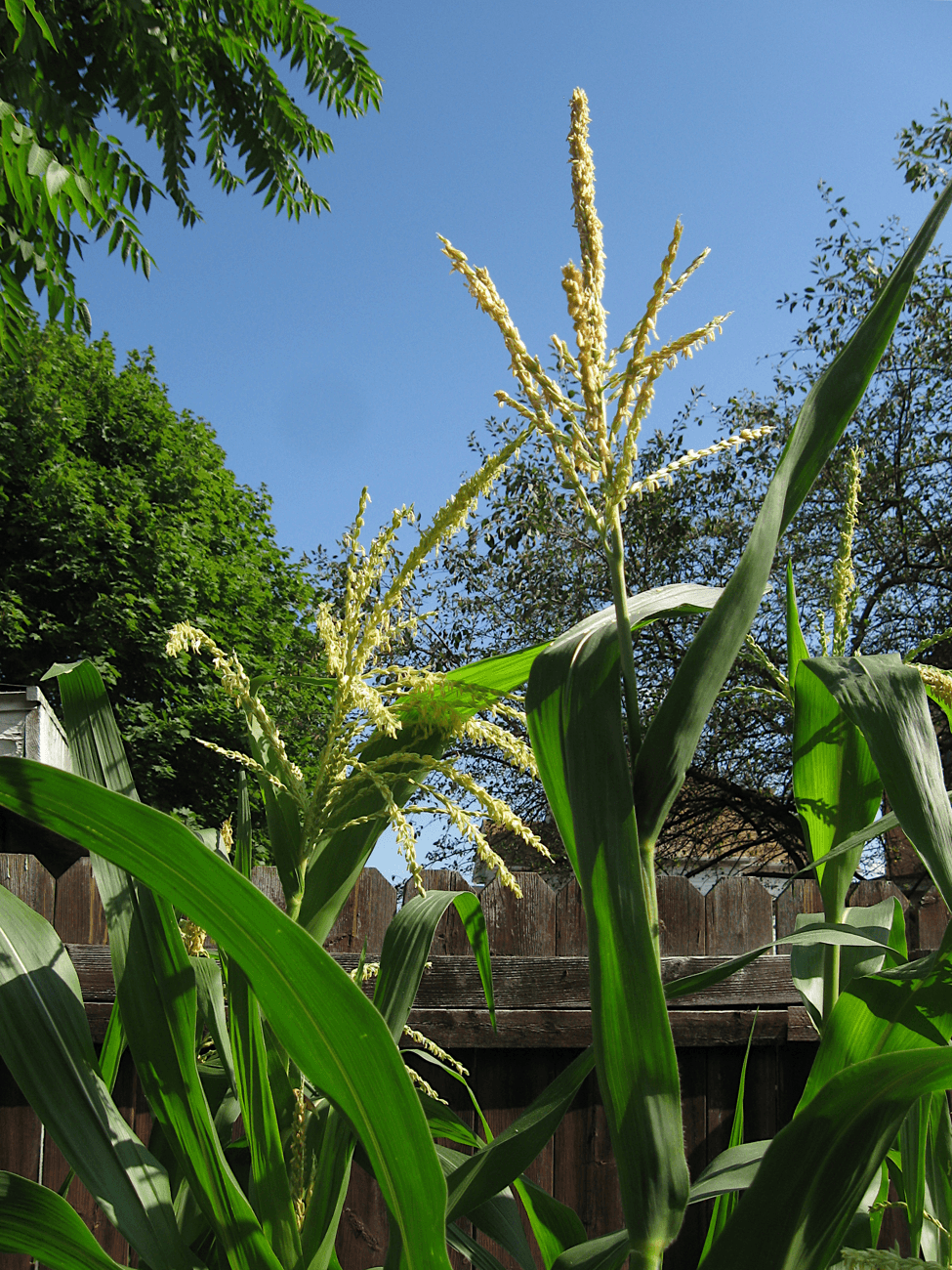
A field of corn has a hidden enemy: weeds, which choke the young crop while it is small. Before chemical weedkillers, the only defence was to cultivate — to drag a hoe or a horse-cultivator between the plants and tear the weeds out. And you can only cultivate between plants if you know exactly where the plants are.
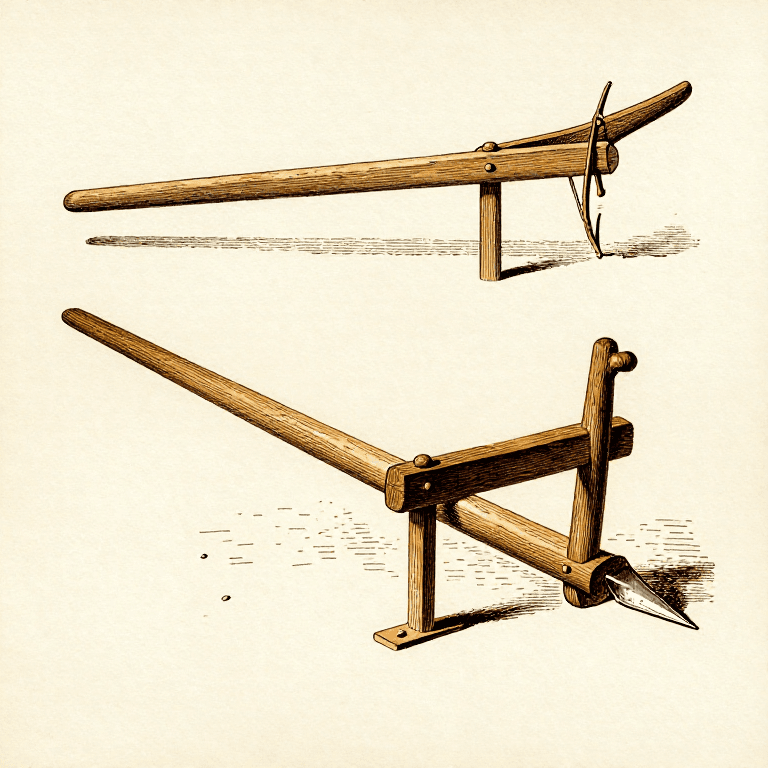
The check-rower plants corn in a perfect grid, so it can be cultivated in BOTH directions. A long knotted wire is stretched across the field, and as the planter rolls along, each knot passing through a fork trips the seed mechanism, dropping a hill of corn at a fixed interval. Because every machine trips on the same wire, the hills line up crosswise as well as lengthwise.
That grid is the whole point: a farmer can run the cultivator up the rows AND across them, killing weeds from every side and leaving the corn standing in clean squares.
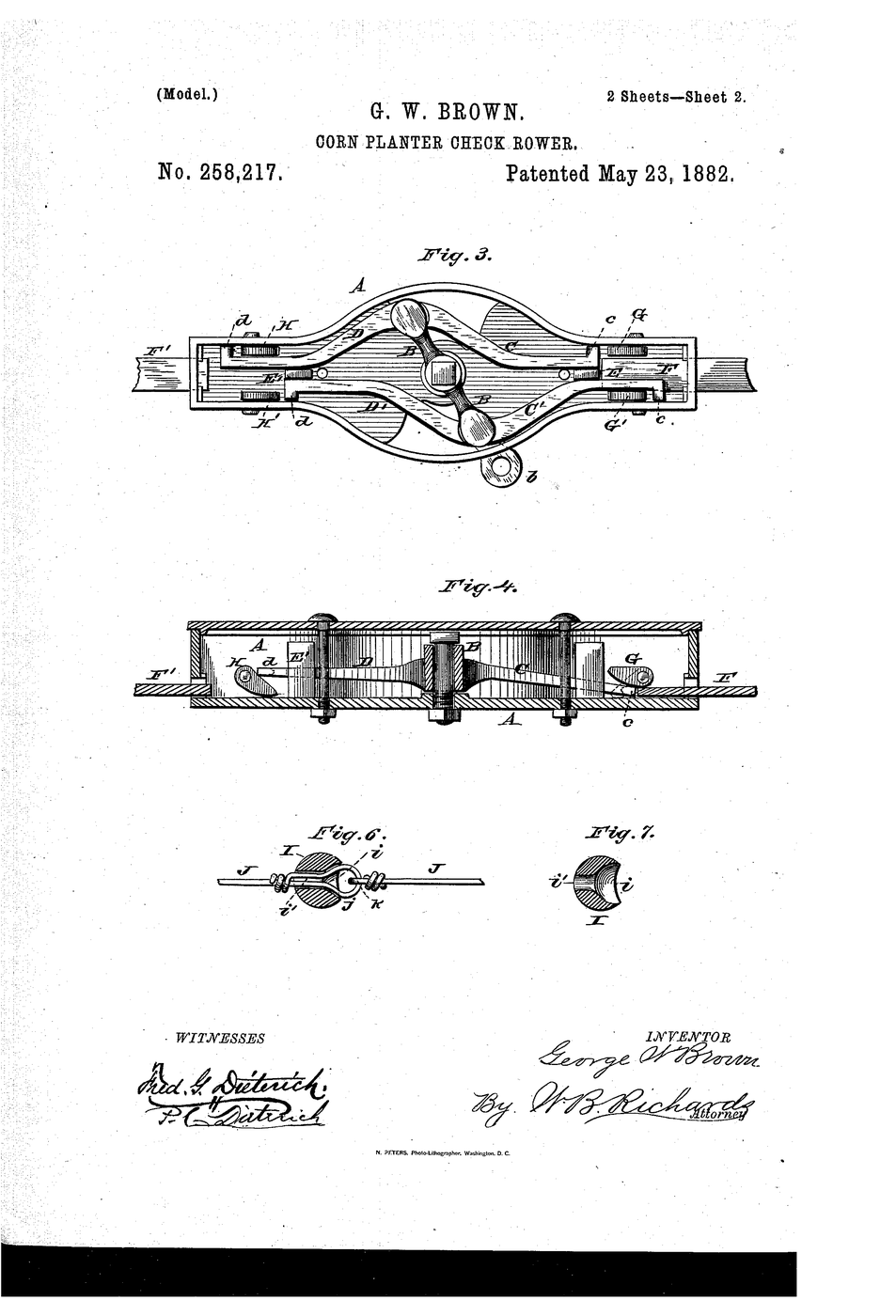
US Patent 258,217, "Corn-planter check-rower", granted 23 May 1882 to George W. Brown of Galesburg, Illinois.
Instruções
Read the claim: a wire that trips the planter
Read the claim: a wire that trips the planter
Brown's check-rower uses a knotted wire with tappets to trip the seed-slide at fixed intervals. Note that the goal is a precise GRID of plants, not just rows.
Drop seeds by hand along a line and measure spacing
Drop seeds by hand along a line and measure spacing
Walk a line dropping corn "by eye" every step. Measure the gaps. They vary a lot — record the spread. Uneven hills cannot be cultivated crosswise.
Materiais para este passo:
 Sementes de milho100 g
Ferramentas necessárias:
 Paquímetro
Build a seed-drop slide
Build a seed-drop slide
Make a sliding gate under a small seed hopper. Push it one way and a few kernels drop; return it and it reloads. This is the seed-drop mechanism.
Materiais para este passo:
 Folhas de cartão canelado1 folha
Ferramentas necessárias:
 X-ato (faca de precisão)
Knot a wire at equal intervals
Knot a wire at equal intervals
Tie beads or knots onto a wire at equal, measured spacings. Each knot will trip one hill of corn. The spacing of the knots sets the spacing of the crop.
Materiais para este passo:
 Arame de aço galvanizado2 metros
Ferramentas necessárias:
 Alicate universal
Make a fork the wire runs through
Make a fork the wire runs through
Fit a forked lever on the planter so the wire passes through it. When a knot reaches the fork, it pushes the lever as the machine rolls forward.
Link the fork to the seed slide
Link the fork to the seed slide
Connect the tripped fork to the seed-drop slide so that each knot fires one drop of corn. Knot passes → lever moves → seeds fall.
Roll the planter along the stretched wire
Roll the planter along the stretched wire
Stretch the wire and push the planter along it. Corn drops at every knot, evenly spaced — the machine plants the wire's rhythm, not a person's guess.
Measure the machine spacing against step 2
Measure the machine spacing against step 2
Measure the gaps between hills. They now match the knot spacing, dead even. Compare with the by-eye spread from step 2.
Plant a second pass parallel to the first
Plant a second pass parallel to the first
Move the wire over one row-width and plant again from the same knots. Because both rows trip on identical spacing, the hills line up side by side.
Look down the field crosswise
Look down the field crosswise
Sight across your rows. The hills form straight lines in the crosswise direction too — a true grid. This alignment is the reason for all the machinery.
Run a cultivator both ways
Run a cultivator both ways
Drag a comb (the cultivator) up the rows, then across them. Because the corn is in a grid, you can weed from both directions without uprooting the crop. A random planting blocks the crosswise pass.
Change the knot spacing and replant
Change the knot spacing and replant
Re-knot the wire at a wider spacing and plant again. The grid opens up. The wire is the setting — spacing is chosen by how you knot it.
History & Context — planting corn you could weed from every side
History & Context — planting corn you could weed from every side
The patent. US 258,217, "Corn-planter check-rower", granted 23 May 1882 to George W. Brown of Galesburg, Illinois. Brown was a well-known planter maker who had patented an earlier corn planter in the 1850s; this patent is the check-rower attachment that made planting precise, and the spec describes "a stretched wire with tappets to impart movements to the seed-slides" — exactly the mechanism of steps 4 to 7.
The grid is not tidiness for its own sake — it is a weeding strategy. Corn is planted while the ground is bare and then spends weeks as small, vulnerable plants that weeds will smother. Before chemical herbicides, the only control was mechanical cultivation: dragging a hoe or horse-cultivator through the soil to tear weeds out. But a cultivator can only pass where there is a clear lane between plants. If corn is planted in even rows you can cultivate along the rows; but if it is planted in a true grid — "checked" — you can cultivate both along and across (step 11), attacking weeds from every direction and leaving the corn in clean squares. The check-row wire is what guarantees the crosswise alignment (steps 9 and 10): because every hill on every pass is dropped by the same knotted wire, the plants line up in two directions at once.
Why it rose and why it faded. Check-row planting dominated American corn growing for decades precisely because cross-cultivation was the best weapon against weeds in the pre-herbicide era, and a stretched wire tripping a positive seed-drop was a beautifully reliable way to achieve it — no guesswork, no drift, just the wire's rhythm laid into the field. It faded in the mid-twentieth century for two reasons that arrived together: chemical herbicides removed the need to cultivate crosswise, and higher planting densities (more plants per acre for more yield) favoured continuous drilling over spaced hills. So this is a machine whose job was later done by chemistry — a clean example of how a mechanical solution can be brilliant and still be superseded when the underlying problem is solved another way. The precision-metering idea itself never left: today's corn planter drops single kernels at exact spacings with vacuum discs, still obsessed, as Brown was, with putting each seed in exactly the right place.
Materiais
3- 100 gReferência
- 1 folhaReferência
- 2 metrosReferência
Ferramentas necessárias
3- Referência
- Referência
- Referência
Blueprints relacionados
Estes blueprints compartilham conhecimento — técnicas, materiais ou princípios


CC0 Domínio Público
Este blueprint é liberado sob CC0. Você é livre para copiar, modificar, distribuir e usar este trabalho para qualquer finalidade, sem pedir permissão.
Apoie o Maker comprando produtos através do Blueprint, onde ele ganha uma Comissão Maker definida pelos vendedores, ou crie uma nova versão deste Blueprint e inclua-o como conexão no seu próprio Blueprint para compartilhar receita.