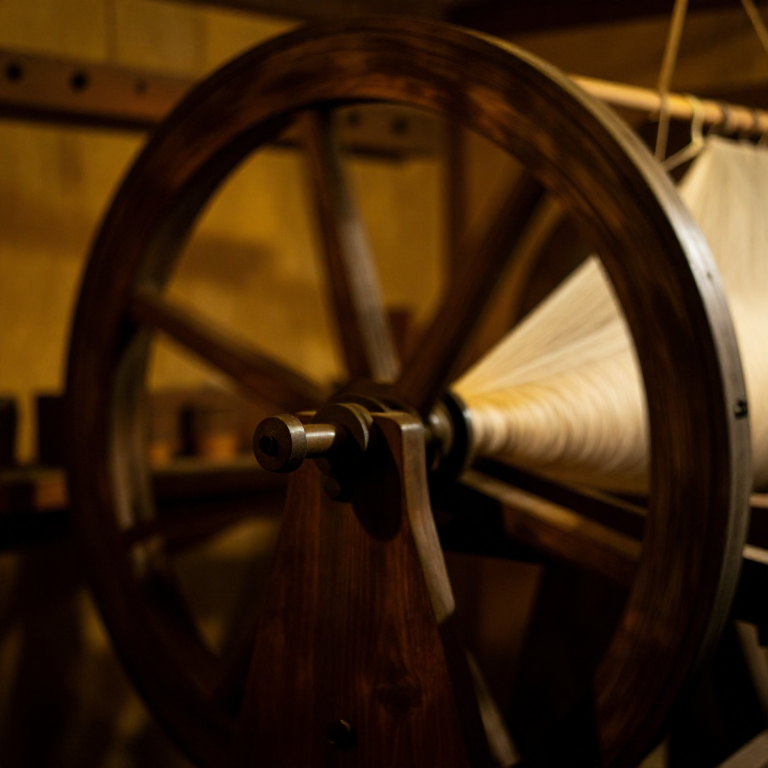

Building a Great Wheel for Spinning — The Machine That Clothed the Medieval World
The spinning wheel appeared in India around 500-1000 AD (the exact date is debated) and reached Europe via the Islamic world by the 13th century. Before the spinning wheel, all yarn was produced on the drop spindle — a simple weighted stick that a spinner twists by hand. A skilled spindle user produces approximately 30-60 meters of yarn per hour. A spinning wheel produces 200-400 meters per hour — a 5-10x productivity increase that transformed textile economics.
The great wheel (also called a walking wheel or wool wheel) is the simplest spinning wheel design: a large drive wheel connected by a belt to a small spindle whorl. The spinner turns the large wheel with one hand while drawing fiber with the other, walking backward to draft the yarn to the correct thickness. The mechanical advantage of the large-to-small wheel ratio multiplies the spindle speed — a single turn of the drive wheel produces 5-8 turns of the spindle.
The spinning wheel's impact on civilization is difficult to overstate. It made cloth affordable enough for common people to own multiple garments — a luxury previously reserved for the wealthy. It created the first cottage industry (spinning at home for market sale) and laid the groundwork for the mechanized spinning that would drive the Industrial Revolution. Gandhi adopted the spinning wheel (charkha) as the symbol of Indian self-sufficiency, hand-spinning cotton as a political act of economic independence from British textile mills.
Instruções
Build the drive wheel frame
Build the drive wheel frame
The drive wheel is the largest component — a wooden wheel approximately 60-80 cm in diameter mounted vertically on a stand. Build the stand from two upright posts (approximately 80 cm tall) mortised into a flat base board. The axle is a smooth hardwood dowel approximately 15 mm in diameter that passes through holes bored in the tops of the uprights. The wheel must spin freely on this axle with minimal friction.
The wheel itself can be built from a single bent hoop (steamed and bent ash or oak) or assembled from segments joined with dowels. Add a handle or crank knob on one side of the wheel for the spinner to turn by hand. The wheel rim should be smooth and uniform — any wobble or irregularity will cause the belt to slip or the spindle speed to fluctuate, producing uneven yarn.
Materiais para este passo:
 Bloco de madeira dura4 peças
Ferramentas necessárias:
 Serrote
 Faca
Faca Sovela
Turn the spindle and whorl
Turn the spindle and whorl
The spindle is a thin, pointed metal rod (approximately 25-30 cm long, 5-6 mm diameter) with a small wooden whorl (pulley) mounted near the driven end. The whorl is approximately 2-3 cm in diameter — the ratio between the drive wheel diameter (60-80 cm) and the whorl diameter (2-3 cm) determines the speed multiplication: a 70 cm wheel driving a 2.5 cm whorl produces a 28:1 ratio, meaning each turn of the drive wheel spins the spindle 28 times.
Mount the spindle in its own pair of small upright supports (maiden posts) positioned on the same base board as the drive wheel, approximately 40-50 cm from the wheel. The spindle must spin freely in bearings — leather cups greased with tallow, or drilled hardwood blocks work well. The pointed tip of the spindle extends past the support and is where the yarn is wound.
Connect the drive belt
Connect the drive belt
Connect the drive wheel to the spindle whorl with a continuous belt — traditionally a loop of cotton cord, linen twine, or a thin leather strip. The belt runs in the groove of the drive wheel rim and wraps around the spindle whorl. Tension is adjusted by moving the spindle supports slightly closer to or farther from the drive wheel.
The belt must be tight enough to drive the spindle without slipping but loose enough that the spinner can stop the spindle by pressing a finger against the whorl. Cross-belt drives (where the belt crosses between wheel and whorl, forming a figure-8) reverse the spindle direction and are used for certain plying operations. For basic spinning, a straight parallel belt is standard.
Materiais para este passo:
 Cordel de cânhamo3 metros
Prepare fiber for spinning
Prepare fiber for spinning
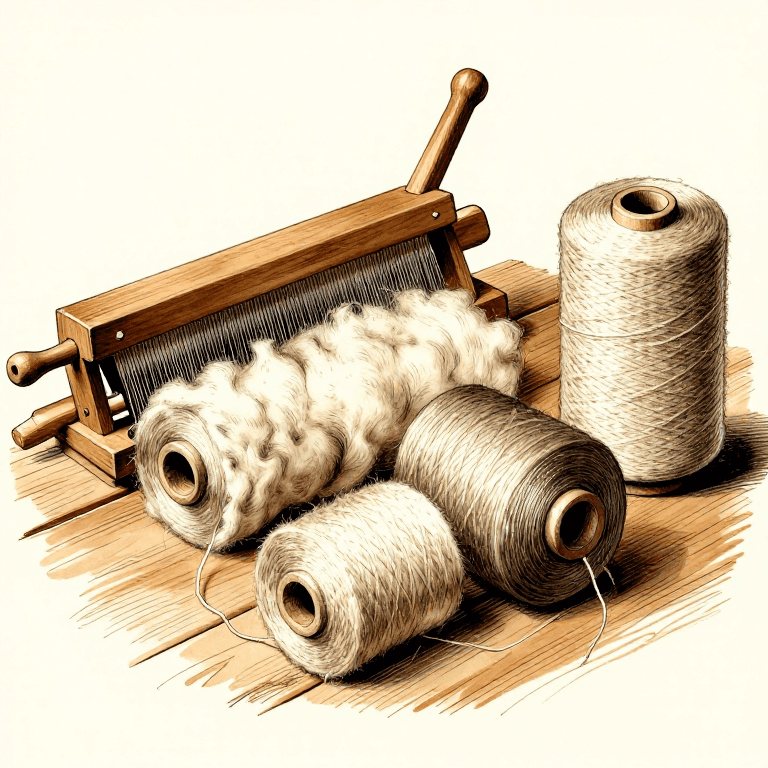
Before spinning, raw wool must be washed (scoured) to remove lanolin and dirt, then carded or combed to align the fibers in parallel. Carding with hand cards (two flat paddles with wire teeth) produces a rolag — a loose, fluffy roll of fiber ready for spinning. Combing with metal combs produces a top — a smooth, dense rope of long, aligned fibers that spins into smoother yarn.
For a great wheel, prepare rolags of approximately 15-20 cm length. Stack 5-10 rolags within arm's reach of the spinning position. The great wheel is best suited to spinning woolen yarn (from carded fiber) rather than worsted yarn (from combed fiber), because the spinning action produces a lofty, airy yarn structure that matches carded fiber's random alignment.
Materiais para este passo:
 Fio de sobras500 g
Spin yarn on the great wheel
Spin yarn on the great wheel
Tie a leader yarn (a short length of existing yarn) to the spindle tip. Hold a rolag in the left hand, draw fibers from the end and overlap them with the leader. Turn the drive wheel clockwise with the right hand — the spindle spins rapidly, twisting the drafted fibers into yarn. Walk backward slowly, drawing the fiber out to the desired thickness while the twist runs up into the drafted zone.
When approximately 1.5 meters of yarn has been drafted and twisted, stop the wheel, reverse it briefly to unhook the yarn from the spindle tip, then wind the new yarn onto the spindle shaft by turning the wheel forward while walking toward the wheel. This draft-twist-wind cycle repeats continuously. The rhythm is meditative — turn, draw, walk back, wind on, repeat. A practiced spinner produces even yarn at a consistent rate, the drive wheel turning with a characteristic rhythmic hum.
Wind the yarn into a skein
Wind the yarn into a skein
When the spindle is full, transfer the yarn to a skein (a loose loop) for washing, dyeing, or storage. A simple niddy-noddy (a T-shaped hand reel) or the back of a chair works as a skein winder. Wind the yarn around the reel in a consistent loop, counting turns to measure yardage — each wrap around a 1-meter niddy-noddy adds 2 meters of yarn.
Tie the skein loosely in 3-4 places to prevent tangling, then remove it from the reel. A day's spinning on a great wheel typically produces 200-500 meters of yarn — enough to knit a pair of socks or contribute to a larger weaving project. The great wheel transformed spinning from a full-time survival task (every household needed yarn) into a productive cottage industry where surplus yarn could be sold at market.
Materiais
4- 4 peçasReferência
- 3 metrosReferência
- 500 gReferência
- 1 peçaReferência
Materiais de Blueprints conectados
Blueprints relacionados
Estes blueprints compartilham conhecimento — técnicas, materiais ou princípios
Warping a Treadle Loom — Measuring, Beaming, and Threading Warp for Broadcloth
por Tex
Têxtil e Couro
Carding and Combing Raw Wool for Spinning — Preparing Fleece for the Drop Spindle
por Tex
Antigo
Building a Horizontal Water Wheel for Grain Milling — The First Mechanical Power Source
por Emma
ARTESANATO
CC0 Domínio Público
Este blueprint é liberado sob CC0. Você é livre para copiar, modificar, distribuir e usar este trabalho para qualquer finalidade, sem pedir permissão.
Apoie o Maker comprando produtos através do Blueprint, onde ele ganha uma Comissão Maker definida pelos vendedores, ou crie uma nova versão deste Blueprint e inclua-o como conexão no seu próprio Blueprint para compartilhar receita.