Colaboração
ARTE
BELEZA E BEM-ESTAR
ARTESANATO
CULTURA E HISTÓRIA
ENTRETENIMENTO
MEIO AMBIENTE
COMIDA E BEBIDAS
ENGENHARIA REVERSA
CIÊNCIAS
ESPORTES
TECNOLOGIA
TECNOLOGIA VESTÍVEL
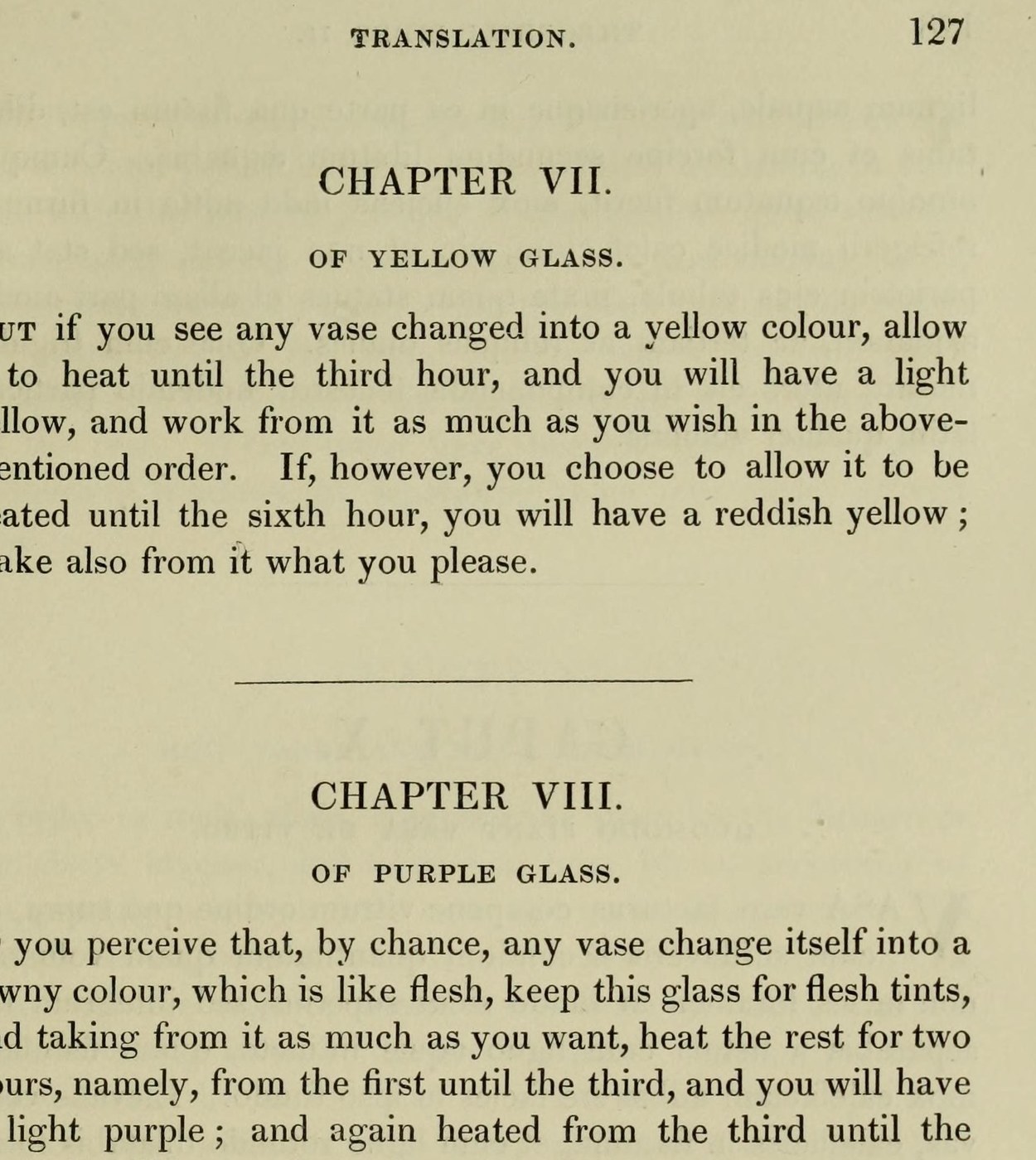


Coloured Glass Sheets: Beech-Ash Glass Blown into Cylinders and Flattened (Theophilus, tr. Hendrie 1847)
Window glass as the monk Theophilus taught it around 1100: two parts beech ash to one of clean sand, fritted for a night and a day, melted overnight in clay pots, blown into long bladders, opened into cylinders, split and flattened in a second oven, and cooled standing upright.
White glass comes first. A pot that turns yellow gives light yellow if heated to the third hour and reddish yellow by the sixth; a pot that turns flesh-coloured gives light purple after two more hours and red purple by the sixth.
Source: Theophilus, De Diversis Artibus, Book II, tr. R. Hendrie (1847), pp. 119-129. Picture: p. 127.
Avançado
2-3 days
Instruções
1
1
Make the beech ash
Make the beech ash
Cut beech-wood logs and dry them. Burn them together in a clean spot and collect the ashes, taking care that no earth gets mixed in.
Materiais para este passo:
 Toros de folhosa (carvalho, ácer, faia)1 beech
Ferramentas necessárias:
 Colher de pedreiro
2
2
Frit the ash and sand
Frit the ash and sand
Mix two parts of ash with one part of sand washed free of earth and stones. Heat it on the upper hearth of the furnace for a night and a day, stirring it with an iron trowel as it warms so that it does not melt into a lump.
Materiais para este passo:
 Areia de quartzo1 1 part to 2 of ash
Ferramentas necessárias:
 Forno de vidro capaz de chegar a 1100 graus CelsiusColher de pedreiro
3
3
Make the pots and melt
Make the pots and melt
Grind dry white clay, wet it, beat it hard with wood and make pots wide at the top and narrow below, with a small lip curved inward. Set the dry pots in the glowing furnace, fill them in the evening with the hot frit and feed dry wood all night until the glass is fully melted.
Ferramentas necessárias:
 Caulino em póForno de vidro capaz de chegar a 1100 graus Celsius
 Tenaz de forjaColher de pedreiro
4
4
Blow the cylinders
Blow the cylinders
In the morning gather glass on the iron pipe (two yards long, a thumb thick), blow a little, tap it on a flat stone so it hangs evenly, and blow it into a long bladder. Melt open the far end in the flame and widen it with a piece of wood, break it off the pipe with a wet piece of wood, open the other end the same way, and let a boy carry the cylinder on a stick to the warm cooling oven. This first glass is pure and white.
Ferramentas necessárias:
 Cana de vidreiroForno de vidro capaz de chegar a 1100 graus Celsius
 Forno de recozimento
5
5
Bring out the colours
Bring out the colours
If a pot turns yellow, heat it to the third hour for light yellow or to the sixth for reddish yellow. If a pot turns tawny like flesh, keep some for flesh tints; heat the rest from the first to the third hour for light purple, from the third to the sixth for a red purple. Blow cylinders from each as before.
Ferramentas necessárias:
Forno de vidro capaz de chegar a 1100 graus CelsiusCana de vidreiro6
6
Split and flatten
Split and flatten
When all are made and cooled, fire the flattening oven. Split each cylinder along one side with a hot iron, lay it on the glowing hearth, and when it softens open it with the pincers and a smooth piece of wood and flatten it. Stand the sheets upright against the wall of the warm cooling oven, one next to another. When cold, cut them into pieces for windows.
Ferramentas necessárias:
Forno de vidro capaz de chegar a 1100 graus CelsiusTenaz de forjaForno de recozimentoMateriais
2- Referência
- 1 1 part to 2 of ashReferência
Este projeto faz

CC0 Domínio Público
Este blueprint é liberado sob CC0. Você é livre para copiar, modificar, distribuir e usar este trabalho para qualquer finalidade, sem pedir permissão.
Apoie o Maker comprando produtos através do Blueprint, onde ele ganha uma Comissão Maker definida pelos vendedores, ou crie uma nova versão deste Blueprint e inclua-o como conexão no seu próprio Blueprint para compartilhar receita.