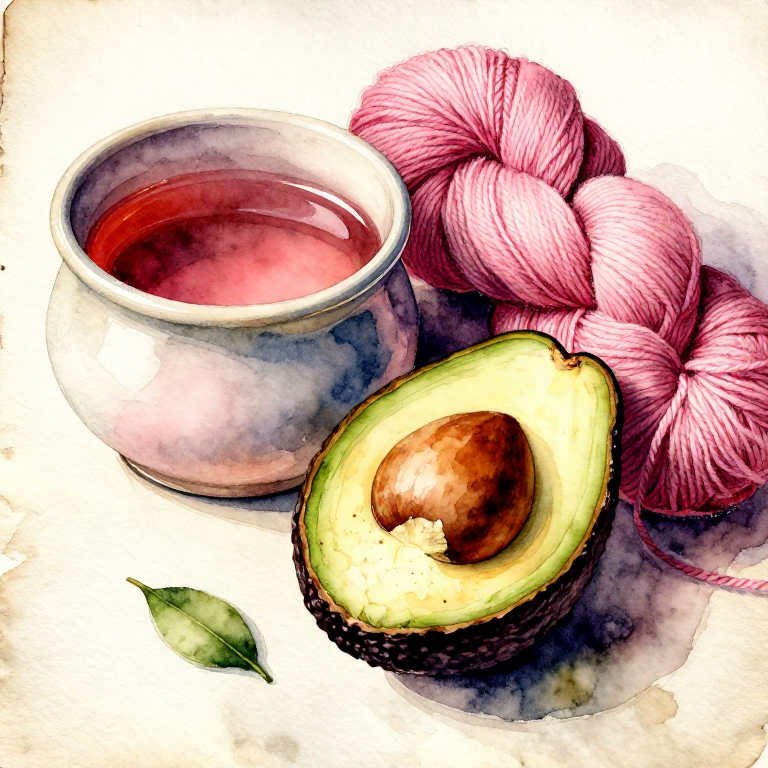


Dyeing Pink with Avocado — The Surprising Blush from Pits and Skins
Avocado (Persea americana) pits and skins produce one of the most unexpected colours in natural dyeing: a soft, warm pink. This surprises most people — the brown pits and dark green skins give no visual hint of the pink pigment they contain. The colour comes from a tannin-based compound that, when heated in water, oxidises to a rose-pink to salmon tone on protein fibres. The chemistry is similar to the condensed tannins found in quebracho and cutch bark, but with a distinctive reddish shift that produces pink rather than brown.
Avocado has been cultivated in Mesoamerica for at least 5,000 years, and archaeological evidence suggests that the Aztec and Maya cultures used avocado pits as a dye source. The tree (Persea americana) is native to central Mexico and Central America, where it grew wild before domestication. The Nahuatl word 'ahuacatl' became the Spanish 'aguacate' and eventually the English 'avocado.'
For the modern natural dyer, avocado is one of the most exciting and accessible dye sources. The raw material is kitchen waste — pits and skins saved from everyday cooking. No specialised supplier is needed, no rare ingredients, no complex chemistry. The process requires patience (pits need thorough simmering to release their colour) but the results are consistently rewarding: a beautiful, warm pink that is difficult to achieve from any other single plant source without chemical modifiers.
Instruções
Save and prepare avocado pits and skins
Save and prepare avocado pits and skins
Use 6-8 avocado pits and their corresponding skins for 100 g of wool. Save pits and skins from everyday cooking — wash off any remaining flesh and store in the freezer until you have enough. Pits can be used whole or chopped into quarters to speed extraction. Skins should be cut into strips. Both pits and skins contribute to the colour, but pits are the primary dye source. The pits should be fresh — old dried pits that have turned very dark may have already oxidised and give weaker colour.
Materiais para este passo:
 Caroços e cascas de abacate8 peças
Ferramentas necessárias:
 Balança digital de cozinha
Simmer the pits and skins at 80°C for 60-90 minutes
Simmer the pits and skins at 80°C for 60-90 minutes
Place the pits and skins in a dye pot with 4 litres of water. Bring slowly to 80°C and hold for 60-90 minutes. Stir occasionally. The water will gradually change colour — first pale amber, then deeper orange, and finally a reddish-pink as the tannins oxidise. Avocado pits are dense and release dye slowly — patience is essential. The longer the simmer (within reason), the deeper the pink. Do not boil — gentle heat produces the cleanest pink tones.
Ferramentas necessárias:
 Panela alta
 Termómetro de cozinha
 Colher de pau para mexer
Strain out the pits and skins
Strain out the pits and skins
Strain the dye liquor through a fine mesh strainer into a clean pot. Remove and discard the pits and skins. Skin fragments especially can stick to wool and cause uneven spots. The strained liquor should be a warm reddish-pink to salmon tone — the colour that will transfer to the wool.
Ferramentas necessárias:
 Peneira de malha fina
Dye alum-mordanted wool at 75-80°C for 60 minutes
Dye alum-mordanted wool at 75-80°C for 60 minutes
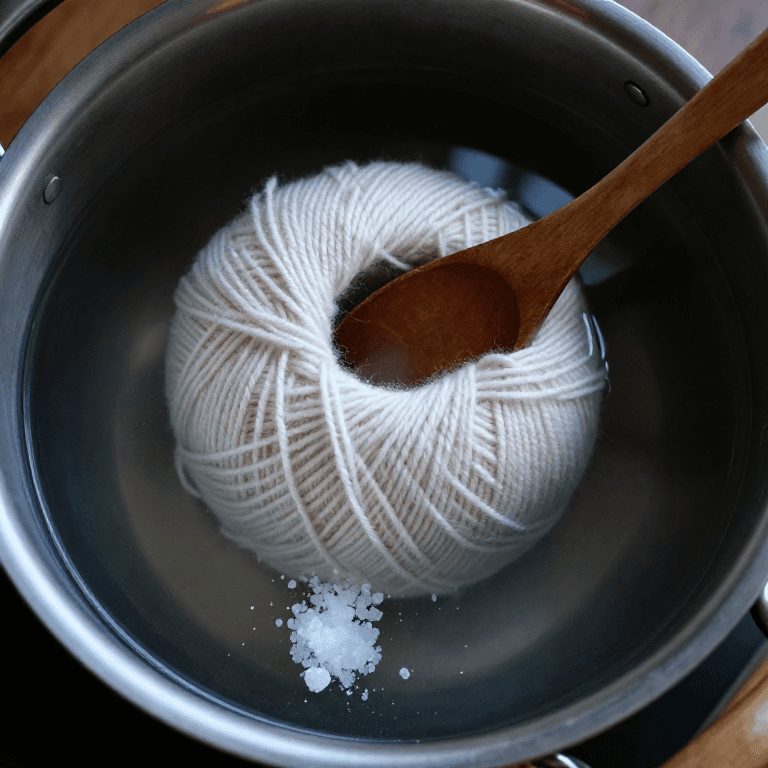
Pre-wet the alum-mordanted wool in lukewarm water for 15 minutes, squeeze gently, and lower it into the avocado dye bath at room temperature. Slowly raise to 75-80°C over 20 minutes, then hold for 60 minutes. Turn gently every 10 minutes. The wool will develop a soft, warm pink — ranging from pale blush to deeper salmon depending on the number of pits used and the length of extraction. Alum mordanting produces the clearest, most vivid pink. Un-mordanted wool gives a more muted, brownish-pink.
Materiais para este passo:
 Meada de lã100 g
 Alúmen (alúmen de potássio)10 g
Cool overnight, rinse, and dry
Cool overnight, rinse, and dry
Turn off the heat and let the wool cool in the dye bath overnight — the pink deepens during cooling. Remove, squeeze gently, and rinse in lukewarm water until the runoff is clear. The final colour is a soft, warm pink — somewhere between blush and salmon, with a peach undertone. This is one of the few truly pink plant dyes achievable without chemical modifiers. Lightfastness is moderate — the pink will gradually soften with prolonged sunlight exposure but retains a warm tone rather than greying. Washfastness is good due to the tannin-fibre bond. Dry in shade.
Materiais
3- 8 peçasReferência
- 100 gReferência
- Referência
Ferramentas necessárias
5- Referência
- Referência
- Referência
- Referência
- Referência
Materiais de Blueprints conectados
Este projeto faz

Blueprints relacionados
Estes blueprints compartilham conhecimento — técnicas, materiais ou princípios
CC0 Domínio Público
Este blueprint é liberado sob CC0. Você é livre para copiar, modificar, distribuir e usar este trabalho para qualquer finalidade, sem pedir permissão.
Apoie o Maker comprando produtos através do Blueprint, onde ele ganha uma Comissão Maker definida pelos vendedores, ou crie uma nova versão deste Blueprint e inclua-o como conexão no seu próprio Blueprint para compartilhar receita.