
Extracting Nickel from Pentlandite — The Devil's Copper That Wouldn't Behave
Nickel (Ni, element 28) gets its name from the German Kupfernickel — 'Old Nick's copper' or 'the Devil's copper.' Saxonian miners in the Erzgebirge encountered a reddish-brown ore (now called nickeline, NiAs) that resembled copper ore but yielded no copper when smelted. They blamed the mischievous sprite Nickel (a diminutive of Nicholas, used as a name for a troublesome goblin) for bewitching the copper. Swedish mineralogist Axel Fredrik Cronstedt isolated metallic nickel in 1751 by heating nickeline with charcoal, proving it was a distinct metal.
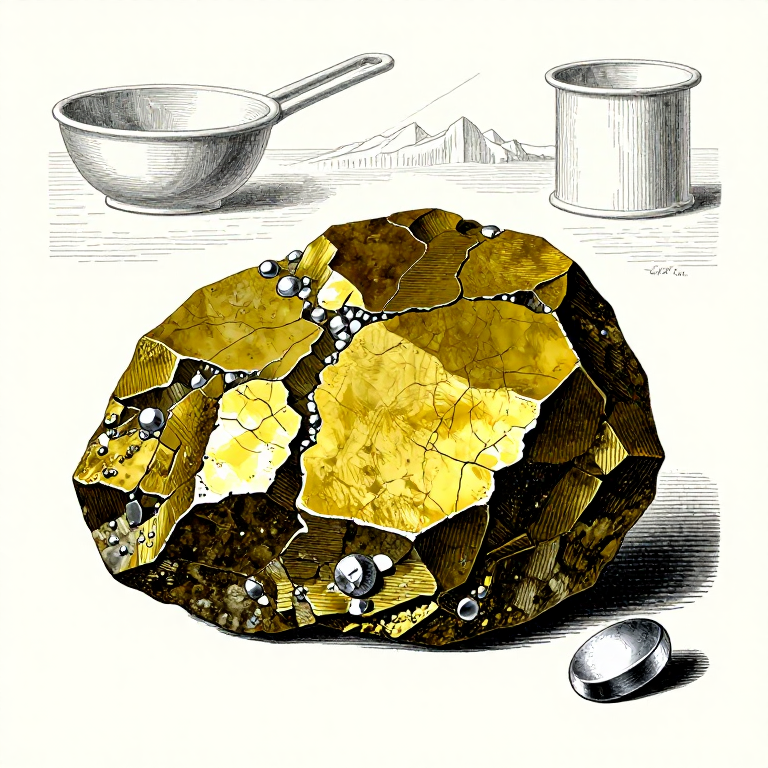
Pentlandite ((Fe,Ni)₉S₈) is the world's primary nickel ore mineral, typically containing 22–42% nickel. It occurs almost exclusively in magmatic sulfide deposits — massive concentrations of metal sulfides that crystallized from sulfide-rich magma deep in the Earth's crust. The two largest deposits on Earth, Sudbury (Ontario, Canada) and Norilsk (Siberia, Russia), together supply a large fraction of the world's nickel.
The extraction of nickel from pentlandite follows a roast-reduce sequence: roasting converts the sulfide to nickel oxide (NiO), and carbon reduction at high temperature produces metallic nickel. The process is complicated by the iron content — pentlandite contains both iron and nickel, and separating them requires careful control of roasting conditions or a matte-smelting step.
HAZARD: Nickel compounds are classified as Group 1 carcinogens (confirmed human carcinogens) by IARC. Nickel dust and nickel oxide dust cause lung and nasal cancer with chronic exposure. Nickel is also one of the most common contact allergens — approximately 10–20% of women and 1–3% of men are sensitized. All work must use respiratory protection and gloves. Roasting produces sulfur dioxide (SO₂), a toxic, choking gas — work outdoors only.
Conteúdo perigoso
Este blueprint contém procedimentos perigosos. Faça login e ative o conteúdo perigoso nas configurações da sua conta para ver as instruções passo a passo.
CC0 Domínio Público
Este blueprint é liberado sob CC0. Você é livre para copiar, modificar, distribuir e usar este trabalho para qualquer finalidade, sem pedir permissão.
Apoie o Maker comprando produtos através do Blueprint, onde ele ganha uma Comissão Maker definida pelos vendedores, ou crie uma nova versão deste Blueprint e inclua-o como conexão no seu próprio Blueprint para compartilhar receita.