Colaboração
ARTE
BELEZA E BEM-ESTAR
ARTESANATO
CULTURA E HISTÓRIA
ENTRETENIMENTO
MEIO AMBIENTE
COMIDA E BEBIDAS
ENGENHARIA REVERSA
CIÊNCIAS
ESPORTES
TECNOLOGIA
TECNOLOGIA VESTÍVEL
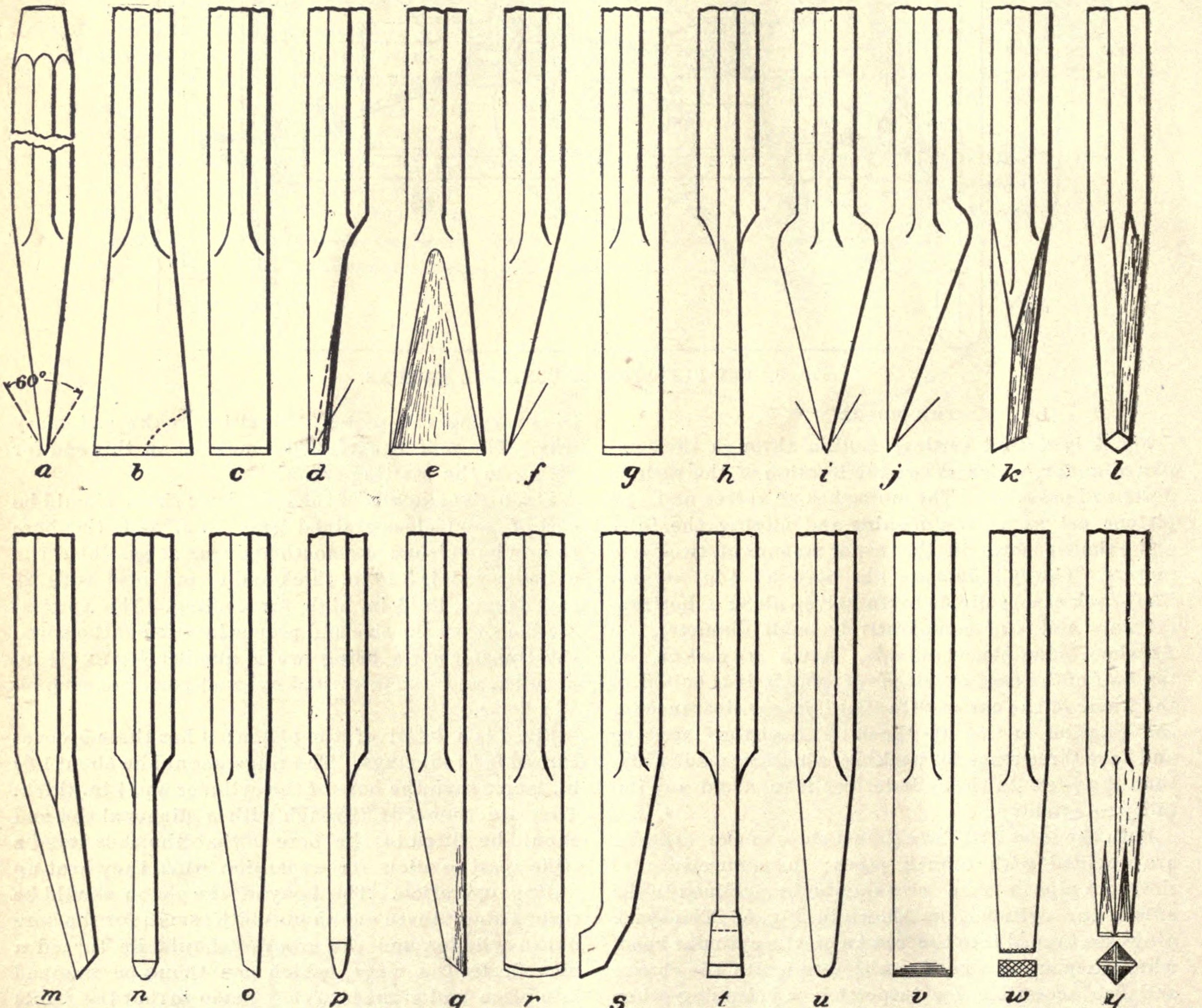


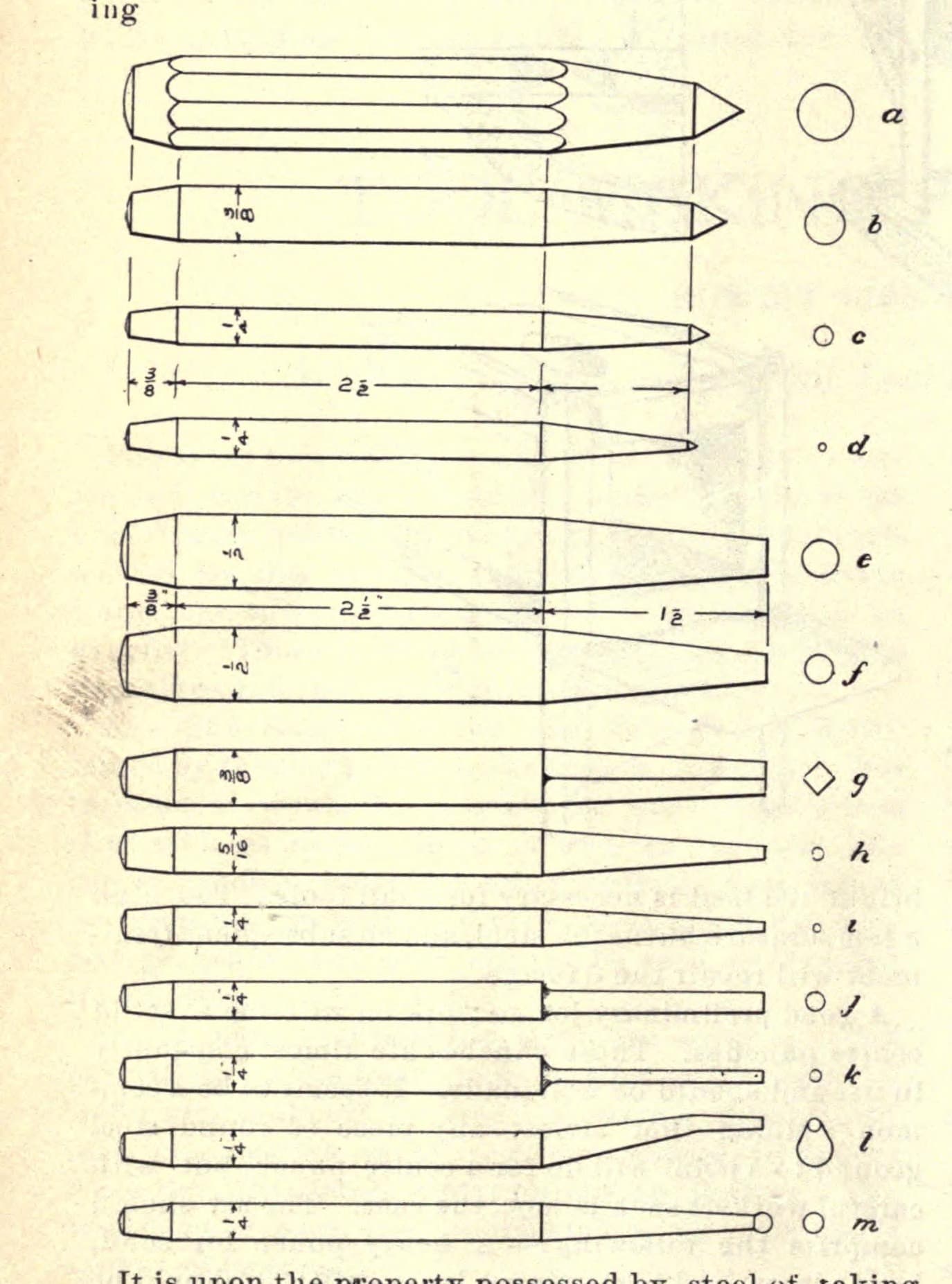
A Set of Cold Chisels: Flat, Gouge, Side, Cape, Diamond-Point and Round-Nose, Edge Hardened Only, Tempered Purple (Griswold, 1904)
Robert Gibson Griswold's working set of cold chisels from Amateur Work (Boston, 1904): octagonal tool steel or old files forged about 5 in. long, flat chisels 3/8 to 1 in. with a 60 degree edge, plus gouges, side, cape, diamond-point and round-nose chisels; only the last 1/8 in. of the edge hardened, tempered light purple for steel or dark purple for iron.
Intermediário
Two or three days for the set
Instruções
1
1
His sizes
His sizes
A carregar o notebook Jupyter…
2
2
Read Griswold
Read Griswold
"When the tool is forged the edge only must be hardened for about 1/8 in., the metal above being left softer to withstand the shock."
3
3
Forge the blanks
Forge the blanks
From octagonal tool steel (or old files) forge each chisel about 5 in. (127 mm) from head to edge with a gradual taper to the edge, and forge the head down so it does not broom. Forging steps are ours: forge at a bright red only, as in his part I.
Materiais para este passo:
 Barra octogonal de aço para ferramentas1 peça
Ferramentas necessárias:
 Forja de ferreiro
 Bigorna
 Martelo
 Tenazes de ferreiro
4
4
Shape the edges
Shape the edges
Flat chisels 3/8, 1/2, 5/8 and 1 in. wide; gouges 1/4-5/8 in. with the bevel inside; side chisels 1/4, 3/8, 1/2 in. with the edge in one flat side; cape chisels 3/16 and 1/4 in. with the stock behind slightly thinner; a diamond point about 1/8 in. on the square (bent version for flat work); round-nose chisels, heavy and a long-tapered drawing chisel (his fig. 1).
Ferramentas necessárias:
Forja de ferreiroBigornaMartelo Limas (lima de mão)
5
5
Harden the edge only
Harden the edge only
Heat the edge and harden only about 1/8 in. (3 mm) of it in water, leaving the body softer: a chisel hard too far up cracks off on a line under a heavy blow.
Materiais para este passo:
 Água1 peça
Ferramentas necessárias:
Forja de ferreiroTenazes de ferreiro Balde
6
6
Temper purple
Temper purple
Brighten the edge with emery cloth and let the heat run the colour down: light purple (530 F) for chisels used on steel, dark purple (550 F) for cast and wrought iron; then cool.
Materiais para este passo:
 Pano de esmeril1 peçaÁgua1 peça
Ferramentas necessárias:
Balde7
7
Grind
Grind
Grind the flat chisel edges to about 60 degrees (45-75: blunter for heavy work), keeping the edge from blueing.
Ferramentas necessárias:
 Esmeriladora de bancada
8
8
Troubleshooting
Troubleshooting
Cold chisel troubleshooting.
Flow
Loading...
9
9
History and honest limits
History and honest limits
From Robert Gibson Griswold, "Tool Making for Amateurs" II, **Amateur Work** (Boston), vol. III (1903-04), pp. 304-305 and fig. 1 (checked on the archive.org scan amateurwork03bostrich); temper temperatures from his part I table. Forging heats, metric figures and tools are ours.
Materiais
3- Referência
- 2 peçasReferência
- 1 peçaReferência
Este projeto faz

Blueprints relacionados
Estes blueprints compartilham conhecimento — técnicas, materiais ou princípios
CC0 Domínio Público
Este blueprint é liberado sob CC0. Você é livre para copiar, modificar, distribuir e usar este trabalho para qualquer finalidade, sem pedir permissão.
Apoie o Maker comprando produtos através do Blueprint, onde ele ganha uma Comissão Maker definida pelos vendedores, ou crie uma nova versão deste Blueprint e inclua-o como conexão no seu próprio Blueprint para compartilhar receita.