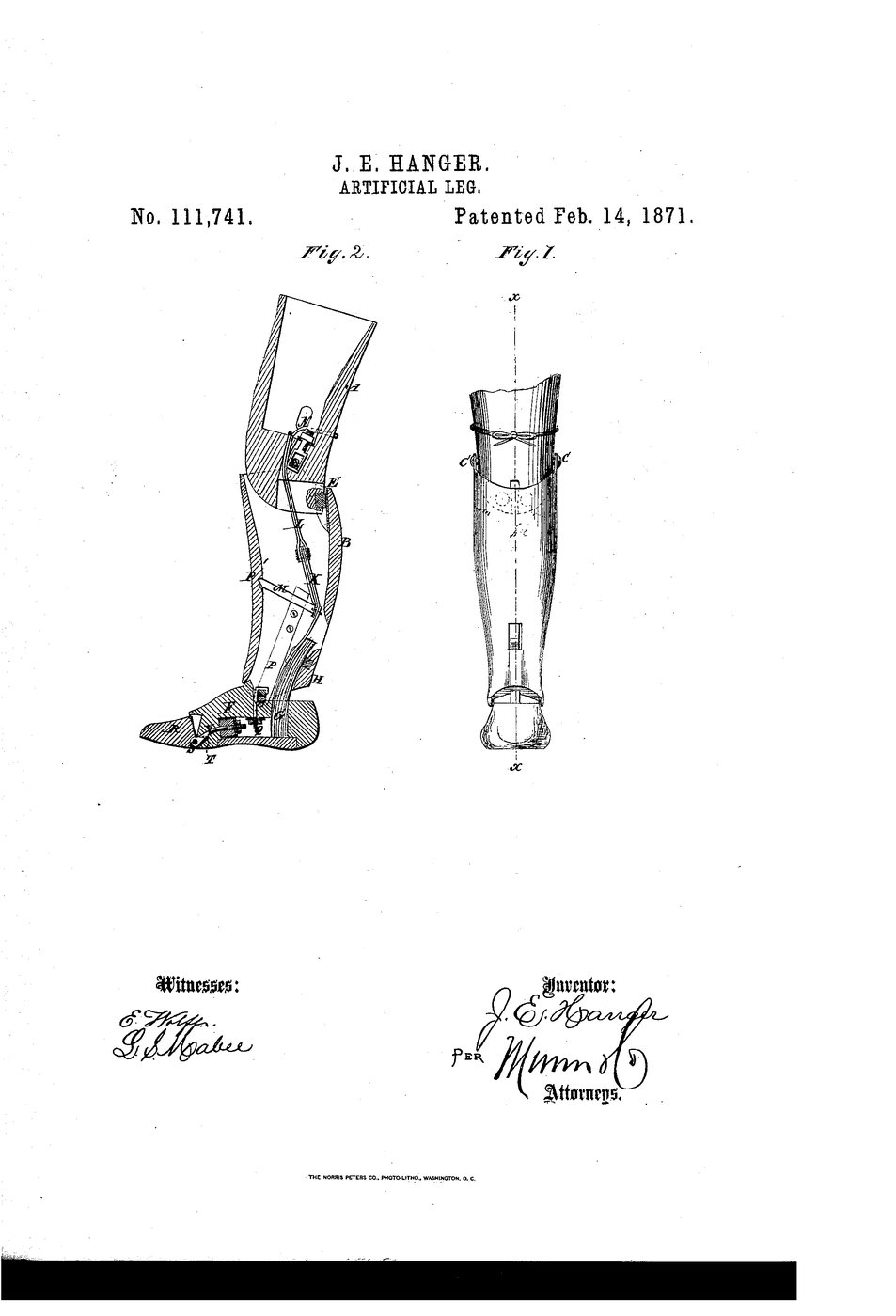


Artificial Leg
A peg leg does not bend, so the wearer must swing the whole limb outward to clear the ground. A jointed leg that bends freely is worse: the knee folds under load and the foot hangs toe-down, so the toe catches on every step and the wearer falls.
The problem is not making joints. It is making them agree with each other. When the knee swings forward the toe must lift at the same moment, without the wearer thinking about it — because there is no muscle left to do it and no nerve to feel with.
Hanger links the two joints with cords and springs. A lifting spring runs from the shin to the foot so the toe rises as the leg swings through, and a deflecting bar coordinates the springs so knee and ankle operate together. Rubber cushions at both joints absorb the shock that would otherwise travel straight into the stump.
US Patent 111,741, "Improvement in artificial legs", granted 14 February 1871 to James Edward Hanger — who had lost his own right leg above the knee at eighteen, and built the first version from oak barrel staves.
Instruções
Build a bench model, not a limb to wear
Build a bench model, not a limb to wear
A real prosthesis is fitted to one person's residual limb by a clinician; a badly fitted socket causes pressure sores and skin breakdown. Build this at model scale to understand the linkage, and never attempt to wear a home-made limb.
Read US 111,741 and find the deflecting bar
Read US 111,741 and find the deflecting bar
Hanger claims a bar that makes the springs operate knee and ankle together. Two joints, one coordinated motion — that is what separates this from a hinge.
Cut a rigid peg leg first
Cut a rigid peg leg first
Make a plain straight leg with no joints. Walk it through a stride by hand over a table. Note the sideways swing needed to clear the surface.
Materiais para este passo:
 Contraplacado de bétula báltica1 folha
Ferramentas necessárias:
 X-ato (faca de precisão)
Cut thigh, shin and foot sections
Cut thigh, shin and foot sections
Shape three pieces to scale. Hanger used oak barrel staves — curved, seasoned, strong and available to a convalescent at home.
Hinge the knee
Hinge the knee
Pin thigh to shin so it swings freely. Walk it through a stride again. It folds under load — a free knee is not yet an improvement.
Ferramentas necessárias:
 Alicate de bico chato
Hinge the ankle
Hinge the ankle
Pin the foot to the shin with a bolt through a slot, as Hanger's hook-headed bolt and adjusting nut allow the joint to be tuned rather than fixed.
Swing it and watch the toe catch
Swing it and watch the toe catch
With both joints free, swing the leg forward. The foot hangs toe-down and drags. Record where it catches — this single failure ends most walks.
Fit the rubber knee cushion
Fit the rubber knee cushion
Set a rubber block where the shin meets the thigh at full extension. It stops the knee snapping straight and absorbs the impact of the swing.
Materiais para este passo:
 Elásticos de borracha1 pacote
Mortise the curved bearing piece into the foot
Mortise the curved bearing piece into the foot
Let a curved wooden piece into the foot so it bears on a cushioned rear part at heel strike. Wood against rubber, not wood against wood.
Run the lifting cord from shin to toe
Run the lifting cord from shin to toe
Fit a cord and spring from the shin to the front of the foot so tension pulls the toe upward. Set it so the foot rests level, not drooping.
Materiais para este passo:
 Cordel de cânhamo1 metro
Swing again and watch the toe rise
Swing again and watch the toe rise
Move the leg through a stride. The toe now lifts as the leg swings and clears the surface without any sideways motion. Compare with steps 3 and 7.
Add the deflecting bar
Add the deflecting bar
Link the knee's motion to the ankle spring so bending the knee increases toe lift. Now the ankle is driven by the knee, not merely sprung on its own.
Tune the ankle nut and re-walk
Tune the ankle nut and re-walk
Adjust the ankle bolt tighter and looser and walk the model each time. Too loose and it flops; too tight and it will not roll through at heel-off. Find the middle.
Drop it from 20 mm onto the heel
Drop it from 20 mm onto the heel
Let the leg fall heel-first, with and without the rubber cushions. Feel the difference through the thigh section — every one of those shocks would reach a residual limb.
History & Context — designed by the man who needed it
History & Context — designed by the man who needed it
The patent. US 111,741, "Improvement in artificial legs", granted 14 February 1871 to James Edward Hanger of Staunton, Virginia. Application and grant share a date. It is filed a single week after the Morrison dental engine elsewhere in this batch — US 111,667 and US 111,741, seventy-four numbers apart.
📌 Hanger was his own first patient. He enlisted at eighteen and lost his right leg above the knee in June 1861, in one of the earliest amputations of the American Civil War. Sent home to convalesce, he spent months in an upstairs room refusing to explain what he was doing, and came downstairs walking on a limb he had built from oak barrel staves, rubber bumpers and nails. Fellow amputees called it the Hanger Limb. The company he founded still exists. This is a different authorship model from most of this programme — not an engineer solving an observed problem, but a user solving his own, with the enormous advantage of being able to feel every fault immediately. The folding wheelchair elsewhere in this batch has exactly the same origin.
Why coordination beats articulation. Adding joints to a prosthesis is easy and, on its own, makes things worse — step 7 shows why. A leg with a free knee and a free ankle has no muscles to hold it in a useful shape, so it collapses under load and drags on the swing. What Hanger supplies is automatic coordination: springs and cords that make the ankle do the right thing because of what the knee is doing, with no conscious control and no sensation required. Modern prosthetics still chase the same goal, now with hydraulic dampers and microprocessor knees that adjust resistance in milliseconds, but the design target — a natural gait from passive components — is unchanged.
The war created the market. Roughly sixty thousand amputations were performed during the American Civil War, and both governments funded limbs for veterans; the Confederate states and later the US federal programme created the first mass demand for prosthetics. That is an uncomfortable but honest reason why prosthetic design advanced sharply in the 1860s and 1870s, and why so many patents of this period are for artificial limbs.
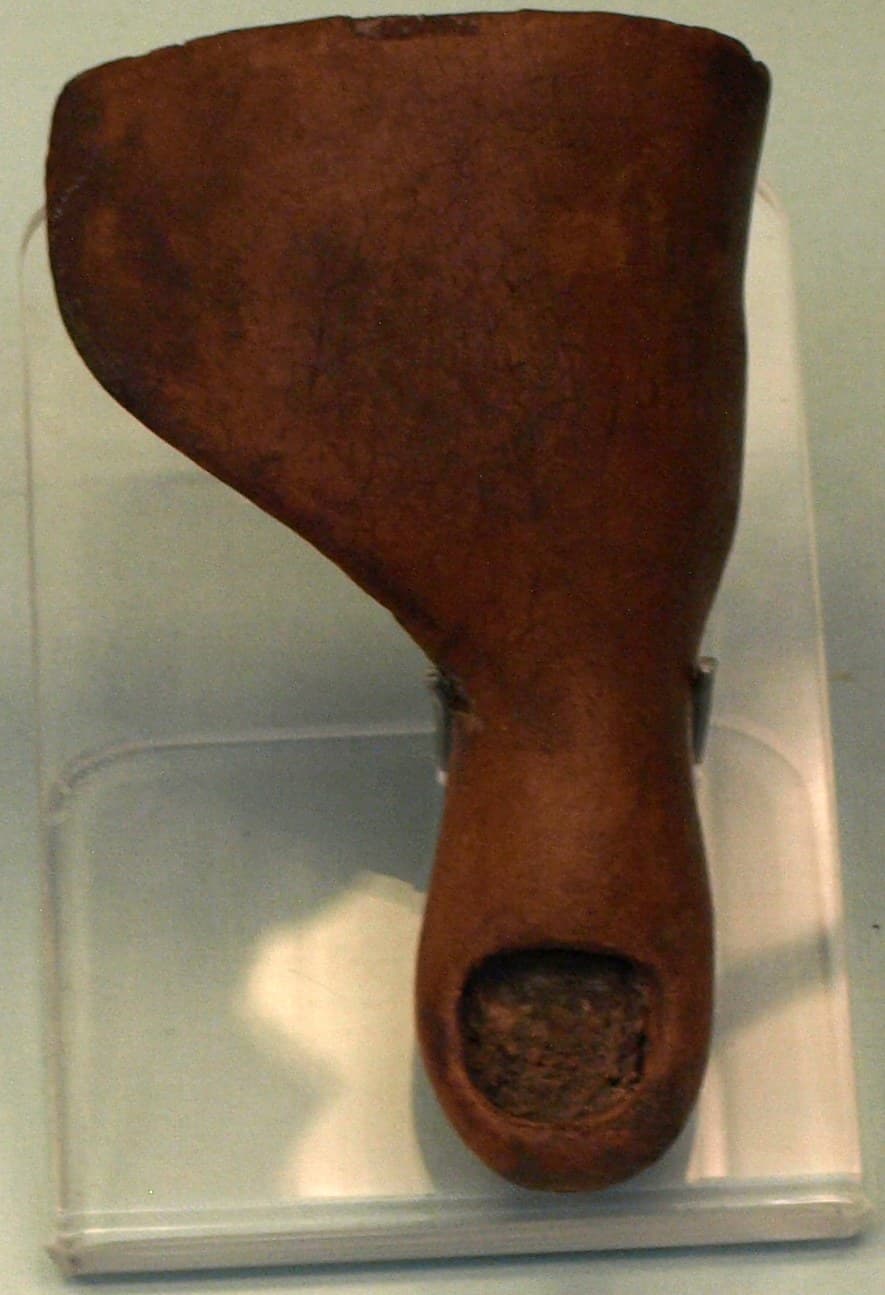
The ancient version is in this collection too. The Cairo Toe — a carved wooden and leather prosthetic toe from ancient Egypt, and one of the oldest known functional prostheses — sits at the other end of the same line. Three thousand years apart, both are passive, both are carved wood, and both exist to restore gait rather than appearance.
Materiais
3- Referência
- 1 pacoteReferência
- 1 metroReferência
Ferramentas necessárias
2- Referência
- Referência
Blueprints relacionados
Estes blueprints compartilham conhecimento — técnicas, materiais ou princípios


CC0 Domínio Público
Este blueprint é liberado sob CC0. Você é livre para copiar, modificar, distribuir e usar este trabalho para qualquer finalidade, sem pedir permissão.
Apoie o Maker comprando produtos através do Blueprint, onde ele ganha uma Comissão Maker definida pelos vendedores, ou crie uma nova versão deste Blueprint e inclua-o como conexão no seu próprio Blueprint para compartilhar receita.