

Reel Lawn Mower
Before the lawn mower, grass was cut with a scythe — a swinging blade that took real skill to keep even, and left a rough, wavy finish only a strong, practised hand could manage. A tidy lawn was a luxury of the rich, kept by teams of scythe-men.
The reel mower turns grass-cutting into a pair of scissors you push. A cylinder of curved blades spins fast, geared to the wheels, and sweeps each blade past a fixed bottom knife. The grass is caught between the moving blade and the still one and sheared — a clean scissor cut, not a chop — at hundreds of cuts a second.
Because the wheels drive the reel, pushing the mower is what powers the cut, and because the blades are set in a spiral, one is always shearing — so the cut is smooth and continuous, giving the even, close-clipped lawn a scythe never could.
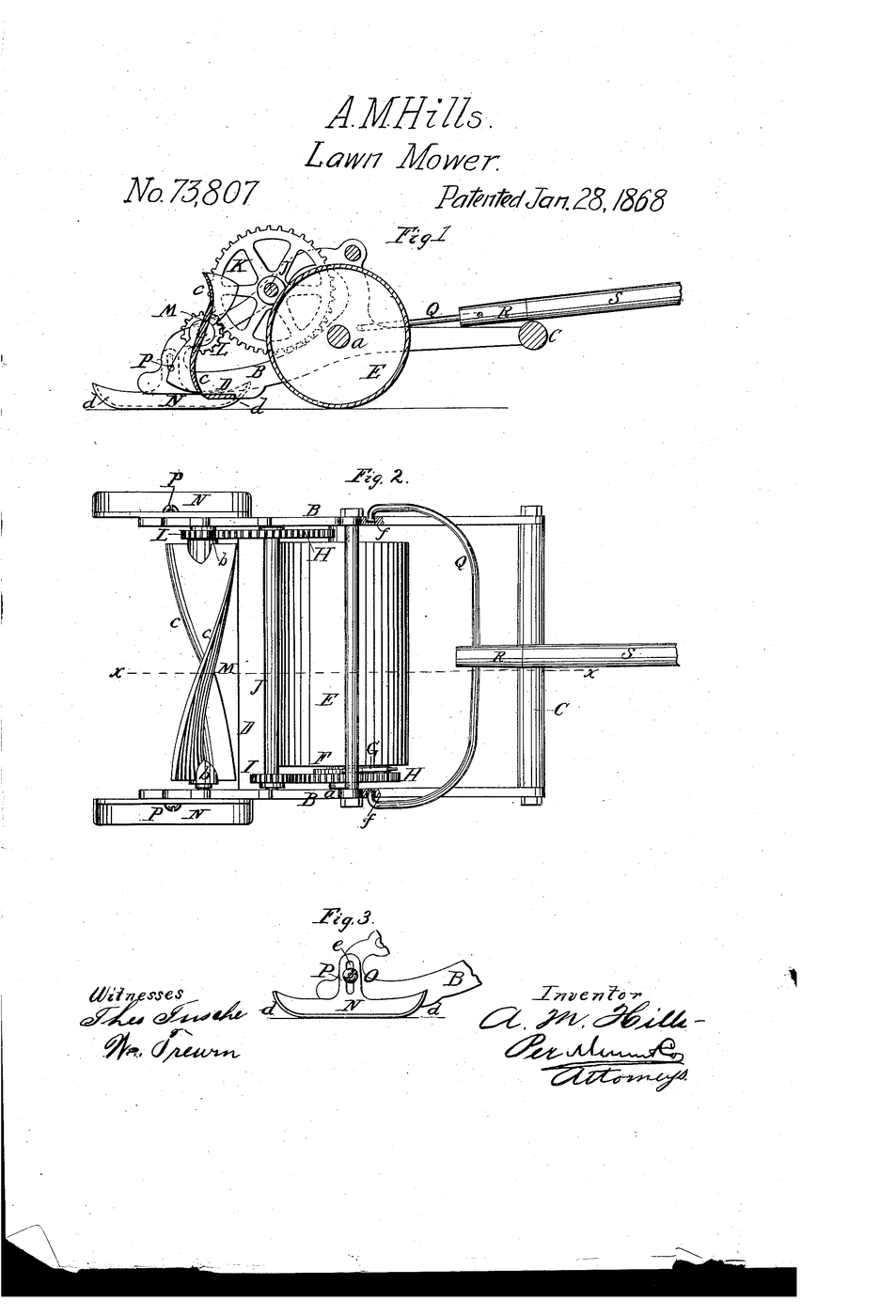
US Patent 73,807, "Improvement in Lawn-Mowers", granted 28 January 1868 to Amariah M. Hills of Hockanum, Connecticut — the first US lawn-mower patent (the reel mower itself was invented by Edwin Budding in England, 1830).
Instruções
Read the claim: a spinning reel shears against a fixed knife
Read the claim: a spinning reel shears against a fixed knife
Hills claims a revolving cylinder of blades geared to the wheels that cuts grass by shearing it against a fixed bottom knife — a scissor, not a chop. Note the two edges.
Make the fixed bottom knife
Make the fixed bottom knife
Fix a straight strip of aluminium along the base of a frame, its edge horizontal just above the ground. This still edge is one half of the scissors.
Materiais para este passo:
 Chapa de alumínio1 folha
Ferramentas necessárias:
 X-ato (faca de precisão)
Build the blade reel
Build the blade reel
Glue several thin blades along a dowel, each set at a slight spiral so they don't all strike at once. This cylinder is the moving edge.
Materiais para este passo:
 Placa de tília1 folha
 Vareta de madeira (cavilha)1 peça
Ferramentas necessárias:
 Serra de recortes
Mount the reel and add wheels
Mount the reel and add wheels
Hang the reel in the frame so its blades sweep just past the fixed knife, and fit a wheel on each side.
Materiais para este passo:
 Conjunto de rodízios1 conjunto
Gear the reel to the wheels
Gear the reel to the wheels
Loop a wire or band from a wheel to the reel spindle so the wheel spins the reel several times faster than it rolls. Now pushing drives the cut.
Materiais para este passo:
 Arame de aço galvanizado1 metro
Push it and watch the reel whirl
Push it and watch the reel whirl
Roll the mower forward. The reel spins fast from a slow push — the gearing multiplies wheel turns into many blade passes.
Cut paper 'grass'
Cut paper 'grass'
Stand strips of paper up in a row and mow over them. Each is sheared between the moving blade and the fixed knife — a clean cut, not a tear.
See why the gap matters
See why the gap matters
Open the reel-to-knife gap wide: the paper folds over uncut. Close it to a whisker: it shears cleanly. A scissor only cuts when its edges nearly touch.
Feel the spiral do a continuous cut
Feel the spiral do a continuous cut
Because the blades are spiralled, one is always crossing the knife — the cut is smooth and steady, not a series of jolts. Straight blades would all bang at once.
Mow real grass
Mow real grass
Run it over a tuft of real grass. It clips the tops evenly, throwing the cuttings forward — a close, level finish.
Set the cutting height
Set the cutting height
Raise or lower the whole reel-and-knife relative to the wheels. Higher leaves the grass long, lower cuts it short — the mower's height adjustment.
Compare with a scythe swing
Compare with a scythe swing
Try cutting the same grass by swinging a ruler like a scythe. It is uneven and needs skill and force. The mower gives anyone a level lawn by just walking. Note why that changed the suburbs.
History & Context — the machine that made the lawn ordinary
History & Context — the machine that made the lawn ordinary
The patent. US 73,807, "Improvement in Lawn-Mowers", granted 28 January 1868 to Amariah M. Hills of Hockanum, Connecticut. This is the first US lawn-mower patent, and Hills went on to found the Archimedean Lawn Mower Company. The reel mower itself, though, was English: Edwin Beard Budding patented it in 1830, having adapted the rotary shearing cylinder from a machine that trimmed the nap on woollen cloth. Hills' patent brought the type to American manufacture and improved the gearing and adjustment.
The physics is a rotary scissors. A scissor cuts because two edges pass each other with almost no gap, trapping and shearing whatever is between them (step 8). The reel mower makes one edge a fast-spinning cylinder of curved blades and the other a fixed bottom knife (the "bed knife"); each blade sweeping past the knife is one snip, and with the wheels geared to spin the reel several times per revolution, a walking-pace push delivers hundreds of clean snips a second. Setting the blades in a helix means only a small part of one blade meets the knife at any instant, so the cut is continuous and the effort smooth (step 9) rather than a hammering of simultaneous blows.
Why it changed the world outside. Before the mower, a smooth green lawn meant either grazing animals or an army of scythe-men, so it signalled wealth. The reel mower let one ordinary person keep a neat lawn in an hour — and with it came the suburban front lawn, the public park, and the modern sports field. Cricket, tennis, golf and football all depend on a closely-mown, level turf that simply could not be produced at scale by hand; the smooth pitch is a product of this machine. Your paper-shearing model is the whole invention: two edges, nearly touching, driven by the wheels you push.
Materiais
5- 1 folhaReferência
- 1 folhaReferência
- Referência
- 1 conjuntoReferência
- 1 metroReferência
Ferramentas necessárias
2- Referência
- Referência
CC0 Domínio Público
Este blueprint é liberado sob CC0. Você é livre para copiar, modificar, distribuir e usar este trabalho para qualquer finalidade, sem pedir permissão.
Apoie o Maker comprando produtos através do Blueprint, onde ele ganha uma Comissão Maker definida pelos vendedores, ou crie uma nova versão deste Blueprint e inclua-o como conexão no seu próprio Blueprint para compartilhar receita.