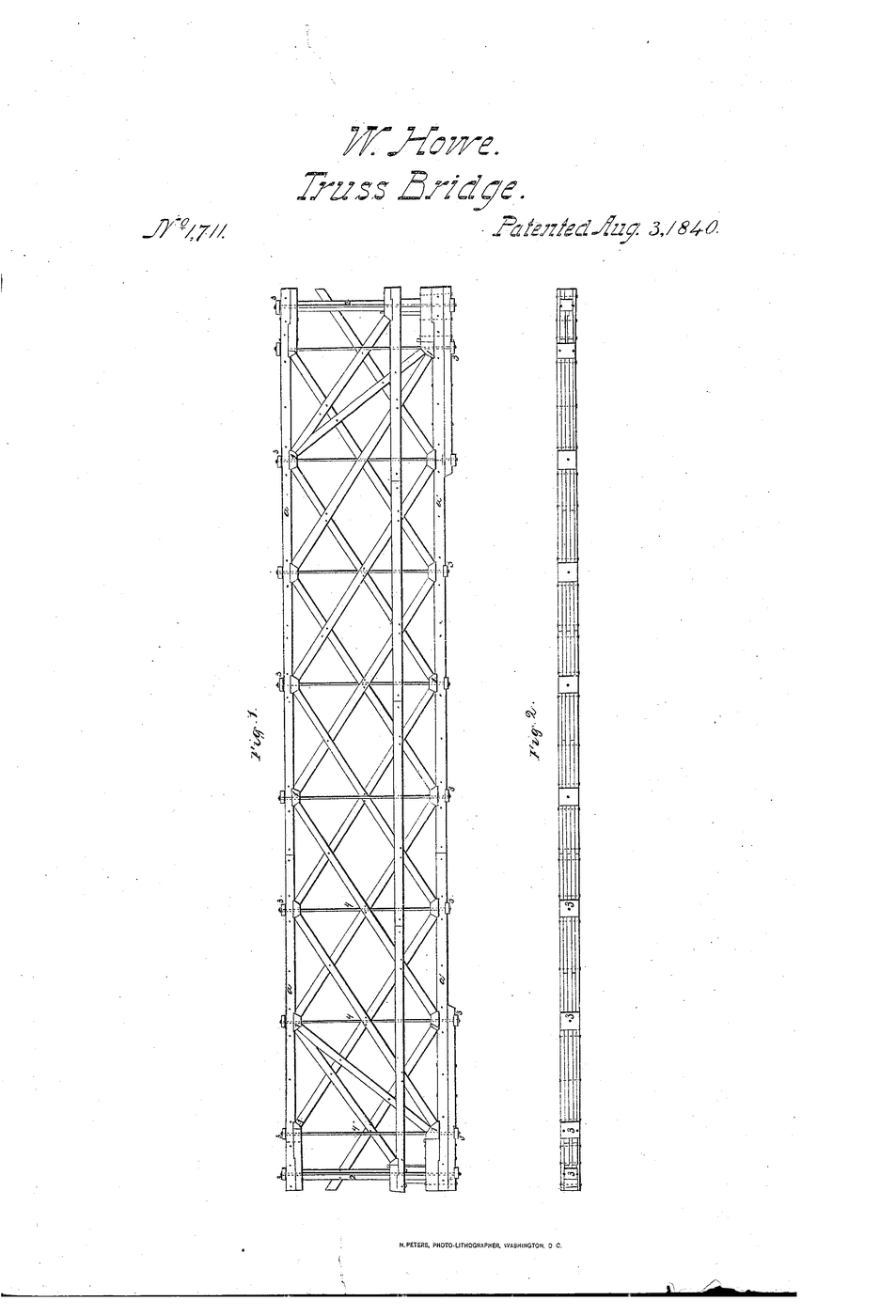


Howe Truss
A beam laid across a gap sags in the middle: its top squeezes (compression) and its bottom stretches (tension). Make the gap wide enough and any solid beam either bends or needs to be impossibly deep. A truss beats this by turning a solid beam into a frame of triangles, so every member carries its load as pure push or pure pull — far more span for far less material.
Howe's truss is a clever marriage of two materials to their strengths. The diagonals are timber, set to be squeezed (wood is strong and cheap in compression); the verticals are iron rods, set to be stretched (iron is superb in tension). And the iron rods have nuts — so the whole truss can be tightened, pre-loaded and re-adjusted as the timber settles.
That adjustability, and the ease of building it from standard timber and rod, made it the truss that bridged the railroads — quick to erect, quick to repair, and tunable on site.
US Patent 1,711, "Manner of constructing the truss-frames of bridges and other structures", granted 3 August 1840 (reissued 1850, No. 175) to William Howe of Warren, Massachusetts.
Instruções
Read what Howe actually combines
Read what Howe actually combines
Howe claims a truss with timber diagonals (in compression) and iron verticals (in tension) that can be tightened by nuts. Note the two materials and the adjustability.
Bridge a gap with a plain stick and load it
Bridge a gap with a plain stick and load it
Lay a single balsa stick across a gap and hang weight at the middle. Note how much it takes to bend or break. This is the beam you are going to beat with a frame.
Materiais para este passo:
 Ripas de balsa1 pacote
Ferramentas necessárias:
 Dinamómetro (balança de mola)
Show a stick fails in compression by buckling
Show a stick fails in compression by buckling
Push the ends of a long thin stick toward each other. It bows sideways and buckles. Compression members must be stout and short; tension members can be thin.
Show a string carries tension but not compression
Show a string carries tension but not compression
Pull a string tight — it holds a big load. Push its ends together — it just goes slack. A string is a perfect tension member and useless in compression. Wood and iron each have a job.
Materiais para este passo:
 Cordel de cânhamo1 metro
Build the top and bottom chords
Build the top and bottom chords
Make two parallel horizontal members — the top chord and bottom chord — the length of your span, from balsa or basswood.
Materiais para este passo:
 Placa de tília1 folha
Ferramentas necessárias:
 X-ato (faca de precisão)
Add timber diagonals as compression members
Add timber diagonals as compression members
Fit stout wooden diagonals between the chords, angled so a downward load squeezes them. These are Howe's timber compression members.
Add iron-rod verticals as tension members
Add iron-rod verticals as tension members
Run wire (standing in for iron rods) as the vertical members, tying the chords together. Under load these are stretched — the tension members.
Materiais para este passo:
 Arame de aço galvanizado1 metro
Ferramentas necessárias:
 Alicate universal
Tighten the verticals to pre-load the truss
Tighten the verticals to pre-load the truss
Twist or tension the wire verticals so the whole frame pulls tight. Howe's nuts do exactly this — you can pre-load and adjust the truss, taking up any slack in the timber.
Load the truss and compare with step 2
Load the truss and compare with step 2
Hang weight at the centre and read the force to fail it. The truss carries far more than the plain stick from step 2, using little more material. Record the ratio.
Find each member's tension or compression
Find each member's tension or compression
Load slowly and feel each member: diagonals are being pushed (they resist buckling), verticals are being pulled (they twang taut). Mark C or T on every member. That map is the whole design.
Swap a wire diagonal in for a wood one
Swap a wire diagonal in for a wood one
Replace a compression diagonal with wire. Load it — the wire goes slack and the truss collapses. The material must match the job: wood pushes, iron pulls.
Loosen a vertical and watch it sag
Loosen a vertical and watch it sag
Slacken one iron vertical. The truss droops at that panel. Tension in the verticals is holding the shape — which is why being able to re-tighten them mattered so much in service.
History & Context — the truss that bridged the railroads
History & Context — the truss that bridged the railroads
The patent. US 1,711, "Manner of constructing the truss-frames of bridges and other structures", granted 3 August 1840 to William Howe of Warren, Massachusetts, and reissued in 1850 as No. 175. The reissue matters — a granted patent could be re-examined and re-granted with amended claims, and Howe's was. He filed an earlier version (US 1,685) a month before.
The truss itself is ancient; Howe's contribution is the material pairing and the adjustability. Triangulated timber trusses go back to Greek and Roman roofs, and to Palladio's Renaissance bridges. What Howe did was assign the two forces in a truss to two different materials chosen for each: the diagonals are timber, which is cheap, plentiful and strong when squeezed; the verticals are iron rods, which are strong when stretched and — crucially — fitted with nuts so they can be tightened. Steps 3 and 4 are why this matters: a slender member buckles helplessly in compression but a thin rod or string is a superb tension member, so matching material to force lets each be as light as possible. And the adjustable rods let a builder pre-load the truss and re-tension it as green timber shrank and joints settled — a truss you could tune.
Why it won the railroad age. The 1840s–1870s were a frenzy of railroad building across America, and railroads needed bridges by the thousand — fast, cheap, from materials available anywhere, buildable and repairable by ordinary crews. The Howe truss fit perfectly: standard sawn timber and iron rods, simple connections, and that on-site adjustability. It was quicker to erect and easier to maintain than the all-timber trusses before it, and it carried the enormous, pounding loads of locomotives. Thousands were built, many as covered bridges (the roof was to protect the timber, not the travellers).
Where it sits in the family. The Howe truss has a famous mirror image — the Pratt truss (1844), which swaps the roles so the diagonals are in tension (iron) and the verticals in compression (later, steel). Which is better depends on the material economics of the day, and as iron and then steel got cheap, the Pratt and Warren trusses took over. But the core idea you built here — resolve a bending load into a frame of pure-tension and pure-compression members, and give each the right material — is the foundation of all structural framing, from steel roof trusses to the booms of cranes to the lattice of an electricity pylon.
Materiais
4- 1 pacoteReferência
- 1 metroReferência
- 1 folhaReferência
- 1 metroReferência
Ferramentas necessárias
3- Referência
- Referência
- Referência
Blueprints relacionados
Estes blueprints compartilham conhecimento — técnicas, materiais ou princípios
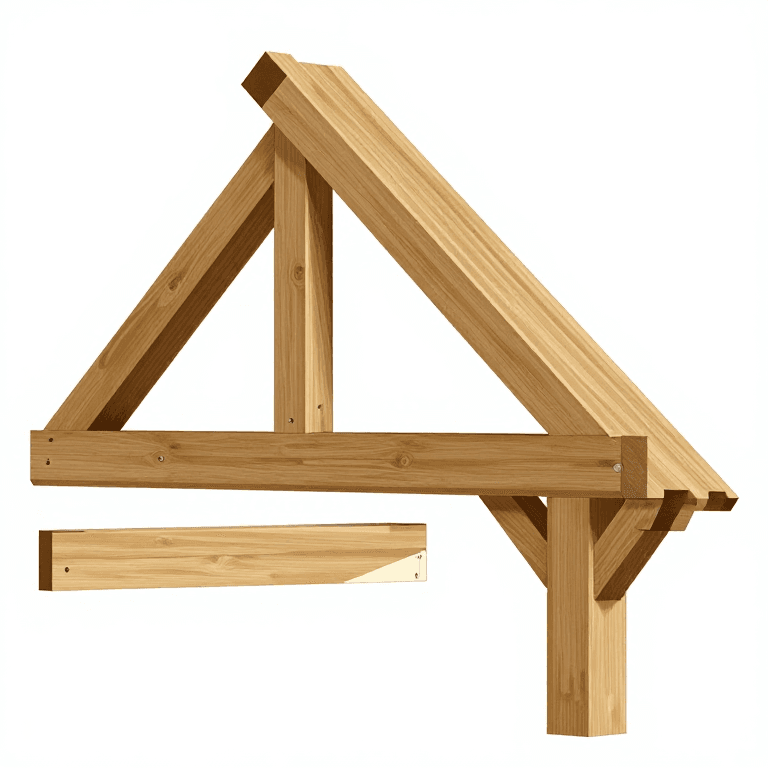
CC0 Domínio Público
Este blueprint é liberado sob CC0. Você é livre para copiar, modificar, distribuir e usar este trabalho para qualquer finalidade, sem pedir permissão.
Apoie o Maker comprando produtos através do Blueprint, onde ele ganha uma Comissão Maker definida pelos vendedores, ou crie uma nova versão deste Blueprint e inclua-o como conexão no seu próprio Blueprint para compartilhar receita.