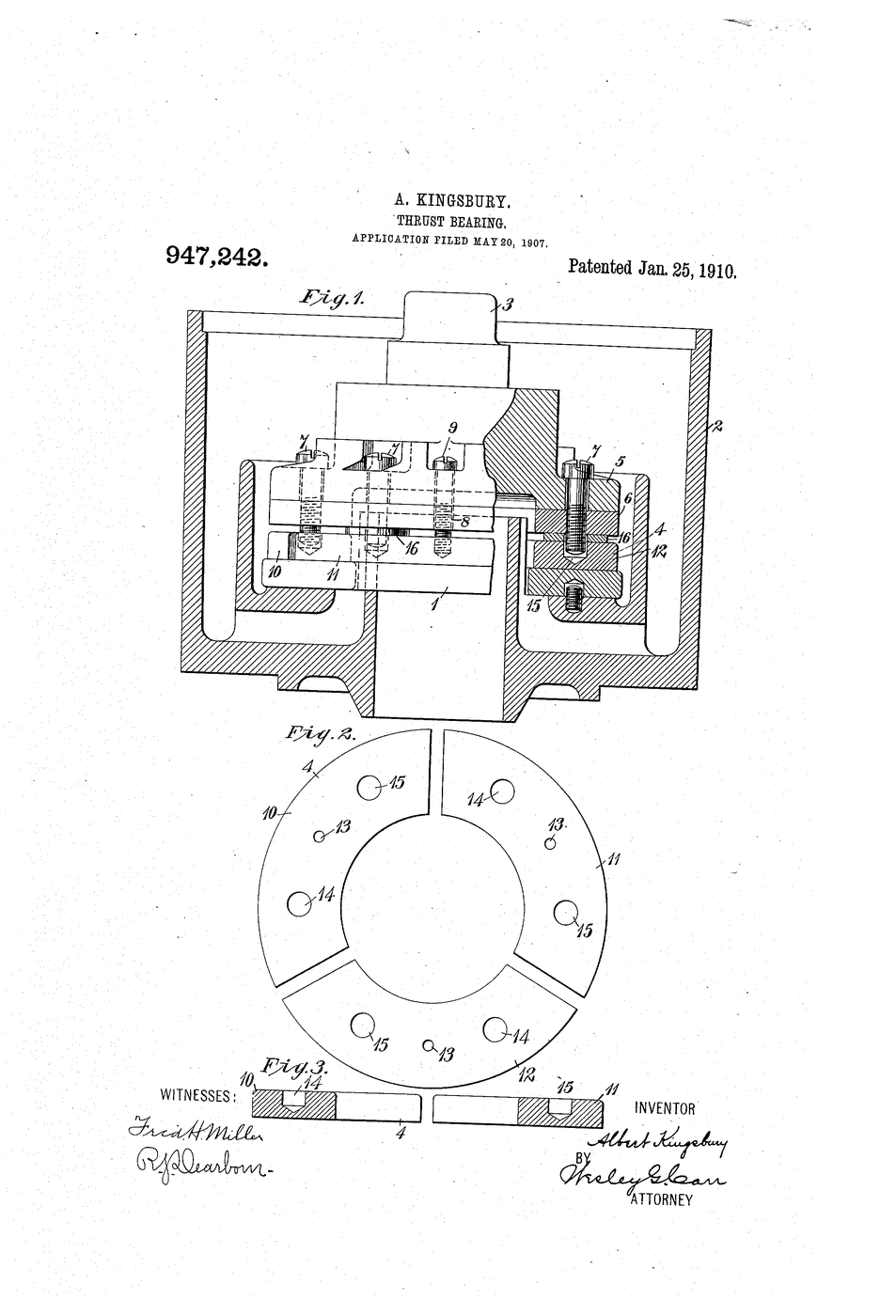


Kingsbury Thrust Bearing
A ship's propeller does not just spin — it shoves, pushing the whole ship forward through its shaft. A water-turbine's runner pushes hard along its axis too. Something has to absorb that colossal end-thrust while the shaft keeps turning, and a plain collar rubbing on a plate will burn itself out in minutes under such a load.
Kingsbury's bearing carries the thrust on a film of oil — and never lets metal touch metal at all. The rotating collar runs over a ring of tilting pads, each free to rock a fraction of a degree. As the collar drags oil under a pad, the pad tips just enough to form a converging wedge, and the oil squeezed into that wedge builds up enormous pressure — enough to lift the collar clear and hold tonnes of thrust on nothing but a whisper of oil.
The pad must be free to tilt, or the trick fails. A rigidly flat pad cannot form the wedge; a pivoted pad finds its own angle automatically at any speed.
US Patent 947,242, "Thrust-bearing", granted 25 January 1910 (filed 20 May 1907) to Albert Kingsbury of Pittsburgh, Pennsylvania.
Instruções
Read the claim: thrust on an oil wedge
Read the claim: thrust on an oil wedge
Kingsbury's "thrust-bearing" carries an axial push on tilting pads that build an oil film. The key word the whole build proves is wedge.
Rub a dry collar on a flat plate
Rub a dry collar on a flat plate
Press a spinning disc against a dry flat plate and feel the drag and heat. This is the plain thrust collar that burns out. Baseline.
Materiais para este passo:
 Contraplacado de bétula báltica1 folha
Ferramentas necessárias:
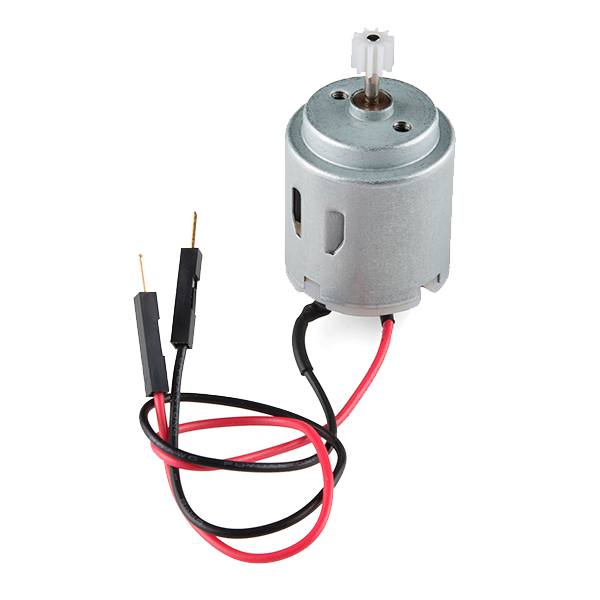 Hobby Motor - Gear
See the wedge with a flat object on a wet table
See the wedge with a flat object on a wet table
Slide a flat card across a wet table, front edge lifted slightly. It planes up onto the water and floats. Aquaplaning IS the hydrodynamic wedge — the whole bearing in a kitchen.
Now hold the card perfectly flat and slide it
Now hold the card perfectly flat and slide it
Same card, kept dead flat, no lifted edge. It does not plane — it drags. Without a converging angle there is no wedge and no lift. Note this is the failure mode.
Cut several pads and a base ring
Cut several pads and a base ring
Cut a ring of separate flat pads that will sit under a rotating collar, like tiles around a circle.
Materiais para este passo:
 Placa de MDF1 folha
Ferramentas necessárias:
 X-ato (faca de precisão)
Mount each pad on a pivot, OFF-CENTRE
Mount each pad on a pivot, OFF-CENTRE
Support each pad on a single ridge or point placed behind its centre, so the pad can rock. The off-centre pivot lets the leading edge lift.
Materiais para este passo:
 Varão de aço macio1 peça
Wet the pads with oil and lower the collar
Wet the pads with oil and lower the collar
Put a film of oil on the pads and rest the rotating collar on top. Handle oil with care and wipe spills.
Materiais para este passo:
 Óleo mineral de uso alimentar50 ml
Ferramentas necessárias:
 Óculos de segurança transparentes
Spin the collar and watch the pads tilt
Spin the collar and watch the pads tilt
Turn the collar in one direction. Each pad tips automatically so its leading edge rises — dragging oil into a converging wedge, exactly like the aquaplaning card.
Feel the drag fall as it lifts onto oil
Feel the drag fall as it lifts onto oil
Compare the effort to turn the collar now versus the dry plate in step 2. It runs far freer — the collar is riding on oil, not rubbing wood.
Lock the pads flat and try again
Lock the pads flat and try again
Wedge the pads so they cannot tilt. The oil film collapses and the drag and heat return. The tilt is not a detail — it is the invention.
Reverse the direction of rotation
Reverse the direction of rotation
Spin the other way. A pivoted pad tips the other way and still forms a wedge — the bearing works in both directions because each pad finds its own angle.
Load it harder and note it still floats
Load it harder and note it still floats
Press down on the collar. The wedge simply builds more oil pressure to match — the film gets thinner but holds. That self-adjusting pressure is why it carries tonnes.
History & Context — the bearing that moved the fleets
History & Context — the bearing that moved the fleets
The patent. US 947,242, "Thrust-bearing", filed 20 May 1907 and granted 25 January 1910 to Albert Kingsbury of Pittsburgh, Pennsylvania. The Google Patents date reads 1907 — the filing date; the sheet says "Patented Jan. 25, 1910". Kingsbury had been working on the idea since the 1890s, testing a tiny model bearing that famously ran for years.
The physics is hydrodynamic lubrication, and it is genuinely surprising. Kingsbury did not set out to reduce friction with slippery oil; he exploited the fact that a moving surface will drag oil into any narrowing gap, and that fluid squeezed into a converging wedge develops real pressure — enough to hold surfaces completely apart. The theory had been worked out by Osborne Reynolds and demonstrated by Beauchamp Tower for journal bearings; Kingsbury's contribution was to carry an axial thrust this way, by making each bearing pad free to tilt so it forms its own wedge automatically at any speed and load (steps 6 to 8). Once running, the collar never touches the pads at all — the two are separated by a film of oil often thinner than a hair, and wear essentially stops. That is why his test bearing could run for years.
The tilt is the entire trick. A fixed, flat pad cannot form the wedge (step 4), and a rigid bearing would have to be built at exactly the right angle for one speed and one load. A pivoted pad finds the correct angle by itself, adjusts as conditions change, and — because the pivot is behind centre — even works when the shaft reverses (step 11). Lock the tilt and the whole thing fails (step 10). It is a rare machine element with almost no moving parts that nonetheless adapts.
Independent invention on two continents. The Australian engineer Anthony Michell patented essentially the same tilting-pad thrust bearing in 1905, slightly before Kingsbury's grant, working entirely separately from the fluid-film theory. Both names are attached to it, and the honest description is the Kingsbury–Michell thrust bearing — a good example of a ripe idea found by two people at once, and worth stating rather than crediting one man alone.
Why it belongs in an energy blueprint. This bearing is what lets a big machine push along its own axis. It took the thrust of ship propeller shafts — its adoption through the World Wars let warships and liners transmit far more power without the thrust bearing overheating — and it sits under the vertical shafts of hydroelectric and steam turbines, carrying the entire weight and thrust of the rotating machine on a film of oil. Every large turbine-generator spinning in a power station today rests, in the end, on a wedge of oil that a tilting pad squeezes into being — the effect you produced with a wet card in step 3.
Materiais
4- Referência
- 1 folhaReferência
- 1 peçaReferência
- Referência
Ferramentas necessárias
3- Hobby Motor - Gear10% de comissãoR$12.54
- Referência
- Referência
Blueprints relacionados
Estes blueprints compartilham conhecimento — técnicas, materiais ou princípios

CC0 Domínio Público
Este blueprint é liberado sob CC0. Você é livre para copiar, modificar, distribuir e usar este trabalho para qualquer finalidade, sem pedir permissão.
Apoie o Maker comprando produtos através do Blueprint, onde ele ganha uma Comissão Maker definida pelos vendedores, ou crie uma nova versão deste Blueprint e inclua-o como conexão no seu próprio Blueprint para compartilhar receita.