ARTE
BELEZA E BEM-ESTAR
ARTESANATO
CULTURA E HISTÓRIA
ENTRETENIMENTO
MEIO AMBIENTE
COMIDA E BEBIDAS
ENGENHARIA REVERSA
CIÊNCIAS
ESPORTES
TECNOLOGIA
TECNOLOGIA VESTÍVEL
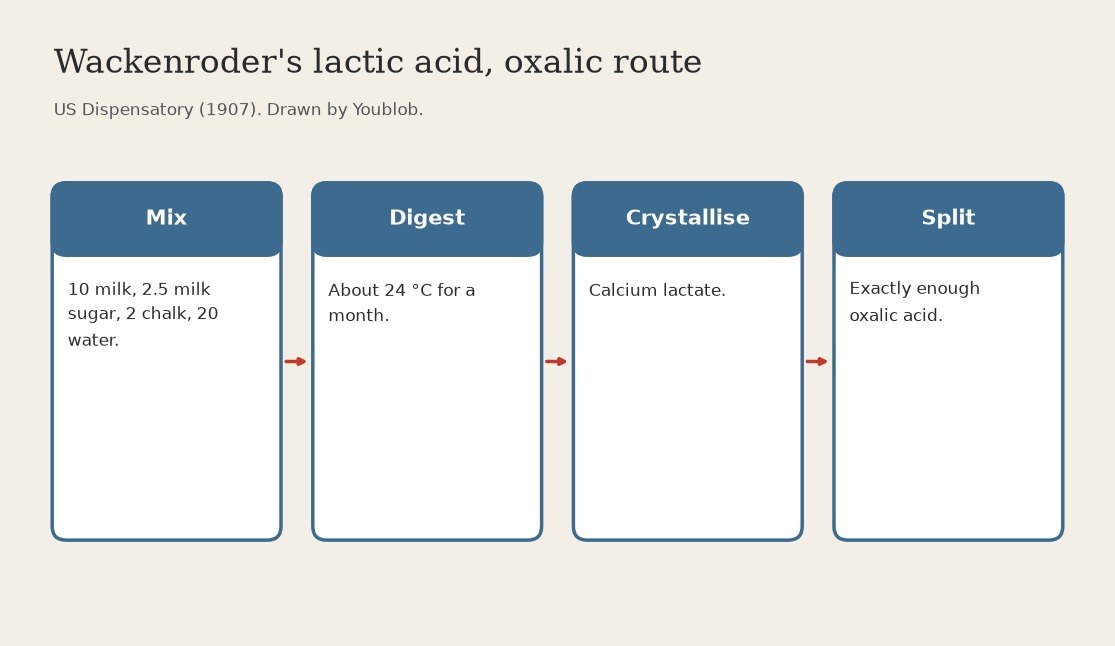


Lactic Acid: Wackenroder's Calcium Lactate Split with Oxalic Acid (US Dispensatory 1907)
Wackenroder's lactic acid: skimmed milk, milk sugar, chalk and water kept warm for a month. As the acid forms, the chalk takes it up as calcium lactate. That salt is crystallised and then split with exactly enough oxalic acid to free the lactic acid; the lime falls as calcium oxalate.
Source: The Dispensatory of the United States of America (1907), Acidum Lacticum. Pharmacopoeial lactic acid, used as food-grade, as ruled. Unknown: how the free acid is separated afterwards; the Dispensatory does not say, so it is linked to an unknown head. The sulphuric-acid version is a separate blueprint. Picture drawn by Youblob.
Intermediário
5 weeks
Instruções
1
1
Mix 10 : 2.5 : 2 : 20
Mix 10 : 2.5 : 2 : 20
Mix 10 parts skimmed milk, 2.5 parts milk sugar, 2 parts chalk and 20 parts water. Ours: grams.
Materiais para este passo:
 Leite magro10 parts
 Açúcar de leite2.5 parts
 Carbonato de cálcio (branco de espanha)2 parts
 Água20 parts
Ferramentas necessárias:
 Balança de pratos
 Recipiente de vidro
2
2
Digest at about 24 °C for a month
Digest at about 24 °C for a month
Keep it at about 23.8 °C (75 °F) for a month, or until the chalk has dissolved.
Ferramentas necessárias:
Recipiente de vidro Termómetro de laboratório
3
3
Press, clarify and crystallise the calcium lactate
Press, clarify and crystallise the calcium lactate
Press it out, clarify it, and evaporate it so the calcium lactate crystallises. Recrystallise it.
Ferramentas necessárias:
 Pano de queijo
 Papel de filtro
 Cápsula de evaporação
 Placa de aquecimento
4
4
Split the salt with oxalic acid
Split the salt with oxalic acid
Decompose the calcium lactate with oxalic acid in exactly the saturating proportion. Oxalic acid is poisonous if swallowed: gloves. Unknown: how the lactic acid is then separated.
Materiais para este passo:
 Ácido oxálico di-hidratado1 as required
Ferramentas necessárias:
Recipiente de vidro Tratamento final desconhecido
 Óculos de proteção química
 Luvas de nitrilo
Materiais
5- 10 partsReferência
- 2.5 partsReferência
- Referência
- 20 partsReferência
- 1 as requiredReferência
Ferramentas necessárias
10- Referência
- Referência
- Referência
- Referência
- Referência
- Referência
- Referência
- Referência
- Referência
- Referência
Este projeto faz

Blueprints relacionados
Estes blueprints compartilham conhecimento — técnicas, materiais ou princípios

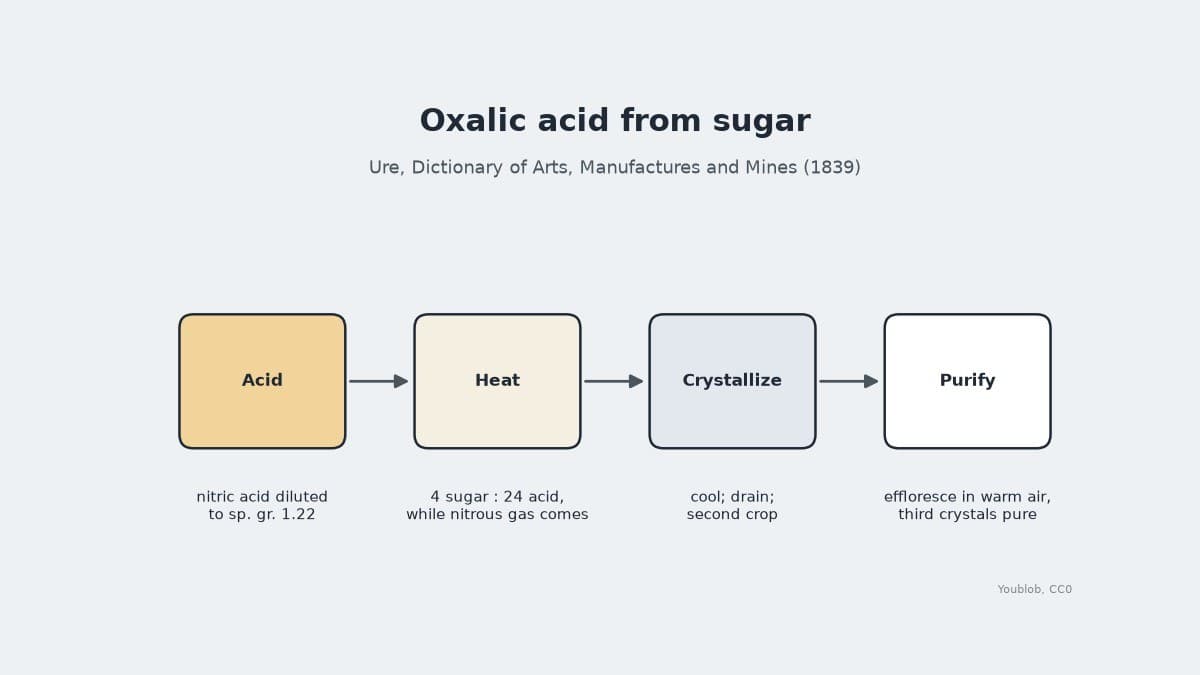
CC0 Domínio Público
Este blueprint é liberado sob CC0. Você é livre para copiar, modificar, distribuir e usar este trabalho para qualquer finalidade, sem pedir permissão.
Apoie o Maker comprando produtos através do Blueprint, onde ele ganha uma Comissão Maker definida pelos vendedores, ou crie uma nova versão deste Blueprint e inclua-o como conexão no seu próprio Blueprint para compartilhar receita.