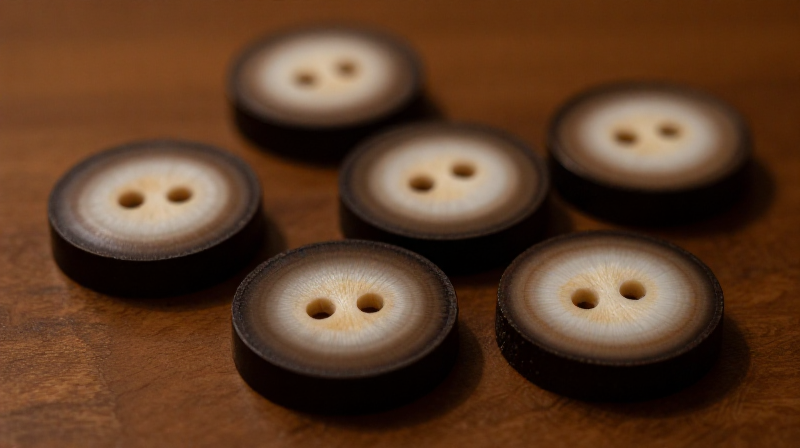


Making Deer Antler Buttons — Cross-Section Slices with Sewing Holes
Antler buttons were widely used from the Stone Age through the 19th century before plastic replaced them. Each cross-section slice is unique — the dark cortex ring, lighter spongy centre, and natural colour gradients make every button one of a kind. Deer antler is hard enough to hold up to daily wear and washing, and the material is completely renewable since male deer shed and regrow their antlers every year.
This blueprint covers making a set of two-hole or four-hole sewing buttons from a single deer antler section: sawing thin rounds, sanding flat, drilling sewing holes, and sealing with beeswax.
Instruções
Select a beam or thick tine section
Select a beam or thick tine section
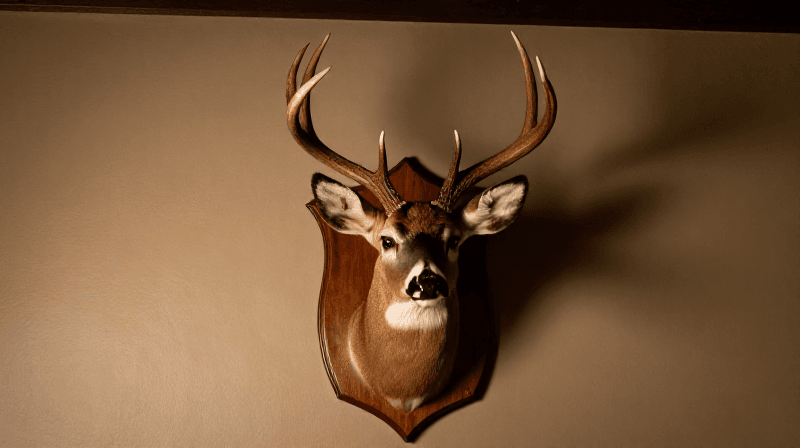
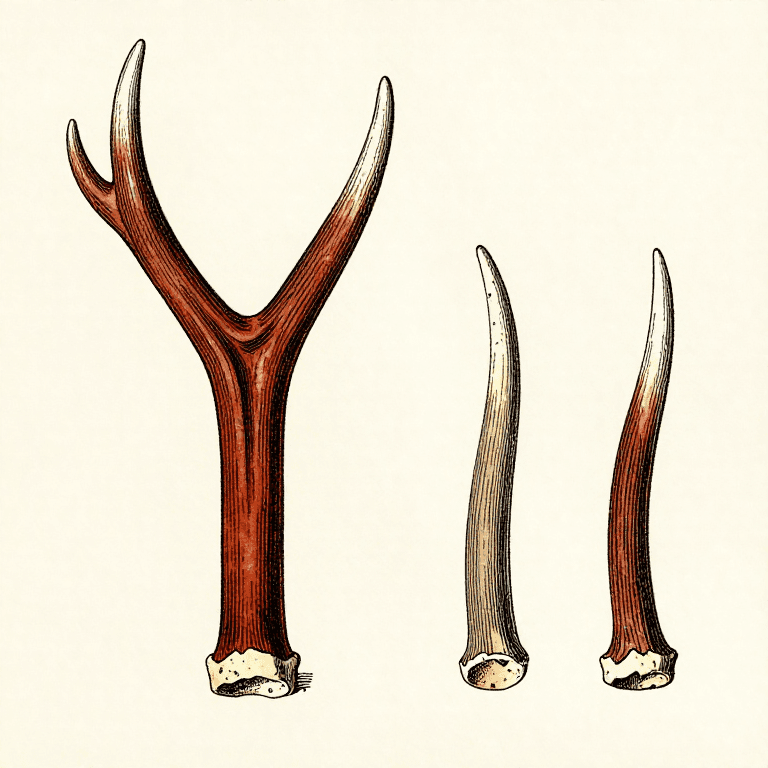
Choose a section of the main beam or a thick tine where the diameter matches the button size you want — typically 20-35 mm across. The lower beam produces larger buttons. The natural colour variation in cross-section (dark cortex ring, lighter spongy centre) gives each button a unique appearance.
Materiais para este passo:
 Secção de haste de veado1 peça
 Veado1 peça
Saw cross-section slices
Saw cross-section slices
Clamp the antler in a bench vise with protective jaw pads. Cut slices 4-5 mm thick using a fine-toothed hacksaw (32 TPI for the smoothest cut). Saw slowly and let the blade do the work — forcing it produces angled cuts. Mark each cut line with a pencil to keep slices uniform. One 15 cm beam section yields 20-25 buttons.
Ferramentas necessárias:
 Bench Vise
 Hacksaw
Sand both faces flat
Sand both faces flat
Lay sandpaper (120 grit) flat on a hard surface and sand each button face by rubbing it in small circles. This flattens the hacksaw marks and ensures both faces are parallel. Progress through 220, then 400 grit. The cortex ring becomes glossy and the spongy centre takes on a creamy texture.
Materiais para este passo:
 Lixa1 folhaLixa1 folhaLixa1 folha
Drill sewing holes
Drill sewing holes
Mark two or four holes evenly spaced, 3-4 mm from the centre. Clamp the slice flat on a scrap board and drill through with a 1.5-2 mm bit at low speed. The slice is thin and can crack if forced, so use light pressure and let the bit cut at its own pace.
Ferramentas necessárias:
 Cordless Drill
 Drill Bit Set
Seal with beeswax
Seal with beeswax
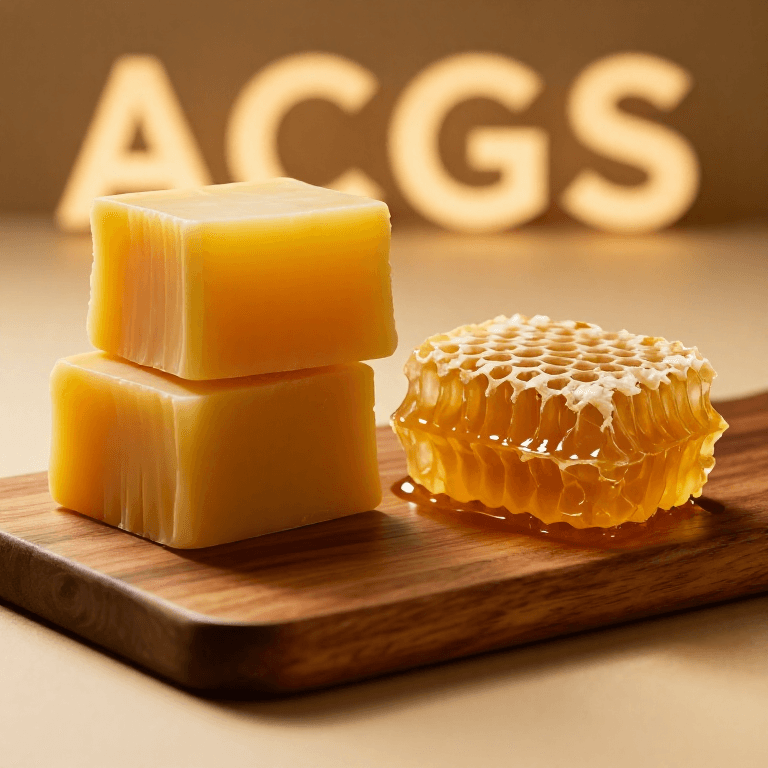
Rub a thin coat of melted beeswax over each button and buff with a soft cloth. This seals the porous spongy centre and adds a subtle sheen. Buttons sewn onto garments need no re-finishing — body oils keep them conditioned naturally over time.
Materiais para este passo:
 Pastilhas de cera de abelha20 g
Materiais
6- 1 peçaReferência
- 1 peçaReferência
- 1 folhaReferência
- 1 folhaReferência
- 1 folhaReferência
- Referência
Ferramentas necessárias
4- Referência
- Referência
- 1 vendor sell this, none ship to you yetReferência
- Referência
Materiais de Blueprints conectados

Blueprints relacionados
Estes blueprints compartilham conhecimento — técnicas, materiais ou princípios
CC0 Domínio Público
Este blueprint é liberado sob CC0. Você é livre para copiar, modificar, distribuir e usar este trabalho para qualquer finalidade, sem pedir permissão.
Apoie o Maker comprando produtos através do Blueprint, onde ele ganha uma Comissão Maker definida pelos vendedores, ou crie uma nova versão deste Blueprint e inclua-o como conexão no seu próprio Blueprint para compartilhar receita.