
Motorkühlung
Ein Verbrennungsmotor verbrennt sein Gemisch mehrere hundert Mal in der Minute. Nur ein Teil dieser Wärme wird zu Arbeit — der Rest bleibt im Zylinder. Ohne Kühlung wird der Motor nach wenigen Minuten so heiß, daß das Schmieröl verbrennt, der Kolben sich ausdehnt und festfrißt. Die frühen Motorwagen fuhren nicht deshalb kurze Strecken, weil der Kraftstoff ausging, sondern weil der Motor heiß lief.
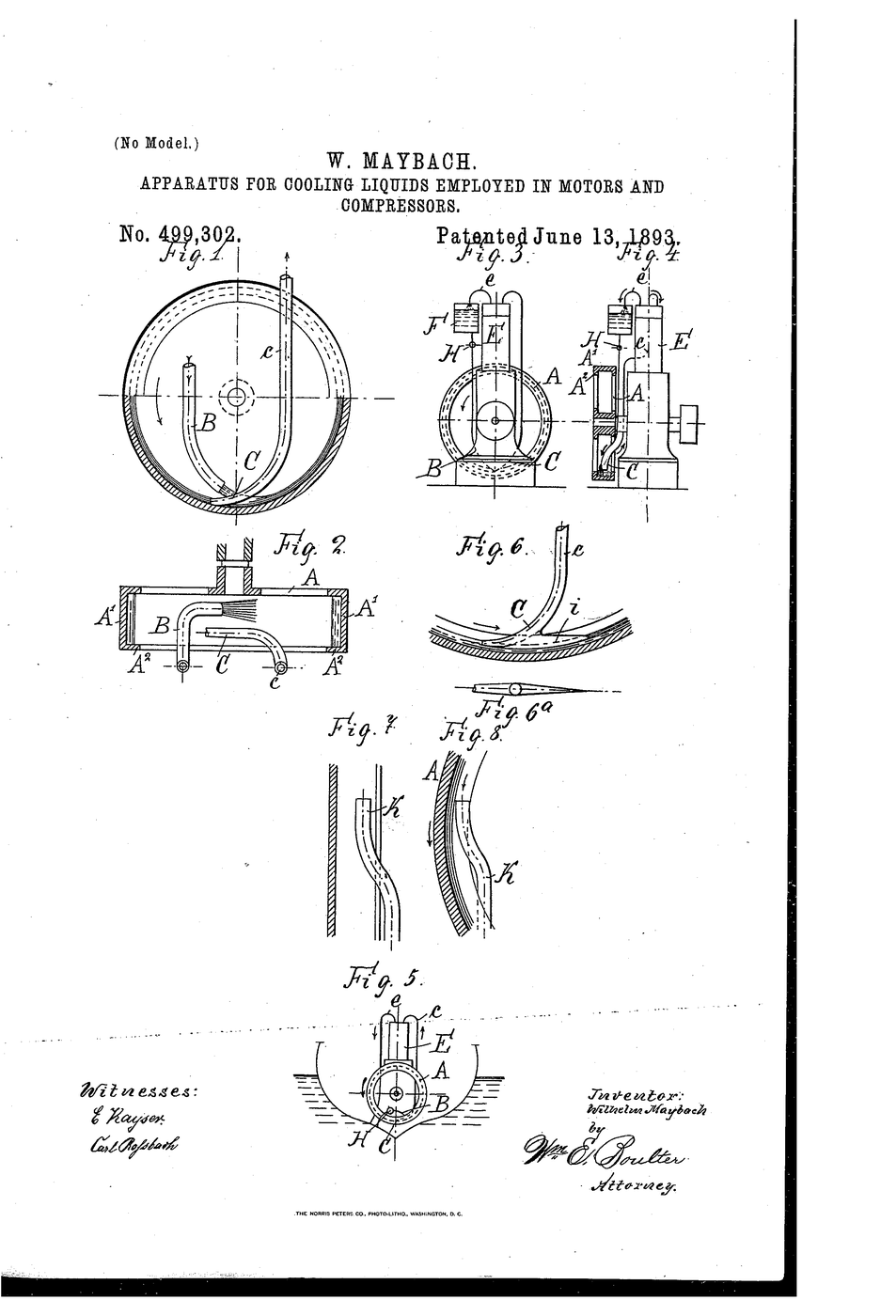
Maybach läßt eine rotierende Scheibe die Kühlflüssigkeit umwälzen. Die Scheibe erteilt der Flüssigkeit Geschwindigkeit und treibt sie durch Rohrleitungen zu den Zylindern — sie wirkt also als Pumpe, ganz ohne Kolben und Ventile.
Dieselbe Drehung erzeugt zugleich Wind und begünstigt die Verdunstung, so daß die Flüssigkeit auf ihrem Weg auch wieder abgekühlt wird. Ein einziges bewegtes Teil erledigt beide Aufgaben: umwälzen und kühlen.
US-Patent 499.302, „APPARATUS FOR COOLING LIQUIDS EMPLOYED IN MOTORS AND COMPRESSORS" (Vorrichtung zum Kühlen von Flüssigkeiten in Motoren und Kompressoren), erteilt am 13. Juni 1893 (angemeldet 15. Oktober 1892) an Wilhelm Maybach in Cannstatt, Deutschland.
Dies ist NICHT Maybachs Vergaser-Patent und auch nicht der Bienenwabenkühler — siehe letzten Schritt.
Instruções
Den Anspruch lesen: eine Scheibe, zwei Aufgaben
Den Anspruch lesen: eine Scheibe, zwei Aufgaben
Maybach beansprucht eine rotierende Scheibe, die der Flüssigkeit Geschwindigkeit erteilt und sie durch Rohre führt — und die durch ihre Drehung zugleich Wind und Verdunstung erzeugt. Beide Aufgaben notieren.
Zwei gleiche Zylinder vorbereiten
Zwei gleiche Zylinder vorbereiten
Zwei gleich große Gefäße mit je 300 ml warmem Wasser (etwa 60 °C) füllen. Sie stehen für zwei gleich heiße Motorzylinder.
Ferramentas necessárias:
 Bacia de recolha
 Termómetro de cozinha
Anfangstemperatur beider Gefäße notieren
Anfangstemperatur beider Gefäße notieren
Beide Temperaturen ablesen und die Uhrzeit festhalten. Die Werte müssen auf 1 °C übereinstimmen, sonst ist der Vergleich wertlos.
Ferramentas necessárias:
 Cronómetro
Die Schleuderscheibe bauen
Die Schleuderscheibe bauen
Eine Scheibe von 60 mm aus festem Karton schneiden und vier gerade Schaufeln radial aufkleben. Auf die Welle des Getriebemotors setzen.
Materiais para este passo:
 Cartolina1 folha
 Motorredutor de corrente contínua de 6 V (4 unidades com rodas)1 conjunto
Ferramentas necessárias:
 Pistola de cola quente
Motor anschließen
Motor anschließen
Den Getriebemotor über Krokodilklemmen an den Batteriehalter anschließen und die Drehrichtung prüfen.
Ferramentas necessárias:
 Suporte de pilhas
 Cabos de ensaio com pinças jacaré
Die Scheibe im zweiten Gefäß drehen lassen
Die Scheibe im zweiten Gefäß drehen lassen
Die Scheibe halb eingetaucht über dem zweiten Gefäß laufen lassen. Das erste Gefäß bleibt unberührt — es ist die Vergleichsprobe.
Alle 3 Minuten beide Temperaturen ablesen
Alle 3 Minuten beide Temperaturen ablesen
15 Minuten lang messen. Tabelle führen: Zeit, ruhendes Gefäß, umgewälztes Gefäß.
Ferramentas necessárias:
Termómetro de cozinhaDie Scheibe als Pumpe nachweisen
Die Scheibe als Pumpe nachweisen
Die Scheibe in einen Kartonring mit seitlichem Auslaß setzen und einen Schlauch anschließen. Beim Drehen wird das Wasser nach außen geschleudert und fließt durch den Schlauch ab — eine Kreiselpumpe.
Materiais para este passo:
 Sortido de tubo de silicone1 conjuntoCartolina1 folha
Den Kreislauf schließen
Den Kreislauf schließen
Den Schlauch um ein Kupferrohr wickeln — den „Zylinder" — und zurück ins Gefäß führen. Das Wasser läuft nun im Kreis: umwälzen statt nur rühren.
Materiais para este passo:
 Tubo de cobre1 peça
Warmes Rohr, kaltes Rohr
Warmes Rohr, kaltes Rohr
Das Kupferrohr in heißes Wasser stellen und den Kreislauf laufen lassen. Temperatur am Rohr mit und ohne Umwälzung messen — strömendes Wasser trägt die Wärme fort, stehendes nicht.
Ferramentas necessárias:
Termómetro de cozinhaDen Wind der Scheibe spüren
Den Wind der Scheibe spüren
Die Hand neben die trocken laufende Scheibe halten. Sie erzeugt einen deutlichen Luftstrom — genau der Fahrtwind, den Maybach im Anspruch nennt.
Verdunstung getrennt prüfen
Verdunstung getrennt prüfen
Zwei feuchte Tücher aufhängen, eines vor der laufenden Scheibe. Nach 10 Minuten beide anfassen: das angeblasene ist kälter — Verdunstung entzieht Wärme, und Wind beschleunigt sie.
Beide Kurven zeichnen
Beide Kurven zeichnen
Temperatur über Zeit für beide Gefäße auftragen. Der Abstand der Kurven ist genau das, was den Motor am Festfressen hindert.
Ferramentas necessárias:
 Papel milimétrico
Geschichte & Hintergrund — was dieses Patent ist und was nicht
Geschichte & Hintergrund — was dieses Patent ist und was nicht
Das Patent. US 499.302, „APPARATUS FOR COOLING LIQUIDS EMPLOYED IN MOTORS AND COMPRESSORS", erteilt am 13. Juni 1893, angemeldet am 15. Oktober 1892, an Wilhelm Maybach in Cannstatt. Die Beschreibung führt eine rotierende Scheibe, die der Flüssigkeit Geschwindigkeit erteilt und sie durch Rohre zu den Zylindern fördert, während dieselbe Drehung Wind erzeugt und die Verdunstung fördert, so daß die Flüssigkeit auf ihrem Weg gekühlt wird.
🔴 Dies ist nicht der Vergaser. Zahlreiche Quellen nennen die Nummern 499.302 und 668.111 als „Maybachs Vergaser-Patente". Das ist falsch: 499.302 beansprucht ausdrücklich eine Kühlvorrichtung. Maybachs Spritzdüsenvergaser von 1893 ist eine eigene Erfindung mit eigenen Schutzrechten. Und es ist auch nicht der berühmte Bienenwabenkühler, der erst um 1900 für den Mercedes 35 PS entstand. Wer eine Patentnummer zitiert, sollte die Ansprüche gelesen haben — in diesem Programm ist das inzwischen der Regelfall, nicht die Ausnahme.
Warum Kühlung überhaupt das Problem war. Ein Ottomotor setzt nur einen Teil der Verbrennungswärme in Arbeit um; der große Rest muß fort, sonst verbrennt das Öl und der Kolben frißt fest. Die ersten Motorwagen kochten ihr Kühlwasser schlicht weg und mußten nachgefüllt werden. Ein Kühlkreislauf, der die Wärme wegträgt und die Flüssigkeit unterwegs wieder abkühlt, macht aus einem Vorführmotor eine Maschine für lange Fahrten.
Zwei Aufgaben, ein bewegtes Teil. Die Scheibe ist Pumpe (Schritt 8) und Gebläse (Schritt 11) zugleich, und sie nutzt zusätzlich die Verdunstungskälte (Schritt 12). Für einen Motorwagen um 1892 zählte jedes eingesparte Bauteil doppelt: weniger Gewicht, weniger Verschleiß, weniger, was unterwegs versagen kann. Genau dieselbe Kreiselwirkung treibt heute die Wasserpumpe in jedem Automotor — nur sitzt sie im Gehäuse und wird vom Riemen angetrieben.
Wilhelm Maybach (1846-1929) war Gottlieb Daimlers Konstrukteur und wurde später „König der Konstrukteure" genannt. Aus der Arbeit in Cannstatt gingen der schnellaufende Benzinmotor, der Spritzdüsenvergaser und schließlich der Mercedes 35 PS von 1901 hervor — mit Bienenwabenkühler, Vergaser und Umwälzkühlung, also allem, was hier einzeln erfunden wurde, in einem Fahrzeug vereint.
Ehrliche Einordnung. Maybach hat die Wasserkühlung nicht erfunden — Dampfmaschinen und ortsfeste Motoren wurden längst mit Wasser gekühlt, meist mit Thermosiphon, also ganz ohne Pumpe. Der Anspruch dieses Dokuments ist enger und dadurch interessanter: eine rotierende Scheibe, die Förderung und Rückkühlung in einem Bauteil vereint.
Materiais
4- 1 folhaReferência
- Referência
- 1 conjuntoReferência
- 1 peçaReferência
Ferramentas necessárias
7- Referência
- Referência
- Referência
- Referência
- 14 vendors sell this, none ship to you yetReferência
- Referência
- Referência
Materiais de Blueprints conectados
Blueprints relacionados
Estes blueprints compartilham conhecimento — técnicas, materiais ou princípios

CC0 Domínio Público
Este blueprint é liberado sob CC0. Você é livre para copiar, modificar, distribuir e usar este trabalho para qualquer finalidade, sem pedir permissão.
Apoie o Maker comprando produtos através do Blueprint, onde ele ganha uma Comissão Maker definida pelos vendedores, ou crie uma nova versão deste Blueprint e inclua-o como conexão no seu próprio Blueprint para compartilhar receita.