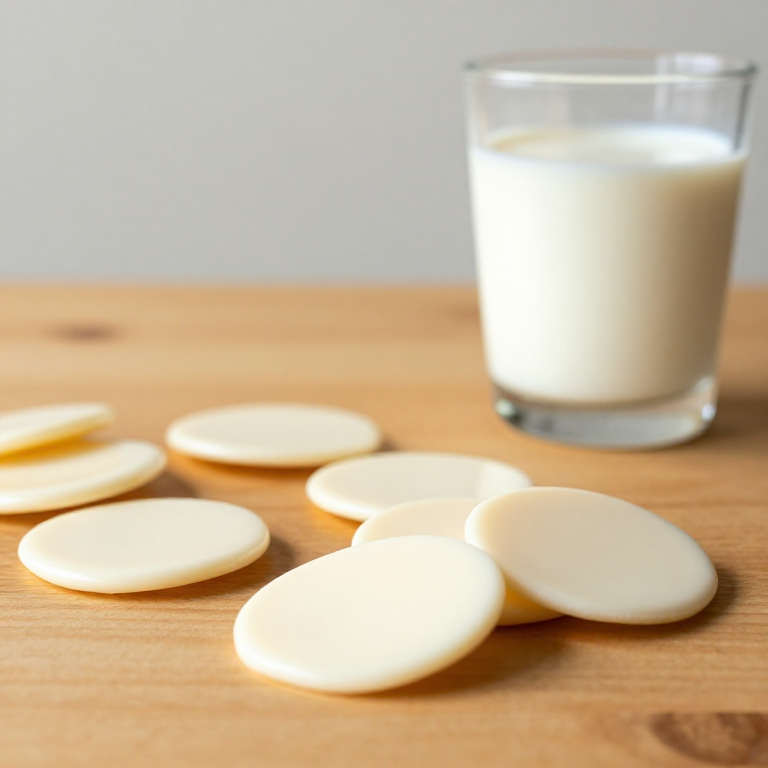


Milk Plastic
Milk contains casein, a protein that stays dissolved only while the milk is close to neutral. Drop the pH with acid and the casein micelles lose their charge, stop repelling each other and clump together into a solid mass. Strain that mass, knead it and dry it, and you have a mouldable plastic made from milk.
This is the school-safe half of a real industrial story. From the 1890s to the 1950s a hardened version of exactly this material — Galalith, 'milk stone' — was turned into millions of buttons, buckles, knitting needles and fountain pens. The industrial process needed formaldehyde to make the plastic waterproof, and that step is not something to do in a kitchen. Everything up to it is.
So the honest limit of this build is written into the last steps: your milk plastic is real casein plastic, it hardens genuinely, and it softens again in water. That weakness is precisely the problem the formaldehyde stage was invented to solve.
Instruções
Measure 240 ml whole milk
Measure 240 ml whole milk
Measure 240 ml of whole milk into a heatproof jug and write the volume down. Whole milk gives the best yield — skimmed milk works but produces a smaller, more brittle lump.
Materiais para este passo:
 Leite gordo240 ml
Ferramentas necessárias:
 Conjunto de copos de medida
Heat the milk to 50-60 °C
Heat the milk to 50-60 °C
Heat the milk until a thermometer reads 50-60 °C. Do not boil it. Hot milk curdles faster and more completely; boiled milk gives a stringy, hard-to-handle curd.
Ferramentas necessárias:
 Termómetro de cozinha
 Banho-maria
Stir in 60 ml white vinegar
Stir in 60 ml white vinegar
Add 60 ml (4 tablespoons) of white vinegar to the hot milk and stir for one minute. The acid pulls the milk down toward pH 4.6, where casein is least soluble.
Materiais para este passo:
 Vinagre branco de limpeza60 ml
Watch the curd separate
Watch the curd separate
White rubbery lumps form and the liquid around them turns thin and yellow-green. The lumps are casein; the liquid is whey, which is water, sugar and the whey proteins that do not coagulate at this pH.
Strain off the whey
Strain off the whey
Pour the mixture through a fine sieve or a square of muslin. Keep the solids. Let it cool until it can be handled comfortably.
Ferramentas necessárias:
 Peneira fina
Press out the remaining liquid
Press out the remaining liquid
Press the curd between paper towels and keep changing them until no more liquid comes out. Trapped whey is the commonest cause of a piece that cracks or moulds while drying.
Weigh the yield
Weigh the yield
Weigh the pressed curd and record it. From 240 ml of whole milk expect roughly 15-25 g of wet curd — the exact figure depends on the protein content of your milk, so it is worth comparing brands.
Ferramentas necessárias:
 Balança digital
Knead into a dough
Knead into a dough
Knead the curd for two minutes until it stops being crumbly and behaves like stiff dough. Kneading works the protein chains together — an unkneaded piece dries into a crumbly biscuit rather than a solid.
Colour it if you want to
Colour it if you want to
Work in a few drops of food colouring now, while the dough is still damp. Industrial casein plastic was dyed the same way, in the mass, not painted afterwards.
Materiais para este passo:
 Corante alimentar3 gotas
Press into a mould
Press into a mould
Press the dough into a cookie cutter or silicone mould, or roll it flat and cut shapes. Push it well into the corners; it will not flow to fill them on its own.
Dry for 48 hours
Dry for 48 hours
Leave the pieces on absorbent paper somewhere dry, turning them once after a day so both faces lose water evenly. Thick pieces need longer and warp if dried fast.
Measure the shrinkage
Measure the shrinkage
Measure a piece before and after drying. The loss is water leaving the protein network — expect a noticeable shrink, which is why casein plastic was always machined to final size after hardening, never moulded to size.
Ferramentas necessárias:
 Régua
RéguaSand and finish
Sand and finish
Sand the edges smooth with fine paper. Dry casein plastic cuts, drills and takes a polish like a soft horn — this is exactly why the button industry adopted it.
Ferramentas necessárias:
 Lixa
LixaTest it in water — and record what happens
Test it in water — and record what happens
Drop one piece in water for an hour. It swells and softens. This is the honest result, not a failed build — untreated casein plastic is not waterproof, and that single fact is what the entire industrial hardening stage existed to fix.
History & Context
History & Context
Older than the industry. Casein glue and casein paint are ancient; the idea that the same protein could be a solid material in its own right is late nineteenth century. In 1893 the French chemist Auguste Trillat found that soaking casein in formaldehyde made it insoluble. In 1897 in Germany, Adolf Spitteler and Wilhelm Krische patented a casein material — the origin story attached to it is that the work began with a commission for a washable white schoolboard rather than for a plastic at all.
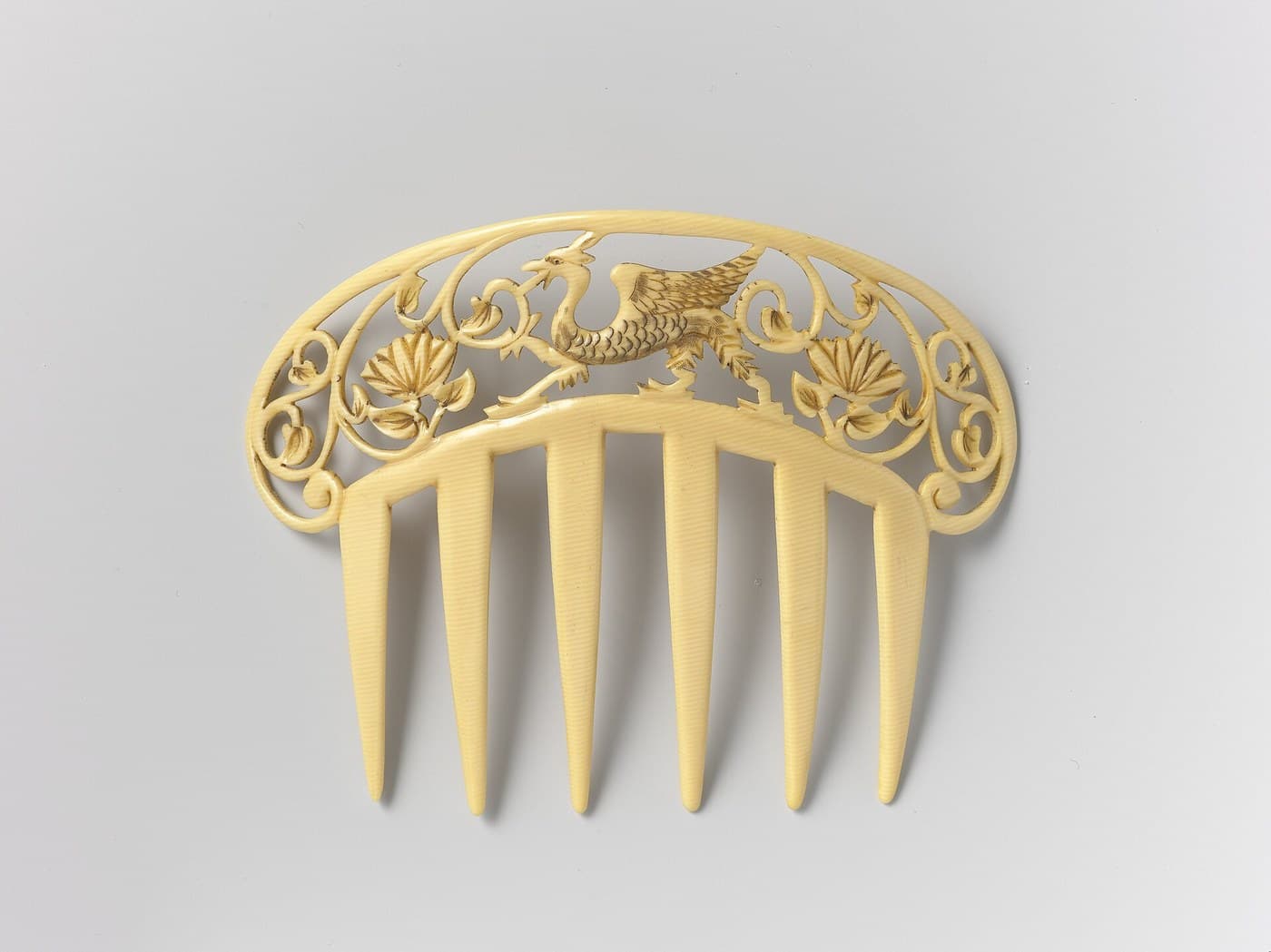
Galalith. The product was named from the Greek for milk and stone. It was hard, took brilliant colours, could be polished to a deep shine, and did not burn easily — a serious advantage over celluloid, which did. It became the button material of the first half of the twentieth century, and also went into buckles, combs, knitting needles, fountain pens and costume jewellery.
Why it is machined, not moulded. Hardened casein cannot be melted and injected like a thermoplastic. It was made as sheet, rod, tube and button blanks, hardened, then cut, turned and polished to shape. The hardening is slow because the formaldehyde has to diffuse right through the piece: thin sheet takes days, and a block around 25 mm thick can take up to a year of immersion.
What replaced it. Petrochemical plastics after the Second World War were cheaper, faster to mould and genuinely waterproof, and casein plastic collapsed into a niche. It has never entirely gone: it is made from a renewable feedstock and is biodegradable, which is why casein materials keep reappearing in bioplastics research.
What you actually made. The same protein, coagulated the same way, kneaded and dried the same way. What you skipped is the formaldehyde bath — the step that turns a water-sensitive protein solid into a material you could sew onto a shirt and wash. It is documented in the companion blueprint for adults working with proper extraction; it does not belong in a kitchen.
Materiais
3- 240 mlReferência
- Referência
- 3 gotasReferência
Ferramentas necessárias
7- Referência
- Referência
- Referência
- Referência
- Referência
- Referência
- Referência
Materiais de Blueprints conectados


Blueprints relacionados
Estes blueprints compartilham conhecimento — técnicas, materiais ou princípios
CC0 Domínio Público
Este blueprint é liberado sob CC0. Você é livre para copiar, modificar, distribuir e usar este trabalho para qualquer finalidade, sem pedir permissão.
Apoie o Maker comprando produtos através do Blueprint, onde ele ganha uma Comissão Maker definida pelos vendedores, ou crie uma nova versão deste Blueprint e inclua-o como conexão no seu próprio Blueprint para compartilhar receita.