
Colaboração
ARTE
BELEZA E BEM-ESTAR
ARTESANATO
CULTURA E HISTÓRIA
ENTRETENIMENTO
MEIO AMBIENTE
COMIDA E BEBIDAS
ENGENHARIA REVERSA
CIÊNCIAS
ESPORTES
TECNOLOGIA
TECNOLOGIA VESTÍVEL
Chinese Dragon Kite: Bamboo-Ring Head With Revolving Eyes and 20 Sections on a Seine-Twine Harness (Boy Mechanic, 1919)
Spartan

Criado por

Spartan

13. novembro 2026NO
7
0
0
0
0

Chinese Dragon Kite: Bamboo-Ring Head With Revolving Eyes and 20 Sections on a Seine-Twine Harness (Boy Mechanic, 1919)

C. M. Miller's dragon kite from The Boy Mechanic, Book 3 (1919): a 12 in bamboo-ring head with horns and two paper eyes that spin in the wind, followed by up to 20 round section kites, each with a 36 in balancer stick, tied 30 in apart on three cords of seine twine. Twenty sections make a kite about 50 ft long.
Avançado
Several days

Instruções

1

Strip lengths and kite length

A carregar o notebook Jupyter…
2

Read The Boy Mechanic, Book 3

"Dragon kites are made as hideous as the maker can possibly conceive, and while the one to be considered is no beauty, it is more droll than fierce-looking."
3

Split and pare the bamboo

Split bamboo into strips about 3/16 in wide and pare them to less than 1/16 in thick for the head's inner ring A. To bend a strip to a sharp angle, heat it over a candle flame until it gives under pressure, bend it, and it keeps its shape when cold.

Materiais para este passo:

Varas de bambuVaras de bambu1 peça

Ferramentas necessárias:

Canivete de açoCanivete de aço
VelaVela
4

Frame the head

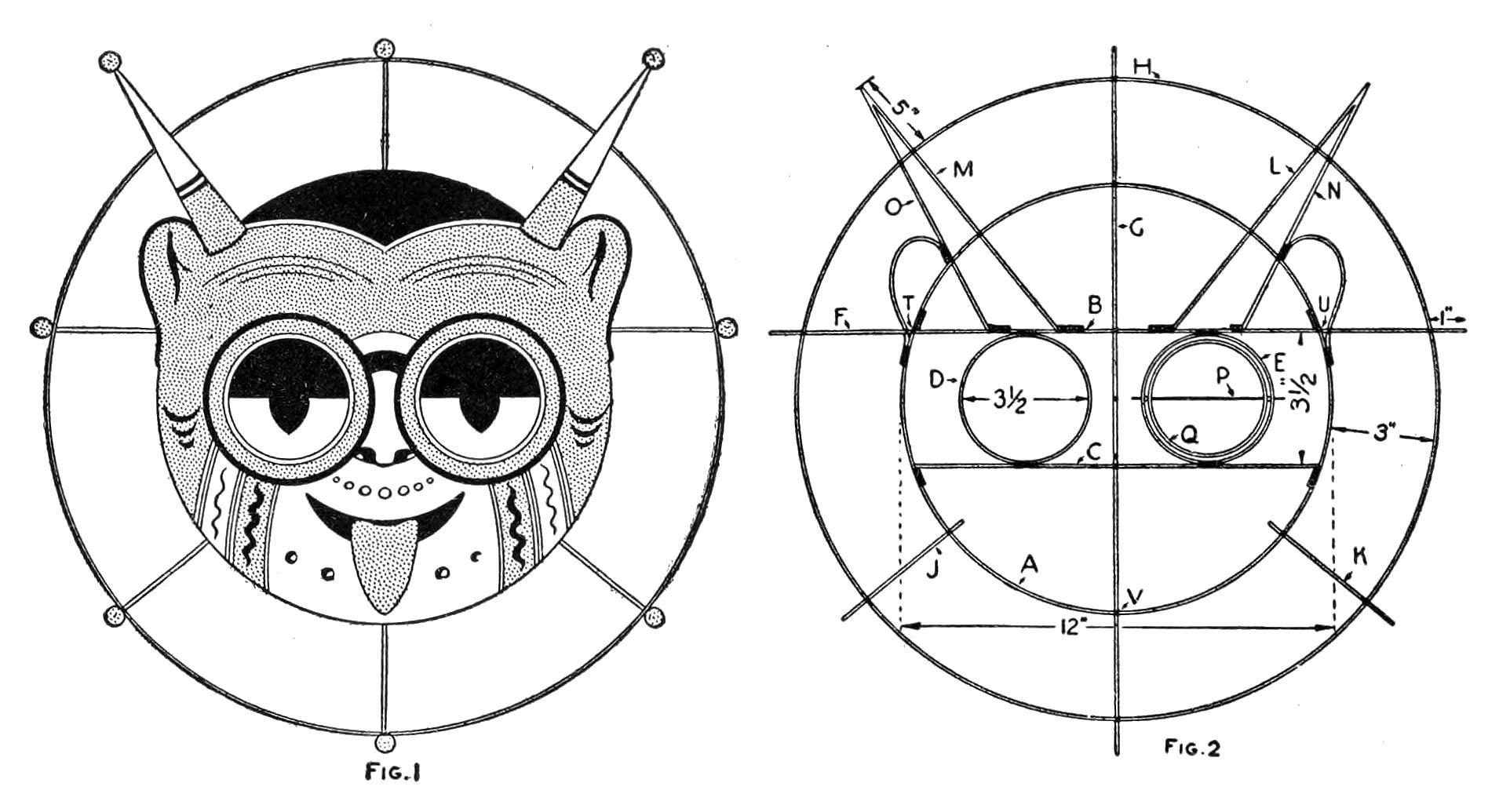
Make ring A 12 in across from a strip about 38 in long, lapping the ends and winding them with linen thread (or with wet pasted strips of rice paper about 1/2 in wide, which bind as they dry). Lash two crosspieces B and C of the same stock 3-1/2 in apart, parallel and equally spaced from the centre, their ends bent sharply and lashed inside the ring. Lash two eye rings D and E, 3-1/2 in across, between them, shaped round a 3-1/2 in cylinder so they are true. Lash stiffeners F and G, 1/16 by 1/8 by 20 in, across the back. Add outer ring H, 3 in outside A (18 in across), of 1/8 in strip under 1/16 in thick, in two pieces if needed, and the short pieces J and K between the rings. Lash the horn supports, 1/8 in wide, to the upper crosspiece and both rings, with L and M halfway between the ends of F and G and radiating from the centre of A, and N and O pointing at the eye-ring centres (Fig. 2).

Materiais para este passo:

Varas de bambuVaras de bambu1 peça
Fio de linhoFio de linho1 peça

Ferramentas necessárias:

Canivete de açoCanivete de aço
VelaVela
Fita métricaFita métrica
TesouraTesoura
5

Cover and paint the head

Cover only the inside of ring A, the horns and the ears with Chinese rice paper, stretched tight with no bagging, leaving the eye rings open. Put the rings on the horns and stick ends, 1/2 to 2 in across, cut from stiff paper (larger ones of bamboo). Shade with a brush and water colours, leaving the face white or tinting it; leave the horns white and colour the tongue red (Fig. 1).

Materiais para este passo:

Papel de arrozPapel de arroz1 peça
Cola de farinha de trigoCola de farinha de trigo1 peça
CartolinaCartolina1 peça
Tinta de aguarelaTinta de aguarela1 peça

Ferramentas necessárias:
Pincel para colaPincel para cola
Conjunto de pincéis de artistaConjunto de pincéis de artista
TesouraTesoura
6

Make the revolving eyes

Pare bamboo to 1/32 in and form each eye into a true ring 3-1/4 in across. Pass a wire axle exactly on a diameter through the eye ring and through its socket ring D or E, with a glass bead on the wire each side between the two rings; fix the wire to the eye ring with a strip of paper wrapped tight and pasted. Cover each side halfway with rice paper, the front upper half and the back lower half, so the wind turns the eye. Blacken the front upper half and paste a round pupil between the halves so it shows on both sides (Figs. 3, 4).

Materiais para este passo:

Varas de bambuVaras de bambu1 peça
Arame de ferroArame de ferro1 peça
Contas de vidroContas de vidro4 peças
Papel de arrozPapel de arroz1 peça
Cola de farinha de trigoCola de farinha de trigo1 peça
Tinta de aguarelaTinta de aguarela1 peça

Ferramentas necessárias:

Canivete de açoCanivete de aço

Alicate de bico chatoAlicate de bico chato
TesouraTesoura
Conjunto de pincéis de artistaConjunto de pincéis de artista
7

Make the section kites

For each section make a 12 in ring of bamboo 1/8 in wide and 1/16 in thick and cover it tight like the head. Lash on a balancer stick 36 in long, small, light and well balanced, at about the place of cross-stick F, with tufts of tissue paper or feathers at its tips. Colour the discs as you like; give the last section's balancer streamers of light cloth (Figs. 5, 6). Sections may instead be 9 in with 30 in balancers, but uniform sections are better and easier.

Materiais para este passo:

Varas de bambuVaras de bambu1 peça
Fio de linhoFio de linho1 peça
Papel de arrozPapel de arroz1 peça
Cola de farinha de trigoCola de farinha de trigo1 peça
Papel de seda coloridoPapel de seda colorido1 peça
PenasPenas1 peça
Pano de algodãoPano de algodão1 peça
Tinta de aguarelaTinta de aguarela1 peça

Ferramentas necessárias:

Canivete de açoCanivete de aço
VelaVela
TesouraTesoura
Conjunto de pincéis de artistaConjunto de pincéis de artista
8

Tie the harness and bridle

Cut three cords of six-ply hard-twisted seine twine as long as the kite plus the knots. Fasten the head to a wall, tie the three cords to it at T, U and V (Fig. 2), and tie each section at the matching points exactly 30 in from the last (Fig. 7). Tie a three-string bridle to the head at T, U and V, the lower string longer than the two upper ones so the head, and with it every section, leans to the wind. A ball balancer of bamboo strips may hang from the head (Fig. 8).

Materiais para este passo:

Fio para redesFio para redes1 peça
Linha de papagaioLinha de papagaio1 peça
Varas de bambuVaras de bambu1 peça

Ferramentas necessárias:

Fita métricaFita métrica
TesouraTesoura
9

Flying and troubleshooting

Dragon kite flying.

Flow

Loading...
10

History and honest limits

From "How to Make Combined Kites, Part I: A Dragon Kite" by C. M. Miller, in **The Boy Mechanic, Book 3**, Popular Mechanics, 1919 (Project Gutenberg 71856; checked on the archive.org scan boymechanic0003unse, pp. 145-148). He gives no bridle lengths and no line size beyond "a strong cord". Fig. 2 also marks 5 in at the horn tip and 1 in where F passes ring H. The tools and metric figures are ours.

Materiais

13

Ferramentas necessárias

7

Blueprints relacionados

Estes blueprints compartilham conhecimento — técnicas, materiais ou princípios
CC0 Domínio Público

Este blueprint é liberado sob CC0. Você é livre para copiar, modificar, distribuir e usar este trabalho para qualquer finalidade, sem pedir permissão.

Apoie o Maker comprando produtos através do Blueprint, onde ele ganha uma Comissão Maker definida pelos vendedores, ou crie uma nova versão deste Blueprint e inclua-o como conexão no seu próprio Blueprint para compartilhar receita.

Discussão

(0)

Entrar para participar da discussão

Carregando comentários...