ARTE
BELEZA E BEM-ESTAR
ARTESANATO
CULTURA E HISTÓRIA
ENTRETENIMENTO
MEIO AMBIENTE
COMIDA E BEBIDAS
ENGENHARIA REVERSA
CIÊNCIAS
ESPORTES
TECNOLOGIA
TECNOLOGIA VESTÍVEL

Oblique-Paddle Churn: Turn One Way to Gather the Butter, Back to Spread It
Once the butter comes, it has to be gathered from the whey, then worked and salted by hand.
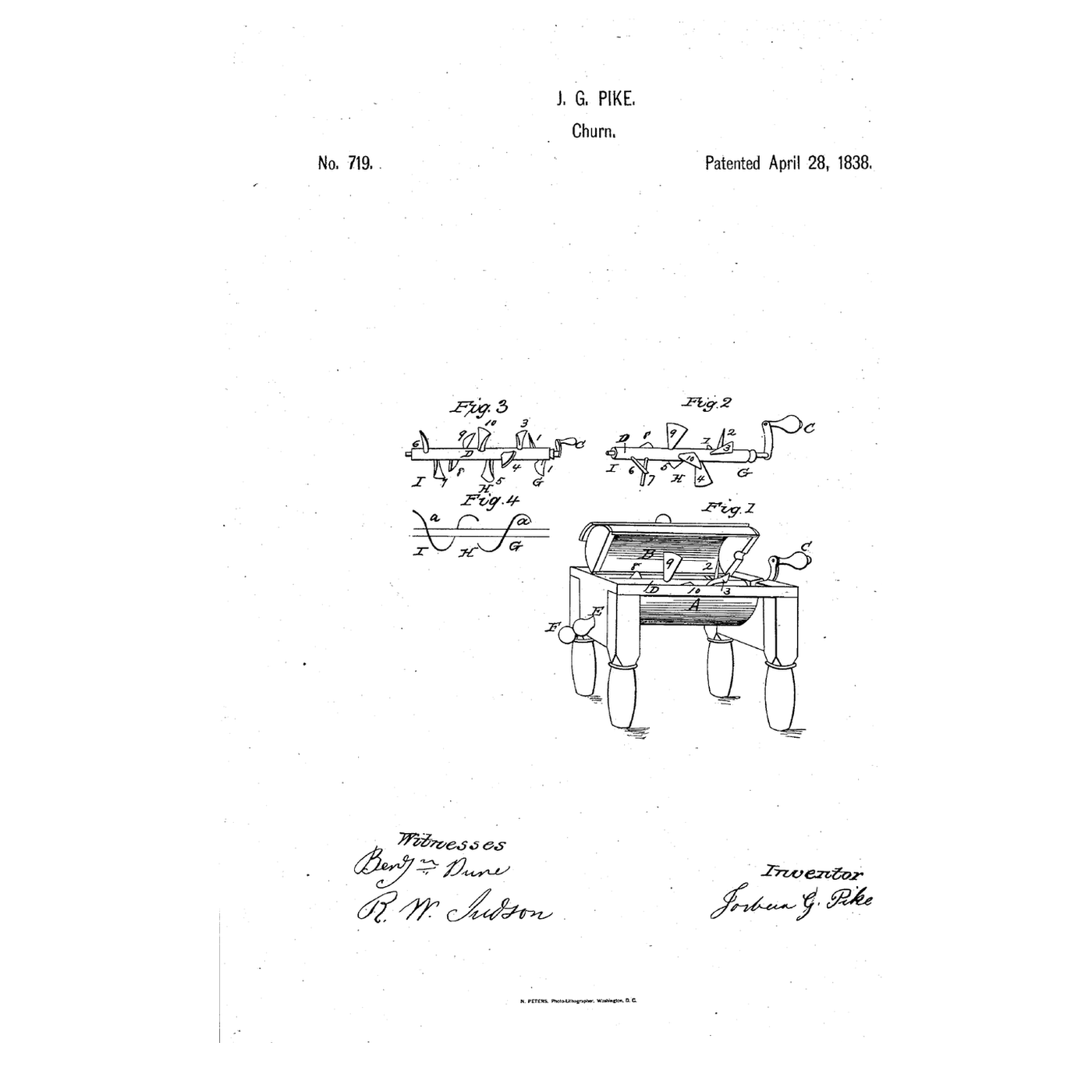
Joshua G. Pike of Lisbon, New York, received US 719, dated 28 April 1838, for a machine for churning and working butter: a horizontal cylinder with paddles set obliquely round its shaft, "so arranged that by turning the shaft in one direction the butter will be collected into one place in the center of the churn and thus separated from the whey while by reversing the motion it will be again spread over the internal surface of the cylinder and prepared for salting."
This rung works out the butter a batch gives, then prints the paddle hubs, builds a tabletop cylinder churn, and makes butter.
Intermediário
About 4 hours, plus printing
Instruções
1
1
Butter yield and paddle push
Butter yield and paddle push
A carregar o notebook Jupyter…
2
2
The churning it does
The churning it does
The embedded blueprint makes butter by agitating cream. Pike sets the paddles so the same churn also gathers and works the butter.
3
3
Read US 719
Read US 719
"When formed the butter is successively struck by the paddles 1, 2, 3, 4 and 5, (see Figs. 2 and 3) in their revolution and by their oblique position moved toward the center of the churn from G to H. At the same time and by the same operation the paddles 6, 7, 8, 9 and 10 sloping in the opposite direction from those first mentioned move the butter in the opposite direction viz. from I to H."
4
4
Print the paddle hubs
Print the paddle hubs
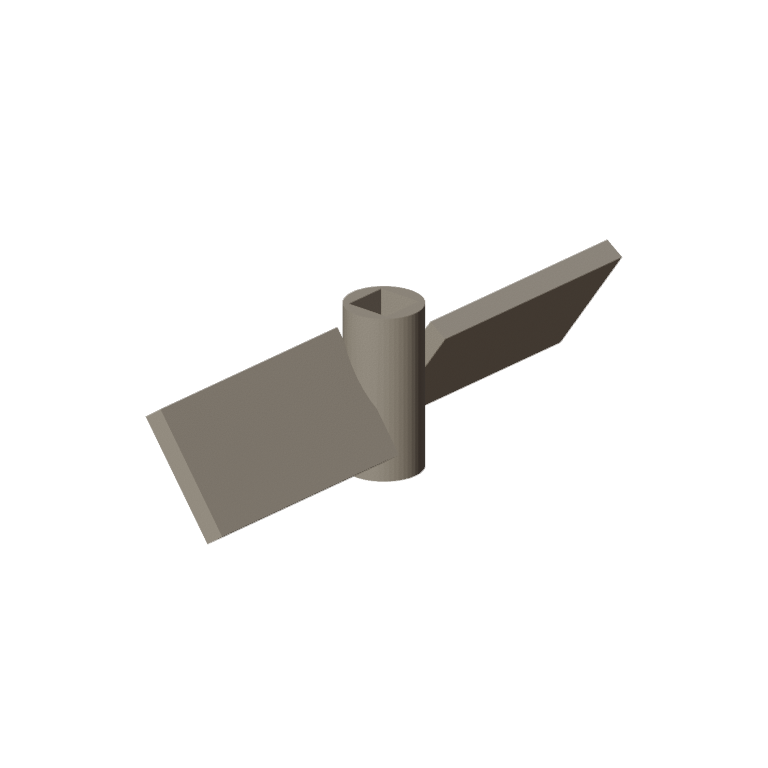
Print two right-hand hubs (/uploads/blueprints/oblique-paddle-churn-hub-right.stl) and two left-hand hubs (/uploads/blueprints/oblique-paddle-churn-hub-left.stl), plus one more of either for the middle. Print in PETG at 0.2 mm layers, 30 % infill, 4 walls; wash before first use.
Materiais para este passo:
 Filamento PETG1 peça
Ferramentas necessárias:
 Impressora 3D de filamento (FDM)
5
5
Make the cylinder
Make the cylinder
Cut 180 mm of 120 mm PVC pipe. Close both ends with plywood disks bedded in silicone, each drilled for the shaft. Saw the top quarter off as a lid, and drill a drain hole in the bottom with a plug.
Materiais para este passo:
 Tubo de PVC1 peça
 Placa de contraplacado1 peça
 Vedante de silicone1 peça
Ferramentas necessárias:
 Serra de arco para metais
 Serra de recortes
 Conjunto de serras-copo
 Berbequim sem fios
 Jogo de brocas
6
6
Shaft and crank
Shaft and crank
Cut a square hardwood shaft 8 × 8 mm. Slide the hubs on: two right-hand toward one end, two left-hand toward the other, so both sets push toward the middle when turned forward. Fit a crank at one end and set the cylinder on legs.
Materiais para este passo:
 Cavilhas de madeira dura1 peça
 Bloco de madeira dura1 peça
 Parafuso para madeira n.º 8 x 1"1 peça
 Epóxi de dois componentes1 peça
Ferramentas necessárias:
Serra de arco para metaisBerbequim sem fiosJogo de brocas Conjunto de chaves de fendas
7
7
The patent drawing
The patent drawing
US 719 drawing sheet, public domain (expired patent).
8
8
Churn, gather and spread
Churn, gather and spread
Let 500 ml of heavy cream stand until it reaches about 15 °C, checked with the thermometer. Pour it in, close the lid, and turn the crank steadily; time until the butter comes. Turn on to gather it in the middle, drain the buttermilk, then turn back to spread it. Pour off the buttermilk, add cold water, churn a few turns and pour off again until it runs clear; work in a pinch of salt and weigh the butter.
Materiais para este passo:
 Natas para bater500 ml
 Sal marinho grosso1 peça
 Água1 peça
Ferramentas necessárias:
 Termómetro de sonda permanente
 Cronómetro
 Balança digital de cozinha
 Taça grande de aço inoxidável
9
9
Butter that will not come, will not gather
Butter that will not come, will not gather
Oblique-paddle churn troubleshooting.
Flow
Loading...
10
10
History and honest limits
History and honest limits
**Joshua G. Pike** of Lisbon, St. Lawrence County, New York, received US 719, dated 28 April 1838. The cylinder's upper half is the cover; the whey is drawn off by a spout. After salting, turning the shaft back and forth gives the butter a horizontal and rotary motion that separates the whey and mixes in the salt, "and thus saves the labor of working and salting by any of the modes now in use." He claimed paddles directing cream and butter from each end toward the centre, or from the centre toward each end.
**Honest limits.** A PVC cylinder and printed hubs stand in for his wooden churn. FDM prints hold food in their layer lines, so wash well and replace when worn. Your times and weights are the result.
Materiais
11- 1 peçaReferência
- 1 peçaReferência
- 1 peçaReferência
- 1 peçaReferência
- 1 peçaReferência
- 1 peçaReferência
- Referência
- Referência
- 500 mlReferência
- 1 peçaReferência
- 1 peçaReferência
Ferramentas necessárias
11- Referência
- Referência
- Referência
- Referência
- 1 vendor sell this, none ship to you yetReferência
- Referência
- Referência
- Referência
- Referência
- Referência
- Referência
Blueprints relacionados
Estes blueprints compartilham conhecimento — técnicas, materiais ou princípios
Churning Butter from Cream — The 5,000-Year-Old Fat Separation
por TheChef
ARTESANATO
46
0
0
0
0
0
Making Aged Farmhouse Cheese in a Cheese Press — Medieval Dairy Craft
por TheChef
Comida
72
0
0
0
0
0
Carving a Wooden Paddle from a Single Piece of Hardwood — Prehistoric Watercraft Propulsion
por Woody
Marcenaria
37
0
0
0
1
0
CC0 Domínio Público
Este blueprint é liberado sob CC0. Você é livre para copiar, modificar, distribuir e usar este trabalho para qualquer finalidade, sem pedir permissão.
Apoie o Maker comprando produtos através do Blueprint, onde ele ganha uma Comissão Maker definida pelos vendedores, ou crie uma nova versão deste Blueprint e inclua-o como conexão no seu próprio Blueprint para compartilhar receita.