ARTE
BELEZA E BEM-ESTAR
ARTESANATO
CULTURA E HISTÓRIA
ENTRETENIMENTO
MEIO AMBIENTE
COMIDA E BEBIDAS
ENGENHARIA REVERSA
CIÊNCIAS
ESPORTES
TECNOLOGIA
TECNOLOGIA VESTÍVEL
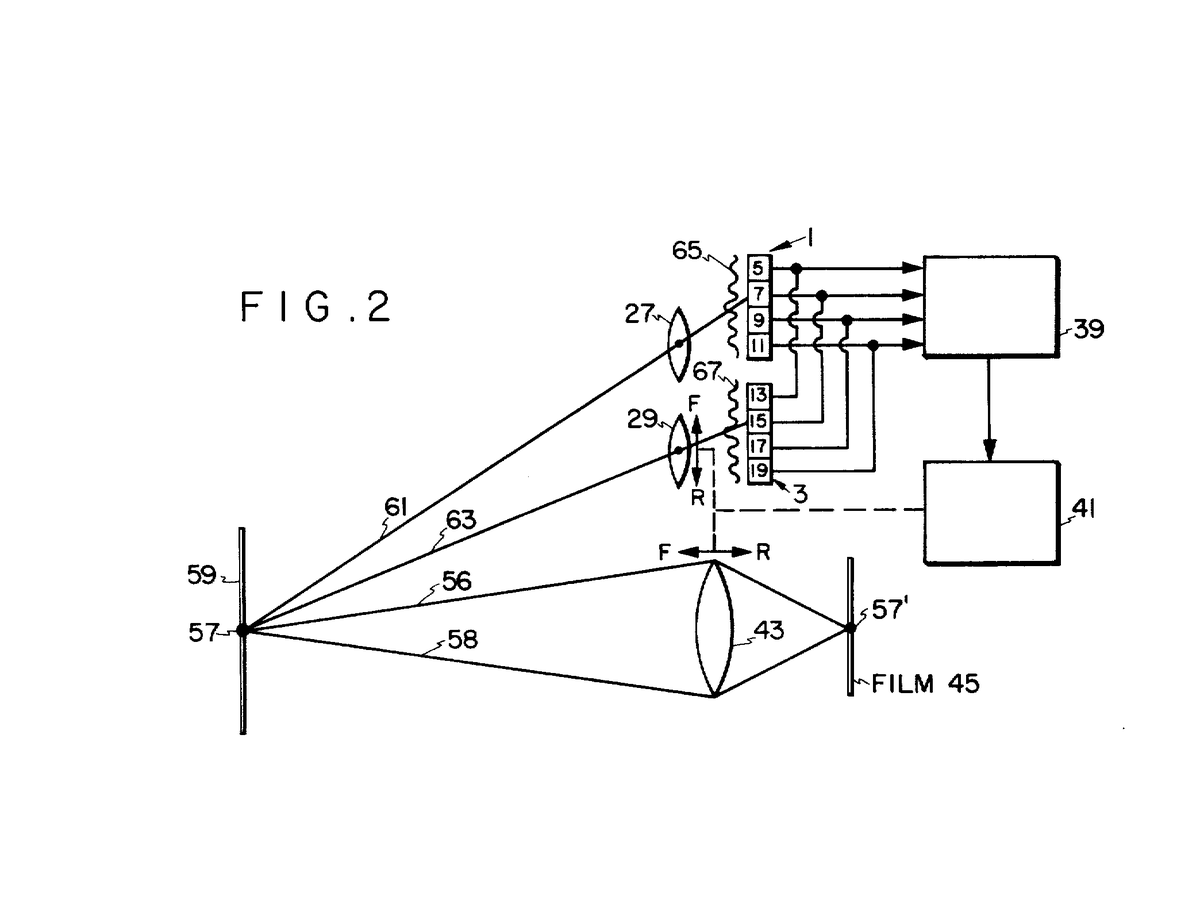


Passive Autofocus (Two-Array Comparison)
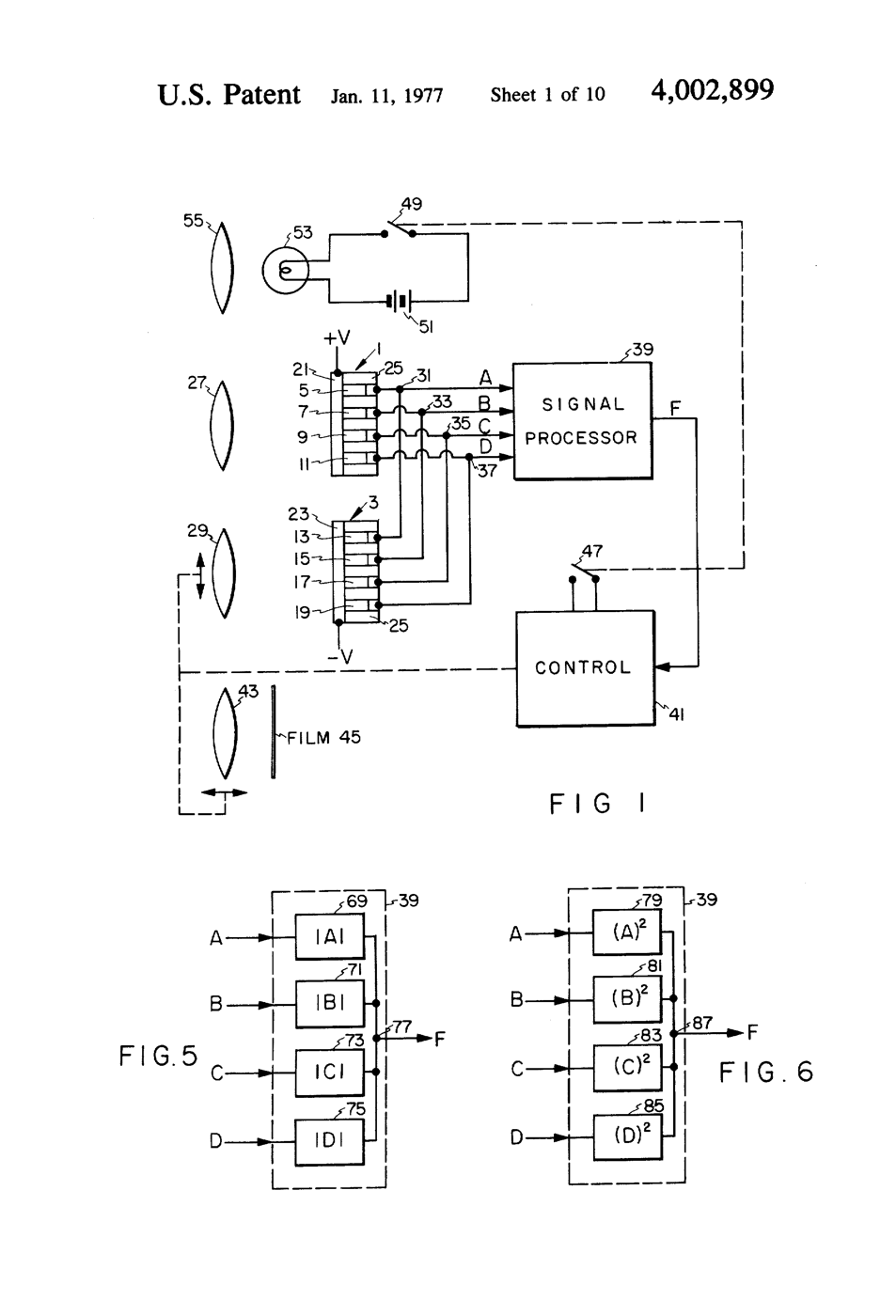
Norman Stauffer at Honeywell built a focus detector from two rows of tiny light sensors side by side on one chip. In his FIGURE 2 each row views the subject through its own small lens, a short distance from the other - like the two windows of a rangefinder. How far one row's picture is shifted against the other's gives the subject's distance, and the camera sets the taking lens to match, without trial and error. Compact cameras from 1977 used it; later SLRs moved the same comparison behind the taking lens itself (phase detection).
**US 4,002,899**, "Focus detecting apparatus", Stauffer, assigned to Honeywell, filed 31. October 1975, granted 11. January 1977: "radiation responsive elements formed on a single planar substrate and divided into two similar coplanar detector arrays lying immediately adjacent each other".
**You see the principle with a card**: a two-hole mask gives a lens two viewpoints, just as Stauffer's two lenses do; out of focus the point splits in two, and which spot vanishes when you cover one hole tells you which way to focus.
Intermediário
90 minutes
Instruções
1
1
Make the two-hole mask
Make the two-hole mask
Cut a card disc to fit a lens holder. Punch two 3 mm holes 20 mm apart, symmetric about the centre.
Materiais para este passo:
 Cartolina preta1 folha
Ferramentas necessárias:
 X-ato (faca de precisão)
 Régua de aço
2
2
A point of light
A point of light
Cover the torch with foil pierced by one pin-sized hole. Put it 2 m from the bench in a dim room.
Materiais para este passo:
 Folha de alumínio1 folha
 Fita de máscara1 rolo
Ferramentas necessárias:
 Lanterna LED de inspeção
 Fita métrica
3
3
Split and join
Split and join
Mount a 100 mm convex lens with the mask right in front of it, and a tracing-paper screen behind. Slide the screen: two spots merge into one exactly at focus. Measure their separation 5 and 10 mm either side of focus.
Materiais para este passo:
 Conjunto de lentes convexas1 conjunto
 Rolo de papel vegetal para moldes1 folha
Ferramentas necessárias:
 Banco e calha ótica
 Conjunto de suportes de lentesRégua de aço
4
4
Which way?
Which way?
With the screen too close, cover the left hole and note which spot disappears. Repeat with the screen too far. The answer flips: that is the direction signal phase detection gives for free.
5
5
Triangles and correlation
Triangles and correlation
A carregar o notebook Jupyter…
6
6
History & Context
History & Context
**What the patent specifies:** two similar, adjacent, coplanar arrays of radiation-sensitive elements on one substrate, whose outputs are compared to measure distance or focus. **Modern build (derived):** a Scheiner two-hole mask - two viewpoints and an image shift, made visible.
Christoph Scheiner described the two-hole experiment in 1619 to study the eye's focusing. Honeywell's chips put it into cameras; today's phones put phase-detection pixels directly into the image sensor. Its limits: it needs contrast (a blank wall defeats it) and precise alignment between the detector and the lens.
Materiais
5- 1 folhaReferência
- 1 folhaReferência
- 1 roloReferência
- 1 conjuntoReferência
- Referência
Ferramentas necessárias
6- Referência
- Referência
- Referência
- 1 vendor sell this, none ship to you yetReferência
- Banco e calha ótica10% de comissãoReferência
- Conjunto de suportes de lentes10% de comissãoReferência
Blueprints relacionados
Estes blueprints compartilham conhecimento — técnicas, materiais ou princípios

CC0 Domínio Público
Este blueprint é liberado sob CC0. Você é livre para copiar, modificar, distribuir e usar este trabalho para qualquer finalidade, sem pedir permissão.
Apoie o Maker comprando produtos através do Blueprint, onde ele ganha uma Comissão Maker definida pelos vendedores, ou crie uma nova versão deste Blueprint e inclua-o como conexão no seu próprio Blueprint para compartilhar receita.